In Mumbai in 2010, Mahesh Malneedi began a conference presentation with a word that usually arrives carrying a filing cabinet: RISK. He displayed it in red, orange and green. Before the systems, the processes and the organizational diagrams, there were three colors. It was a small theatrical choice for a subject more often entrusted to a spreadsheet.
His practical test for a system was equally direct: “will it make my life easier?” The question is an unusually good companion for the career that followed. Malneedi would appear in discussions of integrated systems, configurable software, cloud tools, document management and AI agents. Under the changing vocabulary sat a working person trying to finish a task. The three-color opening dates to January 2010.
A great deal of business software promises a more interesting future. Malneedi’s public comments suggest an appetite for a less eventful afternoon: fewer versions to untangle, fewer repetitive checks, a process that does what its users expect. There is something appealingly unfashionable about that ambition. Nobody has ever complained that their table of contents worked too reliably.
Wall Street, then a different kind of system
The earlier chapter of his career belongs to finance. His 2017 conference biography lists experience at JP Morgan, Citibank and the firm it names as Solomon Smith Barney. It also lists an MS and an MBA from New Jersey Institute of Technology. The combination places technical and business education alongside experience inside large financial organizations. That is the background recorded in his speaker biography.
In 1996, he co-founded MakroCare. The move brought him into specialist consulting and services, work in which experience has to survive contact with a client’s particular requirements. His later career would keep both sides of that problem in view: the knowledge needed to understand a task, and the structure needed to carry it out consistently.
By the time of the 2017 biography, he was described as president of both MakroCare and DDi. The biography dates his co-founding of DDi LLC to 2014. It is a specific corporate milestone in a longer software history. What matters for his personal story is the movement between service delivery and product building, with responsibility for organizations on both sides.
Giving experience a repeatable form
In a 2015 interview, Malneedi discussed an effort at MakroCare to organize accumulated knowledge into a center of excellence and service accelerators. The business logic is easy to recognize. Solving a problem once gives a company an engagement. Learning which parts can be used again gives it a way to approach the next engagement with something already understood.
That effort also puts a useful frame around his software work. A product needs a version of expertise that can travel. The instructions have to be clear enough for another team, the records usable enough for another office. The original expert cannot stand beside every screen. Repeatability becomes part of the offer, alongside the judgment that made the process possible.
MakroCare received an Acquisition International award in 2015, and Malneedi spoke about the recognition as encouragement for employees. The emphasis fits a services organization: a customer sees the delivered work, while the company has to sustain the team and process producing it. His discussion of organizing expertise accompanied that recognition.
There is a modest discipline in this kind of entrepreneurship. The novelty may lie in how familiar work is arranged. A better structure can be useful without being dramatic. For a founder moving between consulting and software, the interesting question becomes how much knowledge can be made repeatable while still respecting the particular job in front of the customer.
Software meets the office
At DDi, risk management became one expression of that problem. Its TULA product brought project, risk, compliance and vendor management into configurable modules. The point of the configuration was consequential: organizations have their own requirements, and a tool has to fit the work closely enough to be used. A tidy product diagram has a surprisingly demanding social life.
A 2018 profile identified Malneedi as co-founder and CEO and discussed an obstacle that cannot be installed away. Executive leadership had to support cultural change. Introducing structured software required an understanding of the organization’s actual needs, followed by support for the actions the process demanded. The profile tied implementation to leadership and behavior.
That is a revealing qualification in a software story. Buying a system is a discrete decision. Making it part of the working day takes repeated decisions by people who have other things to do. Malneedi’s public record includes the product pitch, but it also includes this acknowledgment of the organization that must make the product useful.
His interest in connected information had already taken him to the ACDM conference at BMA House in London in March 2016. The announced topic was integrated systems, with quick access to analytics, visualizations and reports delivered through the cloud. The invitation centered on making information easier for teams to reach.
In the following year, his announced ITCT session examined technology’s effect on data analysis and visualization. The question of where tools actually make an impact sat inside the description. These are practical topics for a founder: what reaches the user, what helps a decision, and what remains merely available on a screen.
The version that matters
By June 2018, another recurring concern was visible in his comments about LABELai, DDi’s cloud software. He described teams needing a simpler, function-rich tool for content management, with different versions linked and information managed across countries. The desired outcome was specific. People needed control of related information without acquiring a process too cumbersome to operate.
Versions are a peculiar form of office suspense. Two files can look alike while carrying different consequences. Somebody must know which one applies, how it relates to the previous one and where the next change belongs. Malneedi’s argument for simpler tooling gave that ordinary administrative problem a place in the product strategy. His 2018 comments focused on core functionality, cost and connected versions.
“We believe in customer first”
Mahesh Malneedi · 2018
In November 2024, DDi announced a generative-AI-enabled version of smartDOC. Malneedi was identified as CTO. The description again concerned documents: preparation, management and control over versions. A new technical ingredient had entered a familiar setting. The material still had to be organized well enough for a team to use it with confidence.
The progression is more interesting when the vocabulary is allowed to settle. Cloud delivery had been part of the earlier conversation. Generative AI entered later. Both arrived attached to the same family of work: managing information, keeping documents under control and making a complicated process easier to carry out. The smartDOC announcement made those aims explicit.
A title caught in time
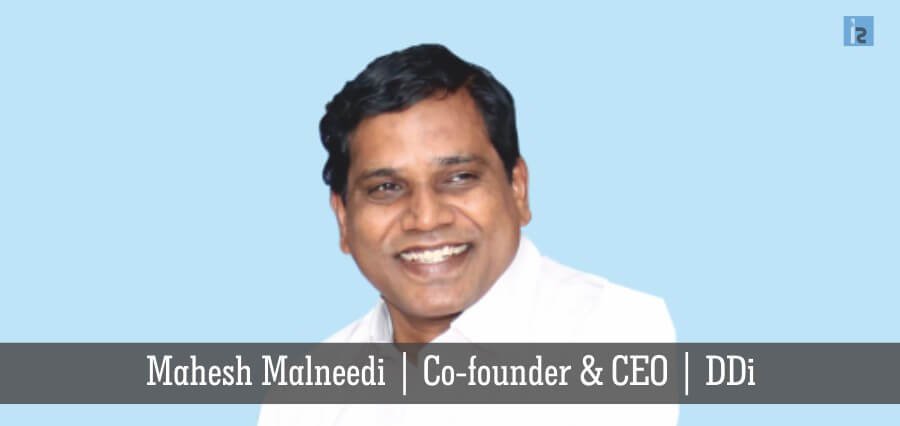
The labels around Malneedi change across the record. President appears in his conference biography. Co-founder and CEO appear in the 2018 profile. CTO appears in the smartDOC release and in a November 2025 announcement of a new customer engagement. Keeping those dates attached gives a more useful picture of his work than squeezing the career into one permanent title.
That November 2025 engagement concerned an unnamed UK manufacturer with approximately $2 billion in annual revenue. DDi described work across strategy, intelligence and assessment workflows. The size belonged to the client. The substance of the engagement was the coordination of information and decisions across markets. Malneedi appeared in the announcement as DDi’s CTO.
The work had widened beyond an individual document, while retaining a recognizable problem: requirements change, teams need to understand the consequences, and somebody must decide what happens next. The founder’s challenge becomes organizational as well as technical. A system has to connect activity that already exists across different people, functions and places.
The return of the ordinary task
In July 2026, DDi announced more AI agents for insights, impact analysis and planning. Malneedi, again identified as CTO, commented on regulatory pressure and faster planning cycles. The advertised agents addressed different stages of the work, from tracking changes to assessing their effects and supporting plans. The July announcement extended the product conversation into those connected tasks.
Then came a September 30 REGai release concerned with the document itself. DDi advertised a library of more than 600 quality-control rules and more than 400 formatting and publishing rules. The examples were disarmingly tangible: table structures, headers, tables of contents, bookmarks and hyperlinks. The company also described fixing formatting errors directly inside files.
Here was the administrative afternoon again, now accompanied by a larger rule library. Malneedi was identified as a spokesperson. His comment concerned avoiding document-quality bottlenecks and reducing repeated formatting work. After years of software development, a stubborn table and a broken link still warranted attention. The release gave those tasks their own list of improvements.
That continuity helps explain the appeal of his opening question in Mumbai. A system can become more elaborate while the test of its usefulness stays personal. The person working through the file needs less rework. The team coordinating a process needs clearer information. The founder has to decide which of those frustrations can become a product people will use.
Malneedi’s career has taken him from financial firms to consulting organizations and software announcements filled with newer technical language. The ordinary task keeps returning. Somewhere in that recurrence is a recognizable business instinct: give careful attention to the work that consumes a day. If the afternoon becomes less interesting, the customer may have something to celebrate.
Continue the conversation
Explore MakroCare’s leadership, Malneedi’s conference biography, the 2018 DDi profile and the 2026 REGai announcement.
Visit DDi