Consider the bank statement. It arrives with the quiet confidence of something nobody expects you to enjoy. You check the balance, perhaps investigate a charge, and move on. Yet the statement occupies an unusual position: it belongs to a relationship you already have. FCI CCM has built its modern business around the possibilities inside that ordinary exchange.
- The job: connect customer data, reusable documents, alerts, and delivery channels.
- The buyers: banks, insurers, and other enterprises with complicated customer communications.
- The useful lesson: tidy the machinery behind a message before making it more personal.
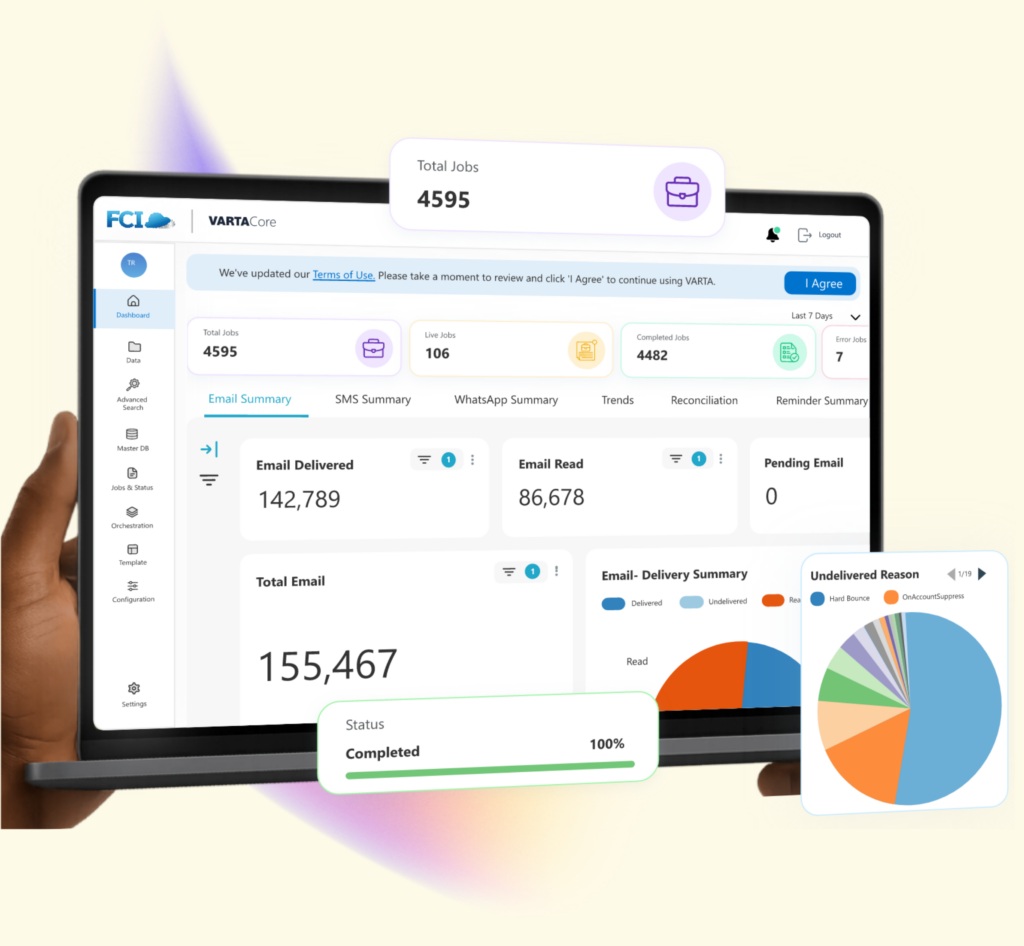
The company’s flagship platform, VARTA, sits between enterprise systems and the customer. It helps turn data into statements, letters, notifications, and interactions across channels. Its ambition goes further: use the signals in those exchanges to make the next communication more relevant. For a bank, that might mean joining the operational task of sending a statement with the commercial task of understanding an existing customer.
A typing college, with a very long afterlife
FCI’s own timeline begins in New Delhi in 1959, with a typing college. In 1970 came typing services for businesses. By 1987, the company had become a network of quick-printing outlets across Delhi-NCR. Transactional printing and mail followed in 2004; regional production facilities followed in 2008. The object being handled kept changing. The underlying chore remained recognizable: take information and get it into somebody else’s hands.
Then the hands acquired phones. FCI dates its adoption of omnichannel communications to 2018, its U.S. expansion to 2019, and VARTA’s launch to 2021. Its January 2025 account of CEO Amit Sawhney’s Business Today interview identifies a declining print industry as a reason for pursuing digital communications. That is a practical explanation for reinvention: the customer’s destination was moving.
The old business has not vanished. FCI still lists print-and-mail facilities in Delhi-NCR, Mumbai, Kolkata, and Chennai. A customer communication can remain a physical object, even when software coordinates the work around it. That history gives the company a useful perspective on a category easily mistaken for email software.

The trouble starts in the template cupboard
FCI’s ICICI Bank case study describes the bank managing communications through a mixture of homegrown and vendor applications, alongside numerous templates. The bank had more than 70 million customers at the time described. Keeping the machinery running required substantial operational effort. The problem was already present before anybody started debating the wording of a personalized offer.
FCI’s response was a centralized VARTA hub, template rationalization, and rule-based segmentation for relevant recommendations. The important sequence is organizational as much as technical: bring scattered work together, reduce duplication, then use the combined system to communicate more intelligently. This is the part another business can copy without buying anything: inventory the documents and identify the rules hidden inside them.
“In FCI, we saw a partner who could and would continue to support us in driving innovation.”
Arun Kumar A R · Technology Head, ICICI Bank · FCI case study
FCI reports a threefold revenue uplift from existing customers in its ICICI case study. Treat that as the vendor’s account of the engagement, rather than a forecast for every buyer. A more narrowly defined result appears in its unnamed telecom case: a reported 60%-70% reduction in printing and stationery costs after communication automation. That describes one expense category, rather than the whole implementation bill.
Four jobs hiding inside “send”
VARTA’s current product family separates the work into four pieces. Core handles documents and statements through shared data, templates, workflows, and delivery controls. Signal handles transactional alerts and notifications, including channel routing and fallback. Sense supplies behavioral intelligence and recommendations. Stream addresses corporate banking statements, including formats intended to work with enterprise resource planning systems.
Data → governed documents
Events → timely alerts
Behavior → relevant action
Statements → business systems
That division explains what people can actually do with the platform. An operations team can maintain reusable templates. A communications team can coordinate email, SMS, WhatsApp, and push notifications. A bank can connect transaction signals with a recommendation. A corporate banking team can automate statement distribution. These are different jobs, even when a customer experiences them as one message.
The software comes with people
FCI also sells the work required to make such systems function. Its professional services include reverse engineering, documenting existing business logic, developing templates, migration, testing, upgrades, and support. It advertises specialist expertise in Quadient Inspire and OpenText Exstream. The resulting business combines enterprise software with implementation and ongoing services, plus the physical production work that remains.
Quadient independently lists FCI as a business partner. In December 2024, FCI announced that their collaboration was expanding into the Middle East, pairing VARTA’s integration and analytics with Inspire. This makes the competitive picture less tidy than a software comparison chart suggests. FCI can supply its own platform while helping customers implement technology from another CCM vendor.
Its place in the market follows from that combination. Banks and insurers need documents to be accurate, traceable, and consistent; they also want communications that customers find useful. FCI works at that intersection, competing for budgets that might otherwise support existing internal systems, other communications platforms, or generalist implementation providers.
First, make the statement useful
The approach depends on foundations that software cannot wish into existence. Reliable customer data, appropriate permissions, documented business rules, and controlled templates determine whether an automated message deserves to be sent. For a business sending a few straightforward reminders, the integration work of a broad enterprise platform may outweigh its benefits. For a bank coordinating many systems and regulated documents, that work addresses a recognizable operational problem.
FCI’s history makes its present proposition easier to understand. A typing service, a print facility, and a communication platform all sit between information and its recipient. VARTA adds intelligence and coordination to that position. The interesting question is what a company does with the attention it already receives. Making a statement useful is a good place to begin.