Imagine a clinical trial in which the data has been collected but has yet to reach the people who need it. The work has happened. The decision still waits. It is an ordinary little gap, the sort that disappears inside a status report, and it makes an excellent place to look for a software business.
- DDi connects clinical, regulatory and quality work.
- Its modular tools cover trial supplies, documents and product records.
- Rule-based automation and optional AI serve different tasks.
DDi, short for Drug Development Informatics, has spent its working life looking at these gaps. It makes clinical, regulatory and quality software for pharmaceutical, biotechnology and medical device organizations. The objects being moved are sometimes trial supplies, sometimes product records, sometimes a document with an obstinate table of contents. The common problem is getting something accurate to the next person, system or authority.
In a 2016 interview, the company described a telling discovery: its technology helped clients identify delays in trial data entry, after which they worked with sites to get information entered on time. The lesson was wonderfully mundane. Faster analysis depended on an earlier operational habit. The expensive pause occurred before the clever part could begin.
That is a useful way into DDi. Its business is easier to understand through the handoff than through its collection of product names. Who owns the information? Which version is current? What happens when it changes? Software earns its keep when those questions stop becoming meetings.
02A document acquires a social life
Consider a medical device product record. Regulatory teams need it for registrations. Quality teams need a reliable history. Labeling teams need approved content. A change can therefore become a small traveling party: a new value, a new document, a review, an approval, a submission and a confirmation that the receiving system accepted it.
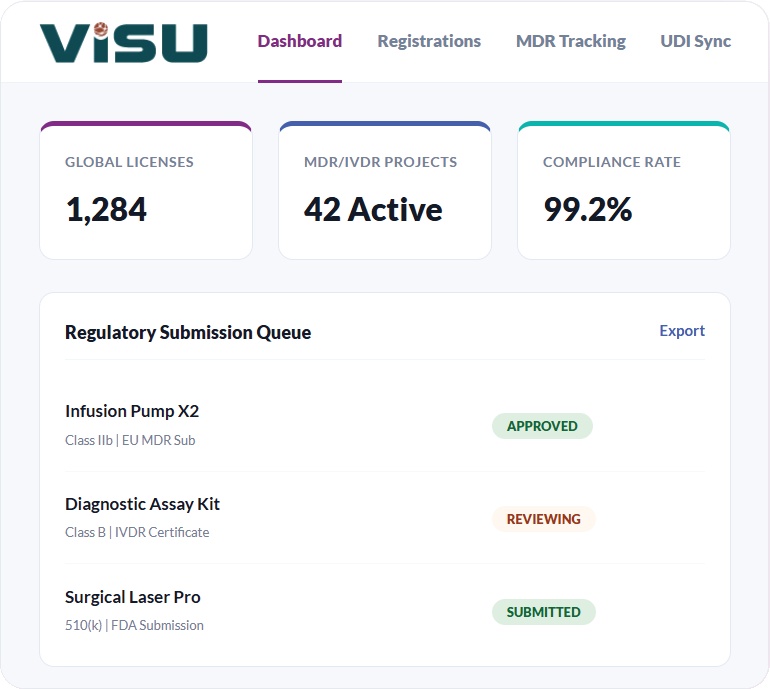
Visu is DDi’s regulatory information and process platform. Its medical device offering brings product registrations, submission planning and health authority correspondence into a common workflow. It can connect with document, product lifecycle, enterprise resource planning and quality systems. This matters because the company selling the device usually already has software. Another isolated database would be an elaborate way to recreate the original problem.
The same logic explains smartDOC, its document and content management offering. Reusable content, collaboration, approval workflows and formatting automation address the labor of keeping related documents aligned. A paragraph that appears in several places becomes a maintenance obligation. Copying it was easy; remembering everywhere it went is the expensive bit.
Vistaar approaches the handoff from outside the organization. It monitors regulatory material, filters alerts and supports impact assessment. DDi describes a combination of searchable information and manually reviewed updates. The useful destination is an assigned action on an applicable change. An inbox full of international announcements is a rather poor substitute.
03The AI company with an off switch
The most revealing choice in DDi’s catalog is tucked inside REGai. Customers can select deterministic rule-based automation, agentic AI, or a combination. The company even calls the first option “Zero AI.” It is an amusing label to find on an AI platform, and a sensible distinction for the work being sold.
Some tasks have a knowable answer. A required field is present or absent. A link works or fails. A formatting rule has been followed or ignored. Other tasks require interpretation, such as assessing what a regulatory change might mean for a product. DDi’s offering separates repeatable verification from work that may benefit from language models and expert review.
Its published AI philosophy keeps humans responsible for review, governance and final decisions. Meanwhile, its discussion of quality control emphasizes tracing findings back to source information. The implication for a buyer is practical: ask how each result was produced, how to reproduce it, and who signs it off. The fashionable feature name tells you considerably less.
On September 30, 2026, DDi announced expanded REGai document operations: a quality check library with more than 600 rules, plus more than 400 formatting and publishing rules. It described direct fixes to tables, headers, bookmarks and hyperlinks. Those counts describe the advertised libraries; they do not establish how many checks a particular dossier needs, or the savings a particular team will achieve.
“AI must be trusted before it can be transformative.”
DDi’s published AI philosophy
REGai announcement · September 30, 2026 · Library sizes, not performance results
04The trial has to have enough medicine
DDi’s clinical supply product, mIRT, handles randomization and trial supply management. It covers planning, forecasting, inventory and drug accountability, with connections to electronic data capture and clinical trial management systems. Here, the handoff has physical consequences: information about a study must translate into the right supply decisions.
The product family includes a configurable Xpress option, protocol-specific capabilities and mIRT Supplies for comparing supply scenarios. DDi lists forecasting methods including moving averages and Croston. That specificity is welcome. A forecast is a method with assumptions, and users benefit from knowing which method is being used.
TULA tackles another clinical problem: oversight. It combines operational information and documents to support vendor performance monitoring, risk detection and clinical data review. Trial sponsors may have outsourced activities, but they still need a coherent view of what is happening. The purpose is to surface an issue early enough for someone to do something about it.
05The bill includes the change orders
DDi sells business software alongside implementation, integration, hosting and support services. Its partner program lets clinical research organizations, manufacturers and consultants package the technology with their own services. That creates another route to customers: a service provider can bring the tool into work it already performs.
For mIRT, DDi advertises fixed and unit-based pricing, and says certain versions avoid change-order charges. That last detail deserves attention. A study’s purchase price is only one part of its cost; amendments and subsequent configuration work can change the arithmetic. The appeal is predictability, provided the contracted version and scope support it.
DDi also advertises deployment in under two weeks for its no-code or low-code mIRT modules. Treat that as a product claim to test against the actual protocol, integrations and validation work. A prepared, standard study and an unusually complex one are different purchases. The sensible comparison includes setup effort, ongoing administration, changes and the time spent by the customer’s own staff.
Its customer mix spans large life sciences organizations and smaller manufacturers. The current website lists more than 50 enterprise and 140 mid-market clients and displays names including Pfizer, Roche, Bayer and B. Braun. These are DDi’s public customer claims. They suggest breadth without telling us the size or duration of each engagement.
Setup + integrations + validation work + amendments + ongoing administration
A purchasing checklist, not a DDi price estimate.06Selling less software is a positioning choice
DDi operates in a market where Veeva RIM and ArisGlobal LifeSphere Regulatory are alternative regulatory platforms. Product coverage, existing infrastructure and implementation requirements shape that choice. DDi’s pitch centers on modular adoption, domain knowledge and integration with systems a customer already uses. That is positioning, rather than proof that one vendor performs better than another.
One of DDi’s own essays makes the position unusually clear. It argues that a medium-sized company may get the regulatory capabilities it needs from a governed regulatory data layer, without adopting a large enterprise RIM application. The layer connects records and context across existing systems. It is an interesting argument from a company that also sells RIM software.
The qualification matters as much as the proposition. Data ownership, provenance, access controls and lifecycle management have to be real. Otherwise, the new layer adds another place for uncertainty to live. DDi’s quality policy describes validation work following GAMP 5 and support for electronic record requirements. Those are part of the delivery discipline; a customer still has to define and operate its own process.
DDi belongs to Makro Group, with a background in life sciences consulting. Its early clinical technology journey began with mEDC, an electronic data capture tool, according to the 2016 interview. Expansion followed work on cross-functional data flow and client feedback. The origin gives the catalog a coherence: repeated encounters with operational friction, turned into products.
07A barcode is only the beginning
A February 2026 Visu UDI update shows this approach in miniature. Unique Device Identification sounds like a labeling job. DDi treats it as a data pipeline: connect enterprise records, check required attributes and formats, submit through authority-specific gateways, then process acknowledgments and errors.
The announced connectors cover FDA GUDID, China’s NMPA and the EU’s EUDAMED. Its smartRules engine is described as validating changes against country-specific rules. The uncelebrated final step is especially revealing. Sending a file is insufficient if nobody can tell whether it was accepted. A complete workflow needs the return trip.
The transferable idea is to map that return trip before buying automation. Pick one recurring handoff. Specify its inputs, owner, validation checks, destination and acceptance signal. Measure the waiting and rework, then test whether a module improves them. DDi’s 2018 discussion of risk software also recognized that executive support and organizational change determine whether the tool gets used.
A process with disputed ownership or unreliable inputs will frustrate this approach. A task requiring expert interpretation will also resist a library of fixed rules. Those conditions belong in the design of the workflow, where people can address them. DDi’s useful proposition is modest enough to be interesting: the small mistake has a route through the organization. Learn the route, and you have somewhere concrete to intervene.
Follow the work
Explore DDi’s tools, thinking and company channels.