The curious thing about R3 Vascular’s implant is that its designers want it to leave. A permanent metal stent advertises its usefulness by staying put. MAGNITUDE, the company’s investigational artery scaffold, is built around a more demanding proposition: hold the vessel open, deliver a drug, and gradually surrender the job. In this business, a graceful departure is an engineering specification.
- The job: temporary support for diseased arteries below the knee.
- The material: a bioresorbable polymer with a sirolimus coating.
- The evidence: a small feasibility study, followed by a randomized pivotal trial.
- The stakes: better blood flow for selected patients facing limb-threatening ischemia.
That makes R3 worth following even if you have no interest in medical devices. It asks a useful design question: how long should a solution remain part of the problem it was hired to solve? In an artery, the answer cannot be an attractive metaphor. It must be a material, a manufacturing process and, eventually, a defensible clinical result.
01 / An artery has a memory
Peripheral arterial disease, or PAD, reduces blood flow when plaque narrows arteries. In the legs and feet, the consequences can move beyond discomfort into wounds and threatened tissue. R3 concentrates on the below-the-knee territory, where restoring circulation can become part of an effort to preserve a limb. The company is developing an implant for physicians to place during an intervention, rather than something a patient buys and uses at home.
Balloon angioplasty opens a narrowed segment by inflating a balloon inside it. Afterward, the balloon leaves. The appeal is obvious: no permanent structure. The difficulty is that an artery may recoil or narrow again. A stent supplies continuing support, but leaves an implant in the vessel. R3’s intended middle course is support during healing, paired with a drug coating, followed by resorption.
Its flagship, MAGNITUDE, releases sirolimus, a drug used here for its anti-inflammatory and anti-proliferative effects. The polymer framework supplies the mechanical part of the bargain. Both matter. A structure can hold a lumen open while the biological response undermines the result; a drug can influence tissue response without doing the work of a scaffold. R3 puts the two jobs in one device.
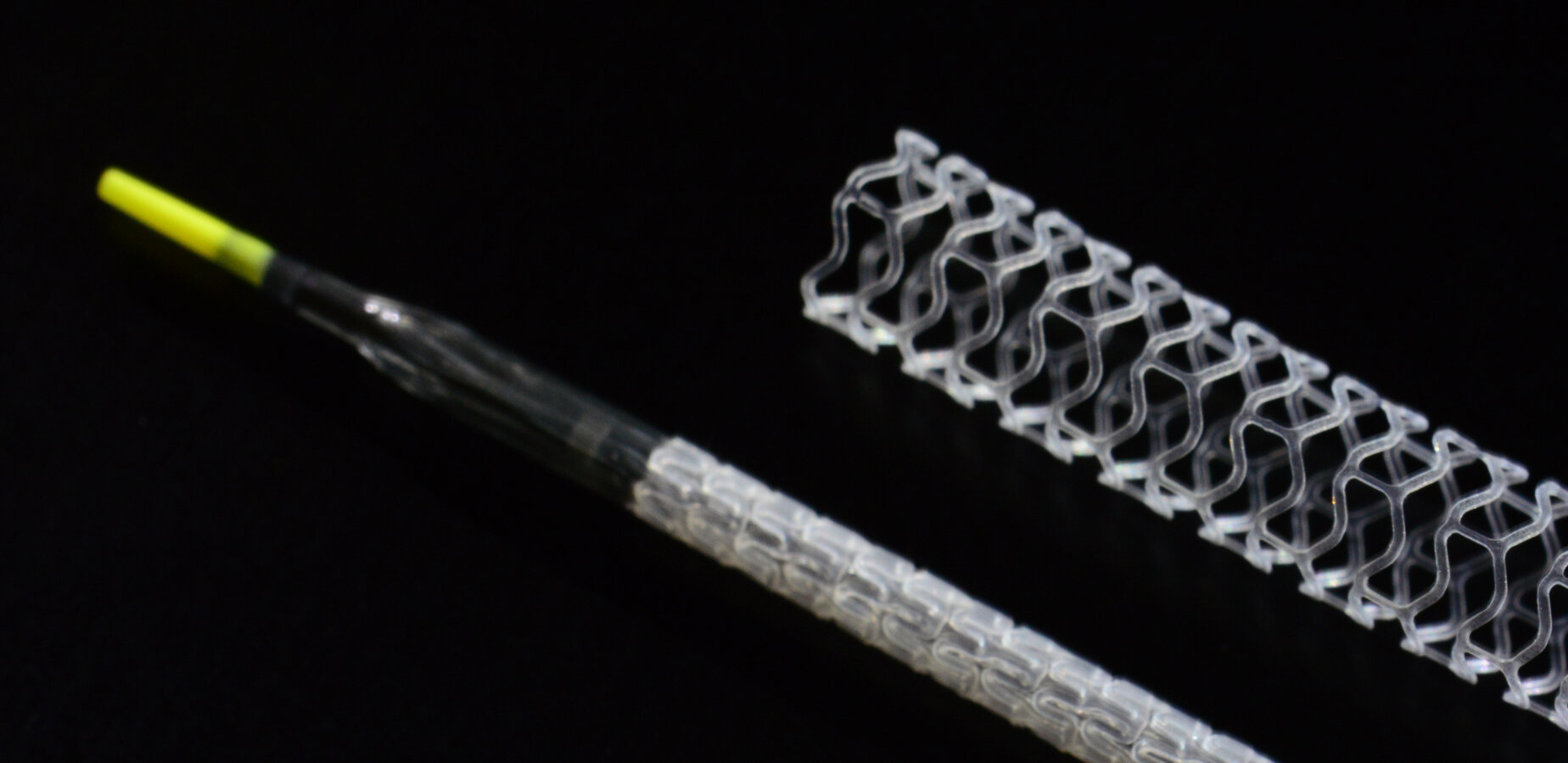
02 / The trouble with leaving too soon
The temptation is to describe bioresorption as a disappearing act. R3’s actual challenge is timing. A scaffold must retain useful support while its polymer breaks down. Resorb too early and the support is gone when it is needed. Make the structure unnecessarily bulky and the implant occupies more of the small vessel it is intended to help. Thinness, strength and controlled degradation are requirements that have to coexist.
MAGNITUDE’s reported strut thickness. A design specification, not a clinical outcome.
R3 describes an ultra-high molecular weight poly(L-lactide) polymer, with carefully balanced crystalline and amorphous regions. Its stated aim is gradual hydrolysis while preserving structural integrity through the relevant healing period. The company also describes production from polymer resin to finished devices. That matters because the material, processing and scaffold geometry collectively determine what the physician receives.
There is a lesson here for other builders: own the process when the process determines the product’s behavior. Buying a familiar material does not by itself settle how a finished implant performs. R3’s manufacturing approach gives it control over iteration. Whether that control produces better patient outcomes is a separate question, and the company has to answer it in patients.
03 / Disappearing devices have a history
The idea arrived with baggage. Earlier coronary bioresorbable scaffolds, particularly Abbott’s Absorb, raised concerns about scaffold thrombosis and target-lesion failure compared with metallic drug-eluting stents. Those were heart-artery studies of a different device. They are neither a verdict on MAGNITUDE nor a detail the field can politely forget.
What failed first in that earlier generation was confidence in the clinical trade-off: the theoretical advantages of eventual resorption did not erase adverse outcomes during follow-up. The useful lesson is precise. A device has to perform while it is present, while it is breaking down and after it has resorbed. An elegant ending cannot excuse a hazardous middle.
Meanwhile, the below-the-knee market has moved. The FDA approved Abbott’s Esprit BTK everolimus-eluting resorbable scaffold in April 2024 for a defined group of patients with chronic limb-threatening ischemia. R3 is therefore pursuing a market with an approved resorbable alternative. MAGNITUDE uses sirolimus and its own polymer processing and scaffold design. Those differences establish a distinct product; they do not establish superiority over Esprit.
04 / Thirty-five patients begin the argument
R3’s RESOLV I feasibility study enrolled 35 patients. The peer-reviewed report, first published online in July 2025, described roughly 90% angiographic patency at six months and improved Rutherford class in 29 of 33 patients assessed at twelve months. Patency concerns whether the treated vessel remains open; Rutherford class describes disease severity. They answer related, but different, questions.
The study was prospective, international and multicentre, but single-arm. Every participant received the investigational treatment. There was no randomized comparison group to show what would have happened with another procedure in comparable patients. The early signal supports further investigation. It cannot settle comparative effectiveness, and the size of the study limits what it can reveal about uncommon harms.
A scaffold’s departure is the design idea. A patient’s outcome is the test.THE QUESTION BEHIND THE ENGINEERING
ELITE-BTK is designed to make that comparison. The current registry describes a randomized, participant-blinded study of MAGNITUDE against balloon angioplasty, with estimated enrollment of 300. The February 2026 update lists recruiting status and estimated primary completion in March 2028. Those are registry plans, not a count of treated patients or a promised date for market entry.
R3 announced FDA investigational device exemption approval in November 2024 and the first pivotal-trial patient treated in April 2025, by Brian DeRubertis at NewYork-Presbyterian and Weill Cornell Medicine. Permission to investigate is a meaningful gate. Permission to sell is another. The company’s September 2026 language still looks toward future commercialization.
05 / The expensive part is the answer
R3’s disclosed financing gives this investigation its means. Its 2020 Series A totaled $17.8 million, including converted notes. In May 2024 it announced an $87 million Series B led by affiliates of Deerfield Management, with existing investors including 415 CAPITAL and a strategic investor participating. The announced uses covered the pivotal trial, further development, regulatory submissions, manufacturing scale-up and initial commercialization.
This is a capital-intensive medical device business whose intended buyers are hospitals and intervention practices. Its economic proposition depends on an authorized product that clinicians can use, manufacture reliably and justify within health systems. The funding is not the price of one procedure. Nor does raising money establish that the device reduces later treatment costs. Those claims require their own evidence.

The leadership change fits that stage of work. Founder Kamal Ramzipoor became CTO in 2024 as Christopher Owens took over as president and CEO. Ramzipoor supplies long medical device and technical experience; Owens has led peripheral vascular company IDEV Technologies. It is reasonable to read the transition as a division of labor for the next phase, rather than invent a private change of heart.
The organization kept adding relevant experience in 2026. August brought Robert Spanos in market development and Katie Segreto in finance. In September, Lisa Wipperman Heine joined the board, bringing experience that includes clinical strategy, reimbursement and commercialization. Owens described the task as “prepare for future commercialization.” That phrase captures the company’s position more faithfully than a launch announcement would.
06 / The artery sets the terms
The trial’s boundaries deserve attention. ELITE-BTK selects adults with particular disease severity and anatomy, including reference vessel diameters from 2.75 to 3.75 millimeters. It excludes severe calcification, dialysis and certain extensive wounds, among other conditions. Those restrictions define where the evidence is being collected. A favorable result would not automatically answer whether MAGNITUDE works in every difficult leg artery.
For a patient, the practical route is a discussion with a vascular specialist about established treatment and, where appropriate, trial eligibility. For an engineer or founder, the transferable idea is to give a temporary intervention an explicit lifetime, then test the consequences of that lifetime. R3’s proposition is appealing because it has a clear ending. The work ahead is to show that patients are better off when the device reaches it.