Fifteen years is a long interval between goodbye and welcome back. In 2022, Madhava Kota introduced Mohan Kuradi as a vice president at Info Services and included a detail more interesting than the title: Kuradi had worked at the company 15 years earlier. The new job brought him back to an old organization, with responsibility for strategy and client relationships. A corporate appointment had acquired a second act.
Kota's announcement ranged over architecture, analytics and business development. Then it became personal. Here was someone he could welcome back. In a trade fond of describing every development as unprecedented, an existing relationship had retained its usefulness. The software had moved on. The acquaintance had survived the upgrades.
That return offers a useful way into Kota's working life. He is the founder of Info Services and its president and CEO, based in Northville, Michigan. His career runs through programming, automotive systems and business analysis. His later work involves building the organization that brings those skills to clients. Along the way, the question becomes less about what one person can develop and more about whom he can bring into the room.
A working education in complicated systems
Kota attended KITS in Warangal from 1993 to 1997. His technical credentials include an IBM DB2 specialist certification and a Six Sigma Green Belt issued in January 2007. The combination places database knowledge beside a discipline concerned with improving processes. It is an appropriately practical pairing for someone whose subsequent roles would involve translating business requirements into software work.
His early career included mainframe development at Cognizant and Java development at IBM. He later worked on Ford programs involving vehicle information, service actions and warranty systems, followed by automotive business analysis at Covisint. These were jobs close to the operational machinery of an enterprise: the records, rules and interfaces through which a large organization gets ordinary work done.
A vehicle may be sold once, but the information around it continues to travel. Service records, warranty decisions and access to business systems each require people to agree on what a record means. For a developer or analyst working in that environment, a correct answer has to survive the trip from one department to another. Elegance alone will have a fairly short meeting with the requirements.
That background gives Kota's later leadership a concrete setting. Cloud services, analytics and enterprise platforms enter a career already concerned with making complicated business processes usable. The vocabulary changes more quickly than the requirement to understand the customer. A database certificate and a process-improvement qualification look rather less dusty when the next project still depends on reliable data and a clearly defined job.
The colleague who came back
Kuradi's return in 2022 brought several of those concerns together. Kota described experience in solution architecture, building a data and analytics practice, and establishing managed services. The appointment connected technical judgment with commercial responsibility. Someone would have to understand the client's problem, help shape the solution and develop the relationship through which the work could happen.
There is a small organizational lesson in the specificity of that introduction. Kota did more than list a senior title. He set out the functions Kuradi would lead, from client engagement and architecture to sales and marketing. The return was attached to a job to be done. Familiarity supplied the history; a defined remit supplied the reason for the next chapter.
Read alongside his technical career, the appointment suggests a recurring professional concern: connecting people who describe the same problem in different languages. An architect wants sound decisions. A customer wants something useful. A business leader wants an engagement that can last. In Kuradi's new brief, those conversations belonged close together.
“I am excited to invite him back”
Madhava Kota, welcoming Mohan Kuradi in 2022
Buying a different kind of future
Another 2022 decision moved beyond hiring. Info Services announced the acquisition of a 75 percent stake in Gentoo Labs, a US learning and test-preparation platform. At the time, the company described a catalog of more than 40 titles and a reach exceeding 500,000 users. Those were figures attached to the acquisition announcement, rather than a count of today's audience.
The strategic purpose was explicit: extend the services business into digital products and platforms. For Kota, the deal brought a different relationship with the end user into view. A consulting engagement begins with a client's particular problem. A learning platform has to serve people returning to a product, choosing when to study and working toward an examination of their own.
At the 2022 announcement · historical company-reported figures
Kota's comments about the transaction emphasized flexibility, personalized lesson plans and preparation at the learner's pace. The aspiration was more specific than simply owning a software product. It concerned how someone would fit learning around an existing schedule. A platform's convenience is tested by the person who has only half an hour available, whatever the ambitions of its owners.
The acquisition therefore supplies a distinct chapter in his story. It puts a visible transaction behind the move toward products. It also adds students and working professionals to the picture of a business leader whose earlier experience was largely inside enterprise technology. The audience changed, along with the form of the software being offered.
Detroit and Chennai, in the same conversation
By the end of 2024, the physical organization was changing too. Info Services opened a new Chennai office. Around the inauguration, Kota joined fellow leaders in a video about the connection between Detroit and Chennai, two cities with substantial automotive and manufacturing industries. The pairing gave the expansion an industrial context as well as a place on the map.
John Lubig, Tasneem Kagal, Kimberly Arnoldi and Mohan Kuradi appeared in that leadership conversation. Their presence matters to the scale of the story: a company operating across locations needs people responsible for strategy, relationships and delivery. The founder's work now takes place among colleagues with their own responsibilities, rather than inside a solitary account of entrepreneurship.
A December visit to Hyderabad makes the arrangement easier to picture. Kota traveled with Lubig, Arnoldi and Kagal, meeting the office team. In his response to the visit, he praised the work of both the Chennai and Hyderabad teams for US clients. Geography, in that brief exchange, was a description of colleagues and the work they shared.
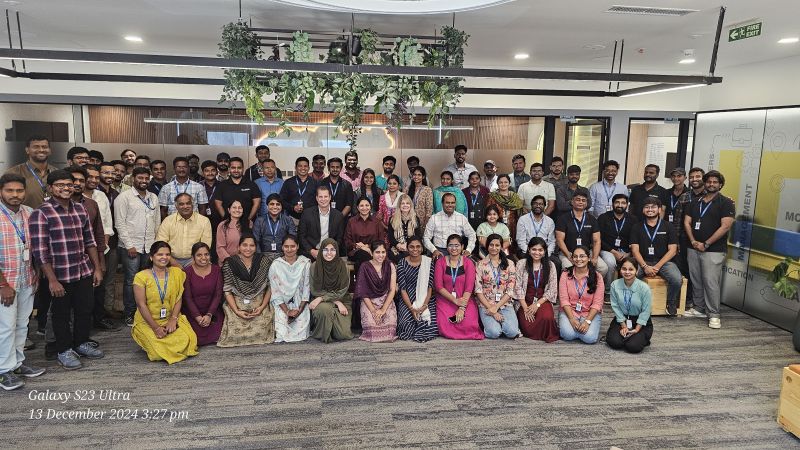
The photograph has the familiar difficulty of any sizable office picture: accommodating everyone. That is also a useful reminder of what a delivery organization consists of. Each extra office eventually means individual people, introductions and working arrangements. The image gives human scale to the much tidier phrase “international operations.”
A conference badge and a continuing job
Kota's public appearances also trace the platforms around which the business works. In 2022 he attended Dreamforce with Amit Chaudhary, then identified as the Salesforce practice lead. Their company already implemented Salesforce for clients. Attending together put executive leadership and practice expertise at the same event, where product demonstrations and customer experiences could feed the next client conversation.
In 2025, Kota attended Google Cloud Next alongside Srinivas Seetha, president of MeganSoft. A photograph places him beside the event's enormous lettering, wearing a conference badge and casual clothes. The sign does most of the announcing. Kota looks like someone attending a working event, which is precisely what the company described.
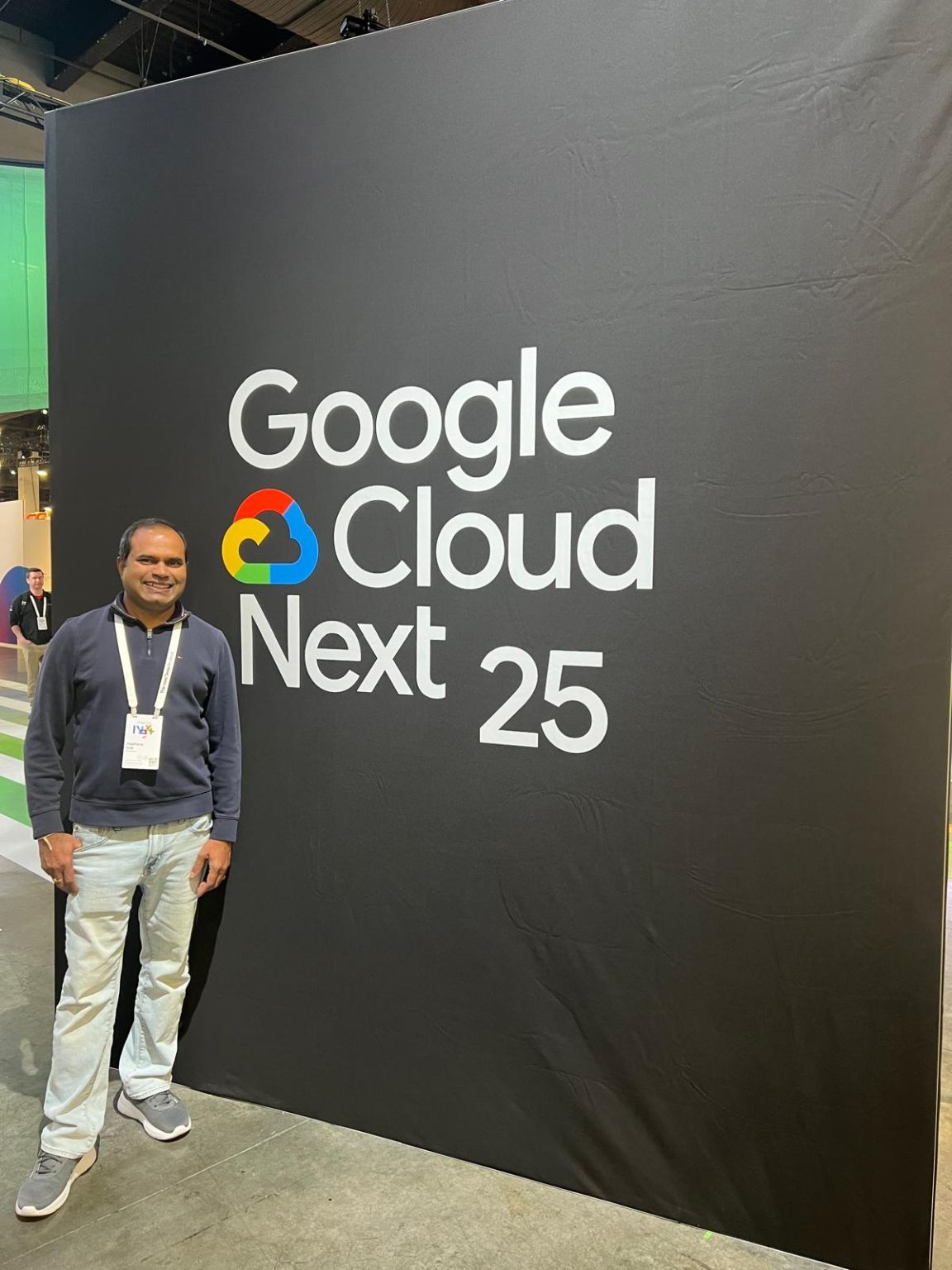
Dreamforce and Google Cloud Next belong to different platform ecosystems. Together, the appearances show the range of relationships surrounding a services business. Clients may arrive with technology choices already made. The leadership task includes keeping the organization connected to the tools, specialists and partners needed to work within those choices.
What the next chapter has to carry
In his message closing 2024, Kota thanked employees, clients and partners, then looked toward another year of development. His most direct line went to the employees: “you are the heart of everything we do.” It was a familiar occasion for a CEO, but the allocation of credit fitted the team visits and returning colleagues elsewhere in his public working life.
Today, Info Services puts AI and cloud engineering alongside enterprise systems, modernization and managed services. For Kota, that range follows a career extending from software development into organizational leadership and a product acquisition. The ambition has acquired more moving parts. It needs technical knowledge, client relationships and people who can make decisions across locations.
The return of Kuradi remains a useful closing detail because it makes continuity visible. Fifteen years could have been a footnote. Kota made it part of the welcome. A business can pursue a new platform, buy a product company and open another office while still finding value in someone who knows an earlier chapter. In a career spent around changing systems, that is a relationship with a pleasantly long service life.
Continue the conversation
Company work, professional updates and a few moments on camera.