The internet has trained us to think that buying is the same as clicking. A book slips into a padded envelope. A shirt folds into a parcel. A sofa behaves differently. It is large, sentimental, expensive to move, impossible to judge from one photograph and, on arrival, occasionally too wide for the lift. MadeiraMadeira has spent 17 years turning those inconveniences into a business.
The Curitiba company presents shoppers with more than 3 million products across furniture, décor, appliances, lighting, housewares and construction materials. That breadth makes it look like a specialist home marketplace. Under the storefront, however, sits a more revealing collection of businesses: a dropship operation, third-party seller tools, private-label furniture, physical Guide Shops, a logistics arm designed for bulky goods, and a network for assembly, installation and repairs.
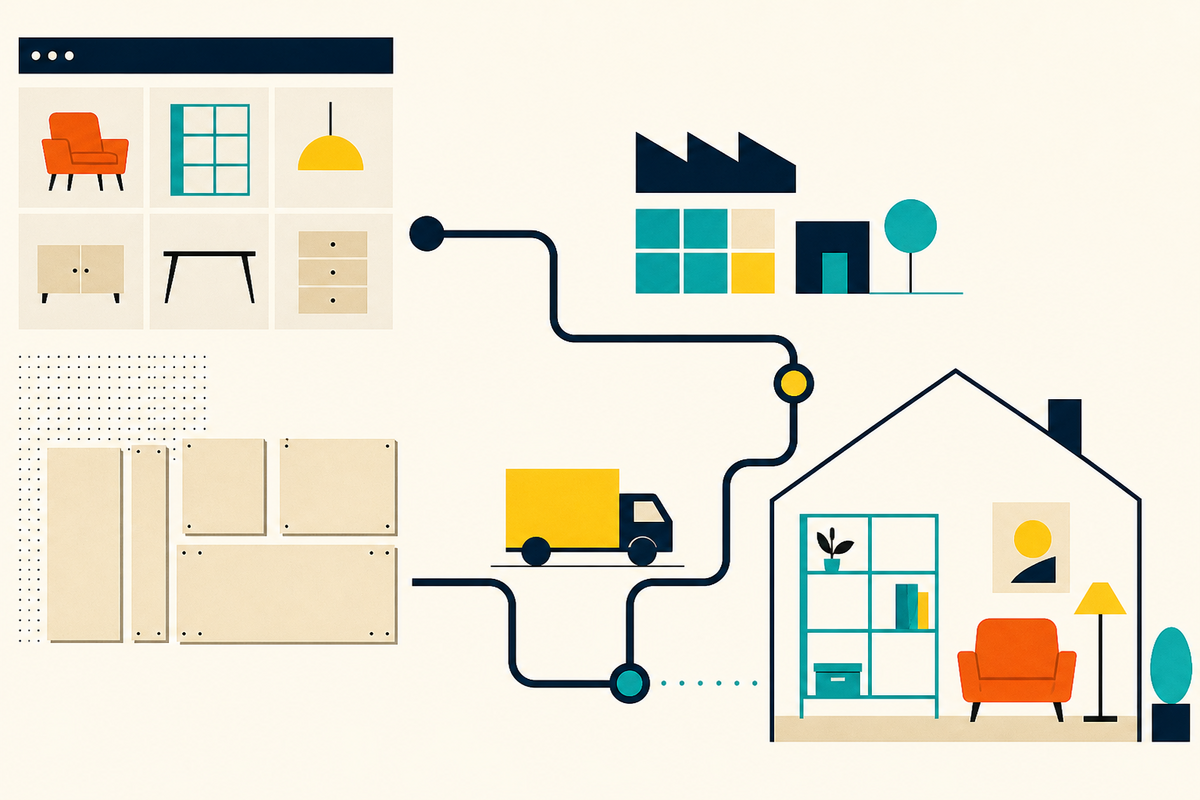
Together, those pieces make MadeiraMadeira less like a digital furniture shop and more like connective tissue for Brazil’s fragmented home industry. It serves the person choosing a wardrobe, but it also serves the factory seeking national demand, the merchant that needs a sales channel and the delivery operation trying to make an unwieldy promise arrive intact.
A failure with useful inventory
MadeiraMadeira began in 2009, when the flooring business run by Daniel and Marcelo Scandian’s family collapsed during the global financial crisis. The brothers had inventory to sell and a fresh reason to try something else. They listed the remaining stock online from a house in São José dos Pinhais, near Curitiba. The catalog started with floors, doors and windows, then followed demand into furniture and decoration.
Robson Privado joined the founding team as the company evolved. In 2012, investors Monashees, Kaszek and Flybridge backed the venture alongside Niraj Shah of Wayfair and Christian Friedland of Build.com. Their presence was a clue: the opportunity was not merely to photograph Brazilian furniture and place a checkout button beside it. It was to organize supply.
Dropshipping became an early lever. Instead of purchasing and warehousing every wardrobe, cabinet or lamp, MadeiraMadeira could pass an order to a manufacturer and coordinate collection and delivery. That structure widened selection without matching catalog growth with inventory growth. In 2018 it added a conventional marketplace, allowing outside sellers to list their own products. The company’s seller page now advertises more than 50 eligible categories, ERP and hub integrations, and a commission-only starting model.
The product starts after the click
A marketplace creates selection, but selection does not carry a dining table from Paraná to Bahia. The company created BulkyLog in 2019 to address that mismatch. The logistics arm plans and operates delivery for large home goods, where dimensions, handling, damage risk, appointment windows and reverse logistics make ordinary parcel networks a poor fit. MadeiraMadeira also acquired tracking specialist iTrack Brasil in 2021 and has continued adding distribution capacity.
Then there is touch. Furniture shoppers care about texture, scale and proportion, none of which compress neatly into a product card. MadeiraMadeira’s answer is the Guide Shop: a physical store that carries displays and consultants but treats the website as its endless aisle. Shoppers can test selected pieces, bring measurements and photographs, see 3D room projects, complete an order with help and receive it at home. The company currently lists 54 shops, 35 of them in São Paulo state.
It is a useful retail inversion. A traditional furniture store turns floor space into inventory. A Guide Shop turns it into reassurance. The showroom does not try to reproduce three million listings; it gives a customer enough tactile evidence to trust one of them. New “2.0” locations opened in Curitiba and São Paulo in March 2026 with a heavier emphasis on modular projects and private labels.
More margin, more control
Marketplace scale is only one side of the economics. MadeiraMadeira can earn a commission when an outside seller completes an order. It can capture retail margin on direct sales, sell logistics and fulfillment support, and use Guide Shops to assist higher-consideration purchases. Private labels add another layer.
CabeCasa, introduced in 2019, became the first company-owned furniture brand. It now sits under Madeira Originals with CasaTema, the children’s furniture company acquired in 2022. The group’s furniture innovation and technology center, opened with SENAI, lets it test safety, durability and performance while converting customer behavior into product decisions. Search queries and marketplace demand are not just marketing data here; they can become a brief for the next modular wardrobe.
Finally comes the screwdriver. MadeiraMadeira bought Argentine home-services platform IguanaFix and children’s specialist CasaTema in 2022, then added Brazilian services marketplace Triider in 2025. MadeiraMadeira Serviços now offers furniture assembly, installation, maintenance and repairs. This closes a stubborn gap between “delivered” and “usable,” while giving the group another reason to remain in the customer relationship after the truck leaves.
Minutes, not days. A marketplace cannot scale if every seller waits on paper. After integrating electronic contracts, MadeiraMadeira said partner contracting fell from two days to 15 minutes. At the time of the case study, a nine-person team could accredit more than 400 new sellers a month.
The Brazilian shape of the market
MadeiraMadeira competes in overlapping arenas. Mercado Livre, Magazine Luiza and Casas Bahia offer broad marketplaces and powerful traffic. Mobly and Tok&Stok focus more tightly on furniture and interiors. Leroy Merlin owns the build-and-renovate context. Local stores and manufacturers still matter because home retail remains regional, physical and relationship-driven.
MadeiraMadeira’s distinction is not that no rival has an app, a warehouse or a sofa. It is the way the company has assembled home-category depth with an asset-light catalog, specialist freight, assisted physical shopping, private labels and services. Each piece answers a specific reason a buyer might abandon a purchase or regret one.
That stack also carries risk. A broad marketplace can create uneven seller experiences. Bulky delivery is expensive and visible when it fails. Assembly introduces another appointment and another contractor into the chain. Recent Google Play reviews illustrate both sides: some customers praise cleaner navigation, while others describe missed assembly visits or difficulty resolving delivery problems. The model’s promise is integration; every handoff is therefore a test of the brand.
The company’s post-boom years make the story more interesting. A US$190 million Series E led by SoftBank and Dynamo pushed its valuation above US$1 billion in January 2021. That was the glamorous milestone. The less glamorous work followed as capital became more expensive and technology valuations reset. MadeiraMadeira returned to operating discipline, kept building the logistics network and looked for more value in private labels and services.
In March 2026, management said gross revenue had risen 21 percent in 2025 while EBITDA increased 208 percent from the previous year. It outlined seven more distribution centers for 2026 and a logistics footprint expected to reach 150,000 square meters of cross-docking space. Those are company-reported figures, but they describe a strategy that has plainly moved beyond growth by catalog count alone.
What to steal from the stack
MadeiraMadeira’s most portable lesson is to map everything customers must do after pressing the button. In a difficult category, the adjacent frustrations may be better products than the original storefront. Delivery tracking became infrastructure. The need to touch a sofa became a showroom format. Assembly became a service network. Demand data became private-label design input. Seller paperwork became an automation project.
The company’s culture language is unabashedly domestic. Employees are MadeiraLovers. Its purpose speaks of turning houses into places where lives and memories are built. The company’s Ammar family program even calls employees’ young children gravetinhos, or little twigs. Beneath the wordplay sits a demanding operating idea: customer obsession must survive the moment when a 90-kilogram wardrobe reaches the wrong loading dock.
For shoppers, MadeiraMadeira offers a wide place to compare, visualize, buy and arrange the finishing work. For sellers and manufacturers, it offers digital demand, national reach, integrations and optional logistics. In the market, it occupies the seam between retailer and infrastructure provider. That seam is unglamorous, operational and difficult to copy quickly.
In practice, the stack is most useful when the purchase is least spontaneous: a first apartment, a modular kitchen, a child’s room or a renovation with several deliveries moving at once. The catalog gives a household range; the shop and 3D plan reduce uncertainty; tracking makes the wait legible; assembly turns cartons into a room. None of these steps is exotic. Their coordination is the product.
A chair is still a chair. MadeiraMadeira’s business is everything required to make it appear in the right room, on the promised day, ready for somebody to sit down.