A furniture customer rarely behaves like a diagram. She may meet a sofa in a catalog, inspect its dimensions on a phone, sit on it in a showroom, ask a designer about fabric, then return to the website before buying. The transaction records an ending. Jen Porter built her career around everything that happens before it.
Porter’s route to the executive suite began on the merchant side of retail. That detail is more than résumé archaeology. A merchant learns to read products and people together: which silhouette earns a second look, which color makes sense in one market but not another, how price and presentation alter a decision. Former colleagues would later praise her for bringing that merchant-and-consumer view to marketing. It became the throughline of a career that crossed fast fashion, lifestyle retail and premium furniture.
After Colgate University, where her public profile places her from 1999 to 2003, Porter began in merchandising at Abercrombie & Fitch. By 2014 she was at Forever 21, moving through international marketing, global marketing and eventually the top marketing role. She then spent 2018 to 2019 as Head of Marketing at Anthropologie. The sequence widened her field of view: first the item, then the market, then the brand, then the connected system that carries all three.
Merchant-side start at Abercrombie & Fitch
International, global and head-of-marketing roles at Forever 21
Head of Marketing at Anthropologie
Marketing and eCommerce leadership at Arhaus
The room is part of the media plan
Porter joined Arhaus in September 2019. Two years later, the Ohio company went public, and her title at Arhaus, Inc. became Chief Marketing and eCommerce Officer. Her remit covered global marketing strategy, the eCommerce business and corporate social responsibility. It was an unusually revealing perch from which to watch a considered purchase.
A dress can go from discovery to checkout in minutes. A dining table enters a home, rearranges a room and may stay for years. Premium furniture asks the customer to imagine scale, texture and daily life. Arhaus had to make that imagination possible across glossy paper, pixels and physical space. Porter’s public remarks kept returning to the links between those places.
“We know the majority of our clients are engaging with us on arhaus.com regardless of where they end up transacting.”Jen Porter, 2024 earnings call
That sentence complicates the neat attribution chart. A website visit may look like failed conversion when it actually supplied the confidence for a showroom sale. A showroom visit may look like costly browsing when it introduced the brand. In 2023, Porter said showrooms were the leading way new clients discovered Arhaus. Recommendations from friends and family ranked second. Digital was both a sales channel and an experience channel, a place to learn the assortment and understand the brand’s difference.
The ranking also turns customer service into marketing. A recommendation cannot be bought in the same way as an ad placement. It is earned across the slow parts of retail: a useful conversation, an order that feels considered, a delivery that arrives as promised, a product that remains worth discussing. Porter connected Arhaus’s investment in product storytelling to that social afterlife. Give clients enough knowledge to understand why a piece is special, give them an experience they feel good about, and the brand can travel into the next household through a friend’s sentence.
The considered-purchase loop
This is the practical value of Porter’s merchant training. She did not speak about channels as abstract pipes. She spoke about what customers were looking at, what they were learning and what might move them from consideration to conversion. In 2024, she described the team as learning, deploying and optimizing the site almost every day. Some improvements were visible; others happened behind the scenes. The goal was not digital purity. It was to help a client continue a journey without feeling the machinery underneath it.
Promotions fit inside that system without becoming the whole system. Porter discussed a subset of Arhaus customers who waited for key shopping weekends and watched competitors stretch Black Friday or Memorial Day messaging across longer periods. Her response was measured: keep Arhaus in the consideration set, tune how the sale section is assorted and described, and resist letting the promotional calendar erase the product story. The distinction matters in premium retail. A discount may create timing. It cannot explain why one table, chair or sectional deserves the room.
The big book still had a job
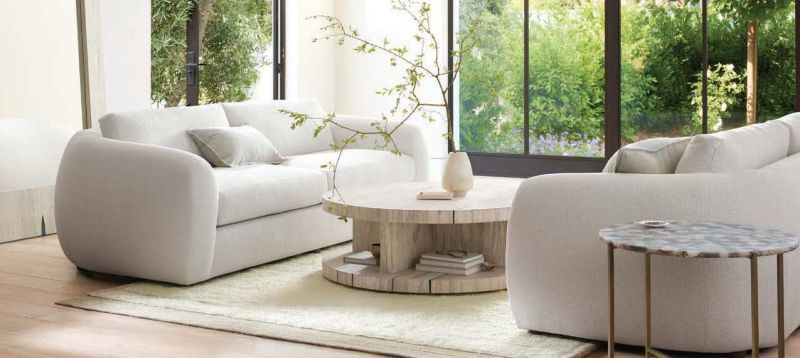
The catalog was one of the more surprising pieces in this system. Porter distinguished among a 228-page “big book,” a 12-page mailing and postcards. The largest catalog did more than announce a sale. It introduced a broad product collection and carried it into homes, where a customer could see pieces in rooms rather than in isolated rectangles.
The format had measurable weight. When Arhaus’s spring catalog was delayed in early 2026, the company said demand timing moved with it. Porter described digital campaigns launching around the catalog’s arrival. Print was not competing with eCommerce. It was creating the context that made the screen more useful.
The catalog also gave newness a front door. Furniture collections arrive in families of shapes, materials and finishes; releasing them as a series of disconnected product pages loses the composition. Porter talked about the book as a supporting system for introducing that full wave of product. Once the system worked, the next actions could be distributed. A customer might save a page, search the name, request a swatch, visit a showroom or bring the room to an in-home designer. The page did not need to close the sale to move it forward.
The lesson travels beyond furniture. Media gets old; customer needs do not. A medium survives when it performs a specific job better than the alternatives. For Arhaus, the catalog could hold an assortment, a mood and a room at once. Digital added depth and action. The showroom supplied touch. Design service lowered the risk of a complicated choice.
Story as product infrastructure
Porter also made the makers visible. In 2023, Arhaus launched Rooted, a campaign about a vendor partner in Mexico whose collection had already performed well. Porter said the added knowledge and detail resonated with customers. In 2025 came Uphold, a film-and-storytelling project about North Carolina upholstery artisans and the techniques behind the company’s furniture.
These were not generic invocations of craft. They attached a place, a process and a pair of hands to an expensive object. When a customer is asked to pay for longevity, the construction story becomes part of the value proposition. Porter summarized the operating sequence cleanly: product begins the work; storytelling brings it to life.
Uphold made that sequence literal. The campaign focused on the heritage and techniques of upholstery artisans at Arhaus’s North Carolina manufacturing operation. It gave the brand a way to discuss tailoring, attention and domestic production without reducing craft to a label on a product page. Rooted performed a related job with a long-running collection made by a partner in Mexico. Porter noted that the collection was already selling; the story supplied a deeper reason to care. In both cases, marketing did not invent value. It revealed work that was already inside the object.
“Product is where Arhaus begins, and storytelling is what brings it to life.”Jen Porter, 2025 earnings call
Her public speaking style was concrete and cumulative. She moved easily from a campaign to site behavior, from a showroom to referrals, from promotion timing to customer acquisition. Former colleagues described her as collaborative, strategic, positive, adaptable and transparent. One called out the way she understood digital, print and physical channels together; another remembered a lighthearted leader with uncommon knowledge of international markets, especially Asia-Pacific.
There is a small, telling exchange in a 2026 call. Arhaus CEO John Reed began describing the size of the U.S. trade market, paused over the number, and Porter supplied it: $27 billion. It takes one line in a transcript. It also sketches the operator behind the brand language, ready with the market fact while the conversation moves.
An ending in a short filing
On July 16, 2026, Arhaus disclosed an organizational change in the plain language of a securities filing. The company would separate marketing and eCommerce into distinct areas under separate leaders. Porter had left the day before. Her tenure at Arhaus lasted nearly seven years, from a private-company chapter through the public listing, showroom expansion and a larger connected-commerce operation.
The July 2026 change
Arhaus split marketing and eCommerce leadership. Porter’s departure was effective July 15. No next role had been publicly announced by the publication date of this profile.
The change creates an interesting coda to her work. Companies can separate functions on an organization chart. Customers keep crossing the boundary. The person inspired by a catalog still expects the site to remember the product. The person who researches online still expects a showroom associate to understand the same assortment. The trade designer still needs brand, inventory, service and checkout to behave like parts of one company.
Porter’s next chapter is not yet public. The useful record is the one she left in the details: a showroom can be media, a website can be experience, a catalog can create digital demand, and a maker’s story can make value legible. The customer does not care which executive owns the box. She cares whether every place she looks tells the same truth.