The exit ramp from his own success may be Maceo Cardinale Kwik's revealing piece of work. In the spring of 2026, Datost looked like the tidy version of a startup story. Kwik and co-founder Jason Wang had found a problem inside Traba, the industrial labor marketplace where both worked as engineers. Business questions piled up faster than analysts could answer them. The pair built an AI analyst that lived in Slack, remembered a company's private definitions and showed its work. They joined Y Combinator. Customers arrived. Kwik says the product reached $400,000 in annual recurring revenue in eight weeks.
Then he began to dread opening his laptop.
A conventional profile would now summon the language of courage and destiny. Hardware will supply enough melodrama without our help. The plain version is better: a 21-year-old engineer had made something people paid for, then realized he did not want to spend the next decade selling it. Datost's analytics product stopped active development. Wang continued the underlying idea separately with his brother at Lark. Kwik kept the company and changed its object of attention.
The useful thing built after hours
Datost began in an ungenerous slice of the clock. Kwik describes working a “996” schedule at Traba, then building from roughly 10 p.m. to 3 a.m. The phrase has an adolescent bravado to it, but the internal adoption is the more useful detail. Around 80 percent of Traba eventually used the tool, he says. The working product answered a recurring complaint in a place he could observe at conversational distance.
The complaint was simple. Companies own plenty of data, but the meaning of that data is scattered among warehouse schemas, code, documents, Slack threads and human memory. Ask which customers might churn and a model can write elegant SQL for the wrong definition of “at risk.” Datost added a semantic layer that kept company-specific meanings, asked clarifying questions when necessary and left notes after corrections. A second model reviewed answers before they reached the channel.
The system around the model / reported BIRD-Interact result
The public launch described 600 ambiguous questions across 22 PostgreSQL databases. Results were reported by Datost.
The benchmark result made the architecture legible: Datost reported 75.2 percent on BIRD-Interact, against 33 percent for the underlying model alone. Its thesis was that the machinery around a model could matter more than merely choosing a newer model. It was a software engineer's answer to an AI problem - context, verification and memory assembled into a system.
Kwik could sell the system, too. At his first tech conference, he arrived too late for a booth and found the price unappealing anyway. On day one, about ten conversations produced one meeting. So he watched the geography. Every attendee walked the same long sidewalk between the conference hall and lunch. The next morning he and friends put two coolers of Red Bull and Celsius on that path, alongside postcards designed and printed the same day. Kwik says the setup cost about $400, booked ten demos and helped land a signed contract that day.
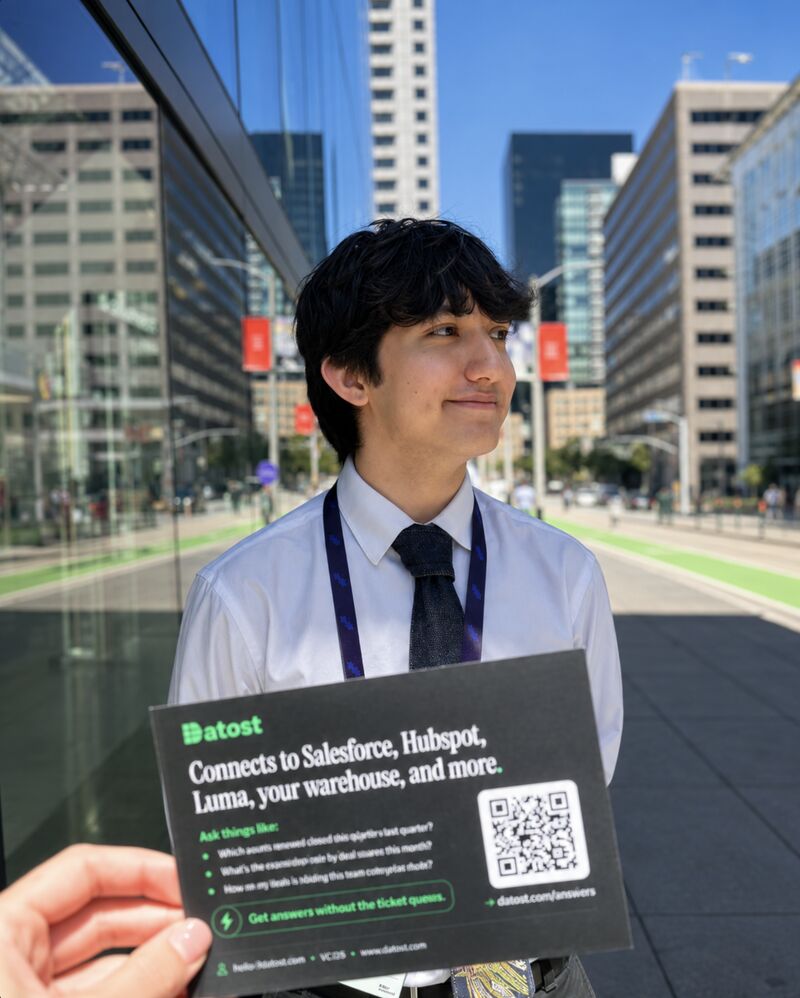
“Sometimes the cheaper move is the better one.”Maceo Kwik, on his conference experiment
A chart cannot choose a decade
All of which makes the pivot less convenient. Datost was not collapsing. Its company page says it reached $400,000 ARR in eight weeks. The graph was moving in the correct and socially approved direction. Kwik even drew it in a notebook. Yet the better the number became, the more expensive it felt to ask whether he cared about the destination.
His explanation is disarmingly unfashionable: science fiction. He got into building because he wanted the future promised by it. Enterprise dashboards and onboarding flows did not satisfy that appetite. “Revenue is not a reason,” he wrote after the decision. The line is too broad to be a universal business principle and just right as a personal one. Revenue can confirm that buyers value a product. It cannot appoint the person who must gladly make version 47.
Does the market want this? And if it does, do I want the life required to keep making it? Datost answered the first question. ED1TH is Kwik's answer to the second.
There is no need to romanticize abandonment. Employees, customers and co-founders live inside a founder's change of heart. Here, the analytics product did not simply evaporate: Wang and his brother Michael continued it at Lark, while Datost Inc. pivoted toward Kwik's new mission. The split preserves a useful distinction between a product people wanted and the person who no longer wanted to lead it.
Engineering at Traba by day; Datost takes shape during the late shift and spreads internally.
Kwik and Wang join Y Combinator and launch a Slack-native AI analyst.
Datost reports reaching a $400,000 annual run rate.
Active development ends. The company pivots from analytics software to ED1TH.
Kwik works across optics, industrial design, software and factories, with Shenzhen next on the itinerary.
The computer at the edge of attention
ED1TH is a personal AI heads-up display inside a pair of glasses. Its public specification is a haiku of constraints: 25 grams, no cameras, all day. The imagined agent reads email, manages a calendar, offers directions and handles tasks without requiring its wearer to pull a glowing rectangle from a pocket. Datost now describes itself as an applied research lab combining industrial design, optics, intelligent systems and interaction craft. Its declared interest is not simply smaller screens. It is computing that earns attention instead of constantly invoicing us for it.
The absence of a camera is significant. Smart glasses usually obtain intelligence by watching what the wearer sees, which makes every nearby stranger an involuntary extra in the demo. ED1TH proposes a narrower sensory bargain. Whether that choice can preserve enough usefulness is an engineering question still being worked out, but it gives the project a clear manner: capable without looking predatory, present without becoming the room's main character.
Kwik says he wore prototypes in public for months without anyone noticing. That may be a persuasive design test for a face computer. Spectacles are intimate architecture. A device can have admirable latency and still lose because it makes its owner resemble a regional manager from the moon. At 25 grams, ED1TH aims near the weight of ordinary frames. Physics, battery life and factory tolerances will now get a vote.
“The room comes first.”Datost's design position
The work also returns Kwik to an older pattern: learning by building in public. His GitHub profile traces a restless technical education through data visualizations, market simulations, cellular automata and open-source experiments. He completed a computer science degree at Virginia Tech in two years with a 4.0 GPA after beginning at Penn State. A trading engine helped his team place in the top ten in the United States in IMC's Prosperity challenge. Elsewhere on the profile: competitive fencing, bouldering, science-fiction books and vintage thrifting. The collection feels less like a personal brand than a desk with every drawer open.
There are earlier signs of civic appetite, too. Kwik co-founded Lighthouse Startups, described as a nonprofit, and prepared food for North Brooklyn Angels' mobile soup kitchen. Those details do not predict a wearable computer. They do suggest that his public record has never been confined neatly to code.
What can be stolen
The obvious lesson would be to follow passion. It is too soft to be useful. Kwik's path offers something more operational. First, build beside a problem close enough to watch. Datost earned internal users before it earned a company name. Second, treat distribution as a system. A sidewalk bottleneck can outperform an expensive booth if you bother to notice the foot traffic. Third, separate evidence from obligation. Fast revenue is evidence. It does not oblige a founder to love the work that produces it.
The fourth lesson is the least comfortable: a successful pivot still leaves the new idea entirely unproven. Software founders crossing into hardware discover that atoms are unimpressed by launch posts. Frames pinch. Components slip. Suppliers misunderstand drawings with expensive precision. Batteries object to ambition. Kwik's current public language includes factory emails at night, software during the day and a journey to Shenzhen. The romance has already acquired a bill of materials.
That is what makes the story worth following now, before hindsight has pressed it into a slogan. Maceo Kwik built a useful company during hours commonly reserved for sleep, found a market, learned to sell and then refused to let traction make the central decision for him. ED1TH may become a computer people wear. It may become a fascinating pile of prototypes. At present it is something rarer and more modest: an honest bet on the work its founder wants to wake up and do.