In 2003, M Rezaul Hassan began REVE Systems in his father’s car garage in Khilgaon, Dhaka. There were six people. Their first business concerned the sort of software that rarely gets invited to a glamorous launch party: billing for internet telephone calls. A call happens, a charge follows, and someone needs the arithmetic to behave. It was a modest place to begin an international company, with a problem specific enough to sell.
The garage is memorable. The choice of problem deserves equal billing. Hassan was entering a business in which his customer could be a service provider, and that provider’s customers might never learn his name. His company would work behind other companies’ conversations. Years later, the product range would extend to chatbots, live chat, cloud communications, and businesses far outside software. The beginning already contained a useful idea: find something another business needs to do, then make a product that helps it do it.
He has kept that international outlook while returning repeatedly to the questions customers ask. The distance between a telecom billing system and an AI conversation is considerable. Both sit at the point where an ordinary interaction meets the machinery of a business. Hassan’s career offers a view of what happens when a founder keeps working at that junction.
A garage with an export address
Hassan came to entrepreneurship after senior roles in IT and internet service providers. He had an engineering degree and an MBA from the Institute of Business Administration at the University of Dhaka. The combination matters in a business where a product must satisfy both the technical team and the person paying for it. A working system and a workable business model have to occupy the same room.
As REVE developed, Singapore became its headquarters, with research and development in Bangladesh and India. The arrangement gave the venture an international base while keeping substantial development activity in South Asia. Today, REVE Systems describes a customer base in more than 82 countries. That is the company’s stated reach, rather than a count of people who personally know Hassan. His work travels through the organizations that use its software.
In Barcelona in 2017, he recalled starting at his father’s garage and spoke of an ambition to reach Nasdaq through building a billion-dollar company. It was a stated target at that moment. Its scale reveals how far his thinking had moved beyond the original premises. A garage is an excellent address for an origin story; considerably less useful as a limit on a business plan.
REVE Systems’ stated customer footprint today.
A garage venture, an international address book.
The invoice came before the app
REVE’s own account describes a difficult early effort to enter international markets, followed by momentum from its 2008 mobile VoIP launch. The iTel Mobile Dialer Express brought the company into the software people used to make calls on their phones. The shift widened the company’s place in the communications chain: from accounting for an interaction to helping the interaction happen.
By September 2013, REVE was launching its Session Controller at the Asian Carriers Conference in Cebu, Philippines. The platform combined switching with billing and included routing and security features. Independent testing by Miercom had examined its performance, including stress and denial-of-service tests. Here was a different sort of sales argument: a system could be demonstrated, tested, and assessed for the work it would carry.
For Hassan, this was also a way of making an export business around products. The customer could purchase a system with a defined job. A phone call looks pleasantly simple from the handset. Behind it sit decisions about routing, capacity, access, and money. REVE was finding commercial territory in those details, where reliable software has a reason to be bought again.
- 2003REVE Systems begins in Dhaka
- 2008Mobile VoIP launch gains momentum
- 2013Session Controller launches in Cebu
- 2015REVE Chat launches globally
- 2025AI customer engagement at MWC
Bangladesh, on the trade-show floor
At Mobile World Congress in 2015, Hassan was talking about global customers and the competitive calling offers operators could make with REVE’s software. The company was presenting itself as an example of Bangladesh’s capacity to export software. That gave his business a second context: every sale could also help make a country’s technical work more visible.
The distinction was useful in a sector where the word VoIP carried difficult associations in Bangladesh because of illegal uses. REVE’s international business involved supplying software to service providers. Hassan’s public argument concerned the opportunities for a legitimate software industry selling beyond its home market. The product had to earn its place with a customer overseas, regardless of the debate surrounding the technology at home.
A trade show makes this argument concrete. There are booths, competing products, prospective buyers, and a limited amount of attention. For a founder from Dhaka, being present is one step; giving a telecom operator a reason to stop is another. REVE’s attendance put its software into that practical contest. The country of origin travelled with the company, but the customer still needed the product to work.
Eighteen reasons to enjoy a customer
When Hassan discussed IDT Telecom in 2018, he chose a detail that says much about the satisfaction he takes in business. REVE had supplied 18 applications and a PIN-less calling-card solution for the American telecom company’s international calling platform. Different brands used the solution in different markets. He remembered the breadth of the sale with evident pleasure.
“Selling 18 products to a single client always gives me a feeling of joy.”
M Rezaul Hassan · 2018
The delight is specific. He was describing one relationship in which a customer had found several uses for what his team could build. In the same interview, he emphasized technical development and listening to customers. Read together, those comments suggest a founder who measures progress partly through a customer’s willingness to entrust more work to the company.
He also named Richard Branson as a business leader he admired, citing the range of businesses Branson had created and his strategy. By then, Hassan’s own interests had extended into security software, web software, fashion, and property. The admiration fits a founder interested in what else a group of businesses might become.
A place in a crowded awards photograph
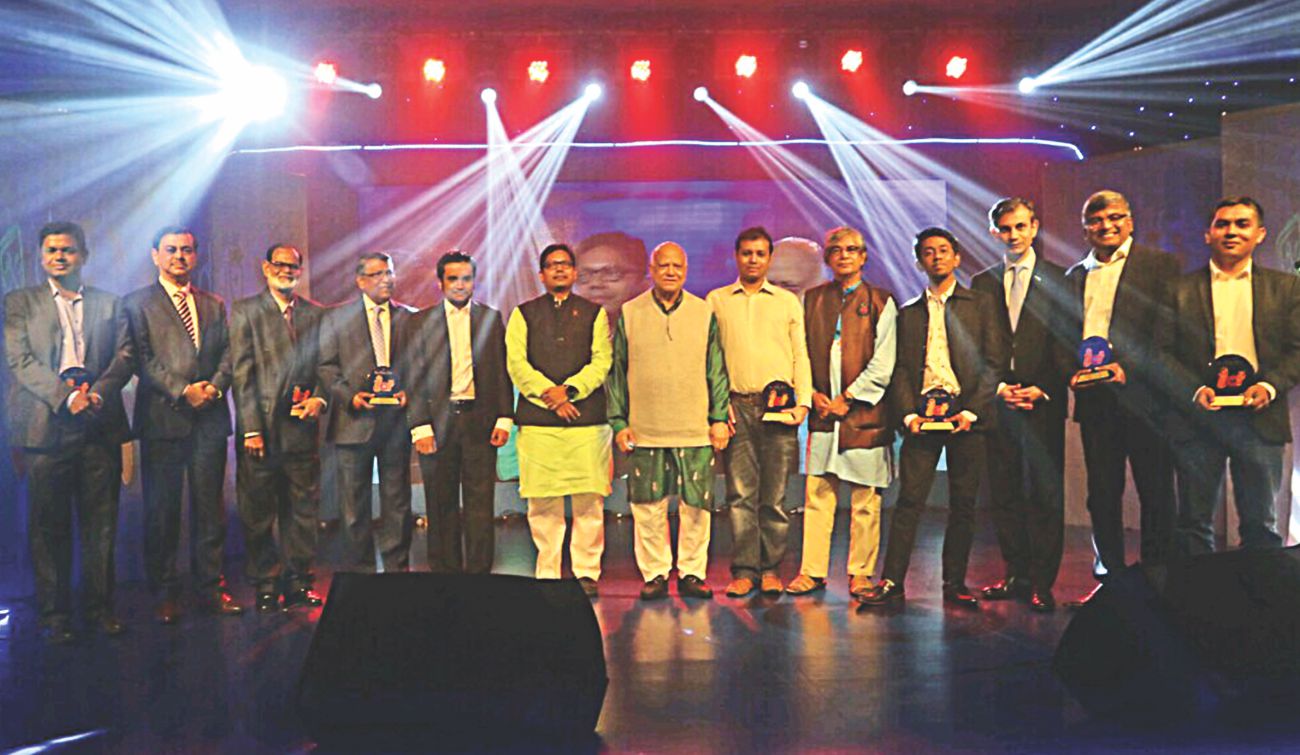
In December 2017, Hassan received the ICT Business Person of the Year award at the Daily Star ICT Awards, organized with the Bangladesh Association of Software and Information Services. The event also recognized companies including Chaldal, Brain Station 23, LEADS, Sheba, and Pathao. His work stood alongside several different kinds of technology business in Bangladesh.
The photograph from the evening is appropriately crowded. Hassan is second from the right, holding his award. The scene gives an entrepreneurial story some company: software exporters, platforms, established IT firms, and newer ventures occupying the same stage. A career can be told through its individual decisions while still belonging to a much larger effort.
In 2023, another recognition followed: CEO/MD of the Year in the technology category of the Bangladesh C-Suite Awards. The two honors sit six years apart. Between them, the portfolio continued to develop, including customer engagement software. Awards supply useful dates in a career. The intervening work supplies the more interesting questions about where the founder took the business next.
From a call to a conversation
REVE Chat was publicly launched in 2015 as a cloud-based live chat platform. Businesses could connect with customers through text, voice, and video. Features included visitor analytics, chat routing, and Facebook integration. Hassan described arrangements to market it in Korea and Japan, alongside use by businesses in Bangladesh. The overseas outlook accompanied this product too.
The move made the company’s communications expertise relevant to a broader set of businesses. A telecom provider has calls to handle; an online shop has visitors with questions. Live chat gives those questions somewhere to go while a customer is still considering a purchase. The sale depends partly on whether a person can get an answer at the moment it matters.
By 2022, REVE Chat’s work with Indian education company iNeuron included co-browsing, allowing teachers to guide students through material on screen. In 2024, TallyKhata added REVE Live Chat for merchant support in English, Bangla, and Banglish. These uses brought the platform into teaching and small-business services. Each added a different setting for the same practical task: helping people communicate clearly enough to get something done.
The question behind the chatbot
On a public LinkedIn profile, Hassan posed a question about why banks would invest in chatbots when they already had online and mobile banking applications. His explanation focused on the effort of navigating screens for routine queries. Customers might prefer to ask and receive an immediate answer, with access across the channels they already use. He described using ChatGPT to discuss the question and compare its response with the team’s findings.
That is a revealing way to approach AI. The starting point is a customer’s inconvenience. A business already has an app; the founder asks what remains awkward about using it. The technology earns a purpose when it makes the interaction easier. It is a more demanding question than whether a chatbot can be added to a website.
At Mobile World Congress in 2025, REVE’s portfolio included AI and customer-engagement products. Its work with STC Kuwait involved an AI chatbot and live chat with large language model capabilities, multilingual support, and omnichannel integration. The company also presented a virtual trial room using augmented reality and AI. The conversations were expanding into new forms of interaction, including how someone might try a product before purchasing it.
The founder who also talks about cookies
Hassan’s wider business interests produce an unexpected change of scenery. In June 2025, he was discussing Le Delecia, a café and bakery brand launched in 2021. It had ten outlets at the time, and he said a new Banasree café was being expanded to three times its size. He spoke about urban customers seeking an experience as well as something to eat.
The premium cookies surprised him. “Honestly, five years ago I wouldn’t have believed it.” His observation concerned buyers willing to spend on a café visit and its products. For someone whose early business involved telecom billing, it is an amusingly tangible market signal. Cookies require no explanation of network architecture, although customers may still have strong views about the service.
Later in 2025, Hassan attended Le Reve’s sixteenth-anniversary gala in Dhaka as REVE Group chairman, congratulating contest winners. Monnujan Nargis, the fashion brand’s CEO, discussed individuality and creative expression. The evening included a winter collection and new faces on the runway. Software, clothes, coffee: his business life now moves among customers with rather different expectations.
Still finding the next useful exchange
Hassan’s present-day message at REVE Chat connects its telecom background with a focus on faster, more personalized customer experiences. His public author biography also names travel and photography among his interests. They offer a small glimpse beyond the corporate roles without needing to turn a founder into a collection of invented habits.
The career has a visible sequence: a garage venture, communications products, international customers, customer engagement software, and a wider group of businesses. Its coherence lies in repeated attention to how a service reaches the person using it. The details change from one market to another. A billing system, a support conversation, and a café table ask different things of a company.
The appeal of Hassan’s story is the distance covered while those ordinary questions remain in view. At the beginning, six people had a telecom problem to solve. More than two decades later, there are more products, more countries, and more ways for customers to ask for something. The next useful exchange is still a reasonable place for him to look.
Follow the conversation
Company pages, public profiles, and further reading.