In November 2015, the jewelry writer behind Gem Gossip visited a Los Angeles showroom and encountered an unusual arrangement: the designers were largely represented by their jewelry. There were bridal pieces, colored stones and diamond fashion designs to examine. The meeting was with Luxury Brand Group, a communications agency. A room full of things to try on had become a way to discover people worth writing about.
That visit offers a useful way into LBG’s business. A designer can make something compelling and still need help getting it considered. Between the workbench and the published photograph sit people with their own assignments: a stylist selecting accessories, an editor assembling a page, a buyer deciding what belongs in a store. LBG provides services aimed at those decisions, alongside advertising and consumer marketing.
A room built for the people who choose
The agency announced its West Hollywood showroom expansion in January 2014, its tenth year in business. The space measured 1,000 square feet and occupied an industrial-style loft on Santa Monica Boulevard. Appointments would bring in stylists, editors and other industry professionals to select pieces for shoots, events and placement opportunities.
On its showroom page, LBG describes Lucite cases, vintage vitrines and overhead skylights. Those details matter to the proposition. Jewelry is small, reflective and intended to be worn. Giving a person time with the actual object lets them make a different kind of judgment from the one available through a press release.
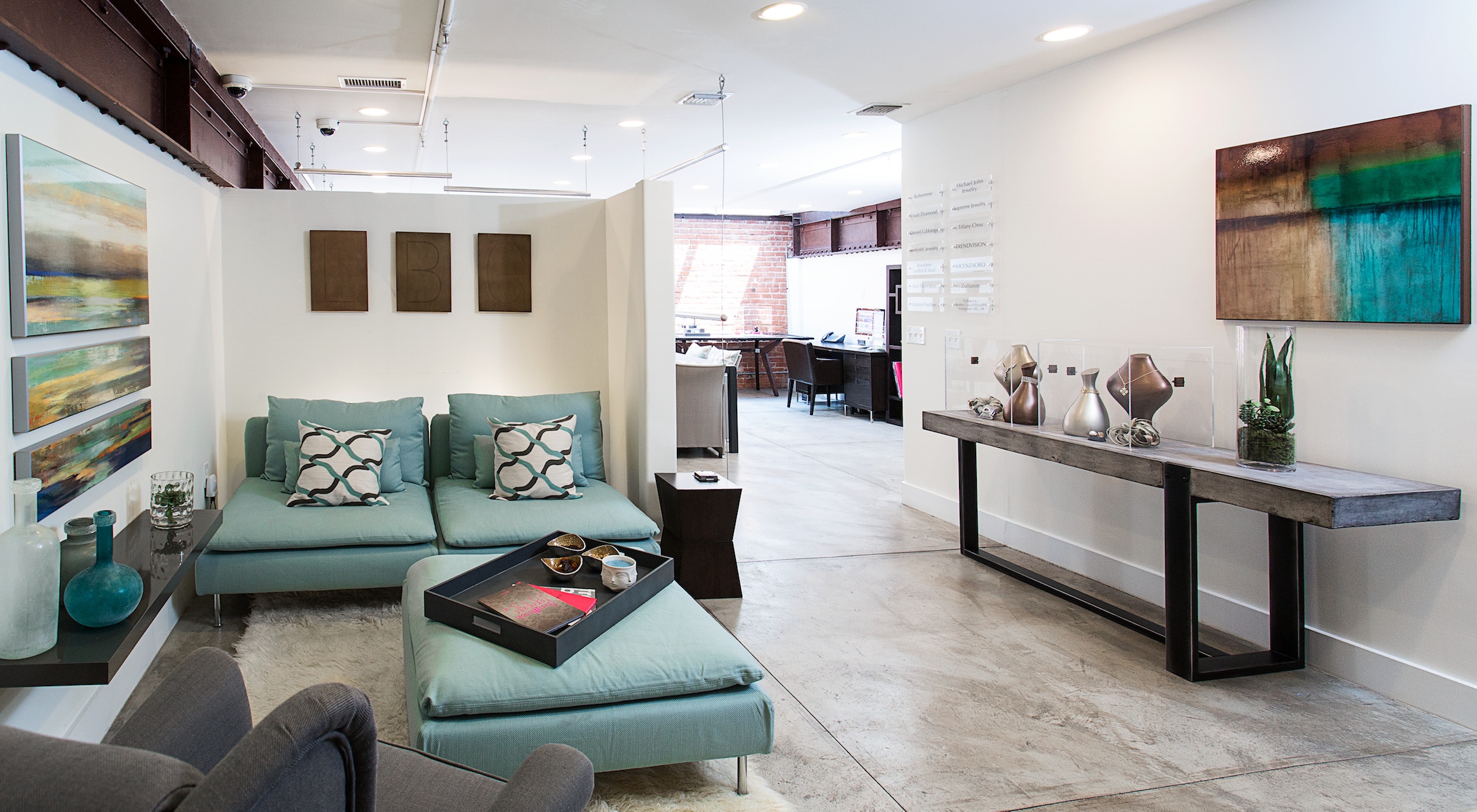
The showroom service includes jewelry loans for celebrity and editorial opportunities, along with stylist outreach and press previews. A useful reading of this setup is that the agency helps a designer become easier to work with. The product is present. There is someone to contact. A professional can compare pieces in the context of a real assignment.
The platinum connection
Frank Proctor founded Luxury Brand Group in 2004. Before the agency, he was a marketing vice president at Platinum Guild International. That background places him inside the jewelry trade before it places him in the business of explaining the trade to everyone else.

LBG presents itself as a specialist in luxury lifestyle and consumer products, supported by a national network of publicists and creative professionals. Its fine-jewelry concentration makes that broad description more specific. Here is a business that can discuss the designer, the retail setting and the editorial opportunity within the same conversation.
Its market position follows from that concentration. A brand deciding how to organize communications could hire internally, use independent publicists or work with a broader fashion agency. LBG’s particular offer combines jewelry knowledge with execution across several channels. The relevant comparison is the work a brand needs done: introductions, campaign planning, event support or the physical handling of products for selection.
Two kinds of attention
The agency’s published client history puts Assael, Ben Bridge and Verragio alongside JCK, the Gemological Institute of America and Platinum Guild International. It also includes Mattel and Merle Norman Cosmetics. The list covers past and present relationships; it is best read as the range of work the agency has encountered.
The pairing of designers and industry organizations is revealing. A consumer may first notice a jewel in a magazine or on a screen. A retailer may encounter its maker through a trade event. These are different routes to attention, involving different people and different reasons to care.
Press materials, previews and product selection
Trade events, introductions and brand alliances
LBG’s service menu covers both routes. Public relations includes press materials, launches and event work. Trade services include introductions, conferences, sponsorships and industry alliances. For a client, the practical attraction is coordination: the product’s explanation can remain coherent as it passes from a trade conversation to an editorial pitch.
A small historical example makes the work tangible. In August 2011, LBG distributed Ostbye’s announcement that the jeweler had acquired rights to the Shimmering Diamonds collection. The release explained the unusual moving-diamond setting and supplied commercial details. This is publicity in its everyday form: making a business development intelligible enough for other people to use.
The media budget is part of the job
The photograph and the showroom tell only part of the story. LBG also offers advertising creative, copywriting and media planning and buying. Its advertising page emphasizes reviewing existing programs and finding better uses for the budget. That is a different assignment from earning an editor’s interest, even when both support the same brand.
Advertising placed over the years, according to LBG’s advertising page. A cumulative media-placement claim, not company revenue.
Buying the agency’s help means defining the work. A new collection may need positioning and press materials; an established company may want a campaign reviewed or an event organized. The sensible budget conversation starts with deliverables and separates agency work, media purchases and production expenses. Those are different uses of money, even when they appear in the same launch plan.
LBG also describes qualitative and quantitative research, including focus groups and large survey initiatives. Research has an obvious role before a message goes public: it can test whether the company’s preferred explanation resembles the customer’s reasons for caring. For a luxury brand, taste is part of the work, but it need not be the only input.
A second coast, for a different conversation
In July 2016, LBG opened a New York office near Bryant Park. Proctor explained the move in terms of access to editorial media. The office would support meetings with editors and stylists, product previews and events.
“We needed a unique presence in the editorial media hub of New York City.”
Frank Proctor · on the 2016 expansion
The following year, the agency announced Amanda Tropila for New York public relations and Deanna Russo Clark for its West Hollywood showroom. The roles make the geographic logic concrete: East Coast media relationships on one side, showroom pulls and placements on the other. Proximity was accompanied by people assigned to do the work.
Seen together, the two expansions suggest a practical principle. If a service depends on another professional making a selection, arrange the business around how that professional works. A well-placed office or accessible sample collection can make the next step less cumbersome. That is the lesson these choices support.
The showroom lesson travels
The agency’s digital offering extends to social content, paid social campaigns, analytics, influencer relationships and email. These services bring the question of presentation into channels where a person may first encounter the product on a phone.
In August 2026, LBG senior consultants Duvall O’Steen and Jen Cullen Williams coauthored a National Jeweler column about selling colored gemstones to Gen Z. They interviewed specialists about individuality, education and transparent explanations. The article encouraged retailers to consider the customer’s preferences and explain what makes a stone distinctive.
For a reader running a brand, the copyable idea is to examine the moment of selection. What does the person need to see, understand or handle before saying yes? A showroom is useful when the object’s physical qualities matter and the relevant professionals can visit. Its logic offers less to a business whose main obstacle is an unreliable product or an audience elsewhere.
LBG’s story brings marketing down to a manageable scale: a piece of jewelry, a person considering it and somebody who has made that encounter possible. The camera comes later. First, the earrings have to get picked.
Take a closer look
Explore the agency, its showroom and the conversations around its work.