Lucky Zhang has spent a decade learning what the internet does to a medium when creation becomes cheap and distribution becomes social. First came video commerce. Then short video in Latin America. Then music streaming in Vietnam. Now he is working on a curious object: software that behaves like a post.
At Sekai, the Sunnyvale company he founded in 2024, a person types what they want and gets a small working app within seconds. It might be a quiz, a game, a date-idea picker, a playable birthday card, or a tool that chooses an outfit according to the weather, the wearer's mood, and whatever survived the laundry basket. Other people can play it. More importantly, they can remix it. Code disappears behind three familiar verbs: create, play, share.
This distinction gives Zhang's fourth startup its shape. Many AI coding products begin with the workplace and promise to make development faster. Sekai begins with the feed and asks what ordinary people would make if software were as casual as a caption. It is an app-building company with the manners of social media.
A feed with moving parts
The internet turned writing, photography, and video into everyday gestures. The tools got simpler, the audience got closer, and polished production stopped being the price of admission. Software mostly resisted that transition. Even a modest app demanded a developer, an interface, testing, deployment, and the courage to read a stack trace at two in the morning.
Generative coding models have changed the cost, but Zhang's product insight is about behavior rather than code. A cheaper factory does not automatically create a new culture. Sekai surrounds the factory with a feed, profiles, play counts, sharing, and the invitation to alter somebody else's work. A mini-app becomes a reply that runs.
The social software loop
One example is pleasingly frivolous. When the Coachella lineup arrived in spring 2026, a 20-year-old in Los Angeles made a personality quiz in an afternoon. Fifty thousand people played it that weekend. The creation was useful for approximately as long as the cultural moment required. It did not need a five-year road map. It needed timing, a point of view, and a share button.
“We want this to be something that's not doomscrolling. The way to get rid of doomscrolling is asking you to interact.”Lucky Zhang
That line is the moral argument tucked inside the product. A traditional feed rewards the thumb for continuing downward. Sekai asks the hand to interfere. Build something, change something, or at least make a choice inside what another person built. The difference sounds small until one remembers that every social platform is, at heart, a set of repeated motions.
Four companies, one long experiment
Zhang's résumé reads less like four disconnected bets than a tour through the ways content finds an audience. His first company, Yi+ AI, worked in video commerce and was acquired by Apple in 2017. His second, Blacktail, built a short-video platform focused on Latin America. ByteDance acquired it in 2020. He also founded NCT, a Vietnamese music-streaming business that remains in operation and has been described as serving more than 30 million users.
The geography matters. Zhang and his teams built platforms across Latin America and Southeast Asia, with experience spanning America, India, and China as well. Consumer habits do not travel merely because a pitch deck says “global.” They move through local tastes, distribution channels, and the recommendation systems that decide what appears next.
Sekai collects those old lessons in a new container. From video comes the feed. From music streaming comes repetition and recommendation. From commerce comes the importance of converting attention into action. The action now is creative: generate a mini-app, send it into circulation, and watch others pull it apart.
Apple acquires Yi+ AI
Video commerce puts Zhang close to the meeting point of content, recognition, and intent.
ByteDance acquires Blacktail
The Latin American short-video platform adds lessons in mobile distribution and cross-market taste.
Sekai begins
The company starts with anime fan-fiction experiences and joins a16z Speedrun's third cohort.
The mini-app phase accelerates
Broader app creation reaches 15 million published mini-apps and attracts a $20 million Series A.
There is a useful founder lesson in the progression. Zhang did not abandon his interest in content when the technology changed. He changed the unit. A music track or short video arrives finished. A mini-app arrives with handles. The audience can grab it, alter it, and send it onward. Distribution becomes collaborative.
The pivot hiding in plain sight
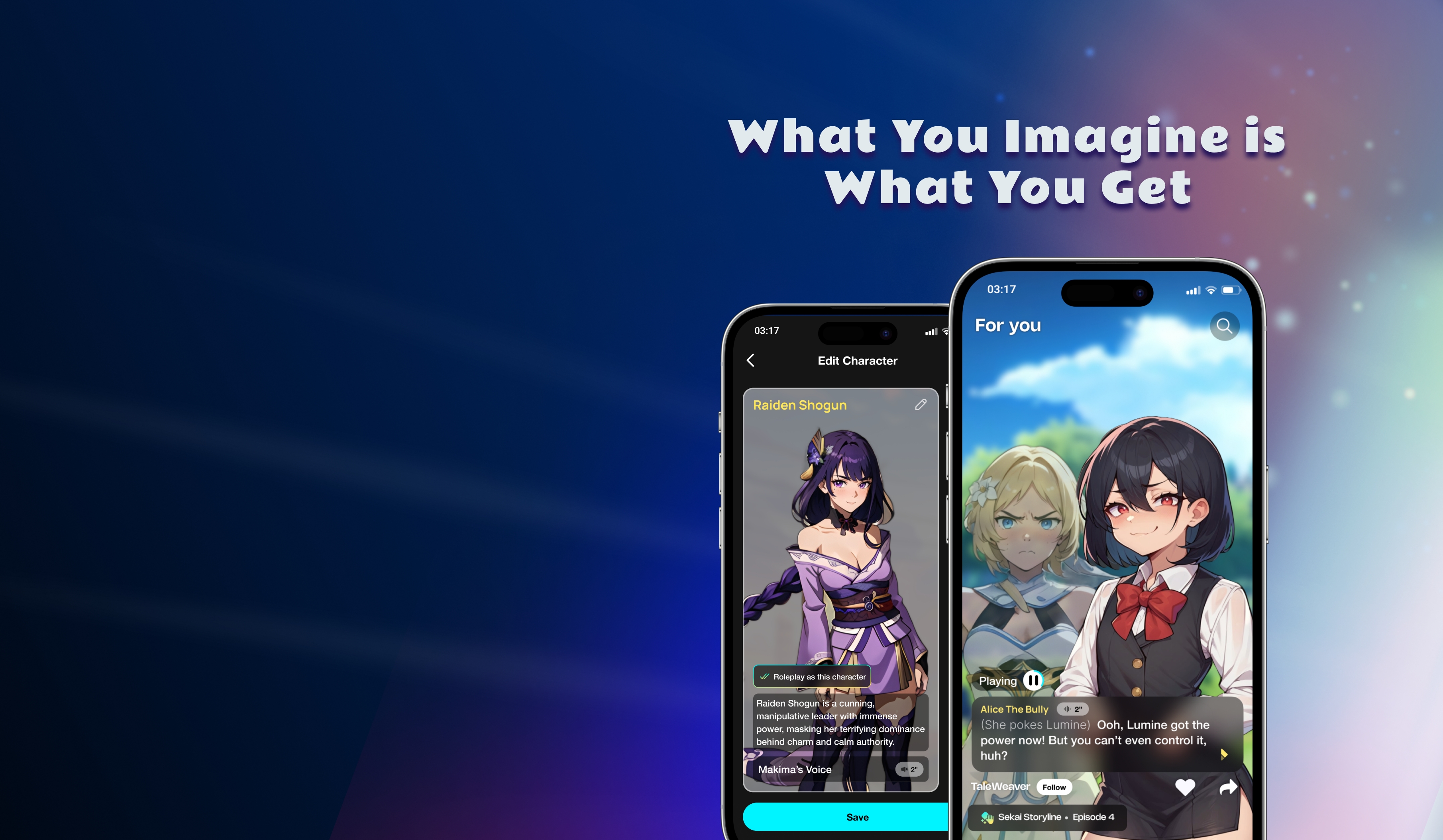
Sekai's first version centered on anime fan fiction. Users could create characters and enter interactive stories. The aesthetic was specific, the fandom was legible, and the appeal of generative narrative made immediate sense. Then coding models improved. Zhang widened the canvas from stories to apps without discarding the social foundation underneath.
This is the kind of pivot that can look obvious after it works. It rarely feels obvious from inside. The company had to notice that its deeper asset was not a single genre. It was a community already comfortable with prompting, playing, and recombining generated experiences. Better models made the broader product possible; the earlier behavior made it plausible.
“You don't call any of the content you create AI slop. It's helping you to fulfill your ideas.”Lucky Zhang
Zhang's wording draws a line between volume and agency. Generative systems can produce endless material, but a person cares differently about the thing they requested, adjusted, and gave to a friend. The raw ingredients may come from a model. The reason for making it still comes from a life: an inside joke, a concert weekend, a pet peeve, a birthday, a tiny inconvenience.
The company says its core users have created more than 100 pieces and spent over eight hours a day in Sekai. Zhang joked that they were putting in longer hours than the team. It is an amusing way to describe intensity, but also a clue. Creation becomes sticky when people experience it as play rather than labor.
Money for the next loop
Sekai raised a $6 million seed round led by Mayfield in 2025. In June 2026, Khosla Ventures and Connect Ventures co-led a $20 million Series A, bringing those publicly detailed rounds to $26 million. Returning and participating investors included a16z Speedrun, A*, MVP Ventures, 359 Capital, Parable VC, and 645 Ventures.
The investor list hints at the work ahead. Connect Ventures was built by Creative Artists Agency and New Enterprise Associates, creating a route toward creators and celebrity partnerships. Zhang has said Sekai plans to help creators earn money through mini-apps and interactive fan experiences. The company is also hiring across engineering and product, including mobile, machine learning, data, analytics, and product management.
Recommendation will matter as much as generation. If anyone can make software, the scarce resource shifts from production to attention. A feed must decide which of millions of tiny experiences deserves the next minute. It must also help new creators find an audience before they have one. The old social-platform problems do not vanish when posts become programs; they acquire buttons.
What the rest of us can steal
A portable idea from Zhang's work is not “add AI.” His published AI-native framework argues for products that improve as models improve, features that reinforce one another, and personalization at the scale of one person. Sekai applies the theory with discipline. The model does not sit in a decorative sidebar. It changes what can be made, who can make it, and how quickly the result can enter a social loop.
There is also a lesson in choosing the interface people already know. Sekai could have resembled a developer tool: file tree on the left, preview on the right, a deployment button waiting sternly above. Instead it resembles a place to play. The complexity remains, but it is kept backstage while the audience throws tomatoes, requests encores, and occasionally remixes the script.
The bet is still a bet. Fifteen million creations prove that production can happen at scale. They do not settle which mini-apps endure, how creators will earn, or whether interactive feeds can hold attention without inheriting every vice of passive ones. Zhang's career suggests he knows that distribution, not generation, will decide the answer.
For now, Sekai offers a charming revision to the internet's default question. Instead of asking, “What do you want to watch?” it asks, “What do you wish existed?” One question fills an evening. The other might fill a world.
Go deeper