A brown sofa is listed in Columbus. A parent in Perth asks a neighborhood group which plumber actually turns up. A baker in Manila posts a Reel, then buys an ad to reach customers six blocks away. None of this sounds like the future. That is precisely why Facebook still matters.
The service that taught a generation to “friend” one another is now 22 years old, a mature product inside Meta Platforms rather than the company name on the stock certificate. It is no longer the default symbol of online novelty. TikTok owns more of that energy; YouTube owns vast video intent; Reddit and Discord can feel more native to particular communities. Yet Facebook has kept an unusually broad job description. It is an address book, a television, a club directory, an events calendar, a creator studio and a flea market sharing one login.
That sprawl can make the app feel busy. It also explains its durability. Facebook’s competitive asset is not a single clever interface. It is accumulated context: real identities, old relationships, local density, business pages, group histories and years of behavior. A rival can copy a tab. It cannot instantly copy the gardening club that has answered questions since 2011 or the pool of nearby buyers who will collect a desk tonight.
The useful internet, hiding in plain sight
Facebook’s contemporary pitch is less “live your life online” than “make the time online useful offline.” Tom Alison, the executive who leads Facebook, put it plainly in July 2026: the job is to help people “sell, create, watch, organize, connect, fall in love, find a couch.” The couch is doing a lot of editorial work. It turns an abstract promise about connection into a mundane transaction between two people who live close enough to fit the same object through a doorway.
Marketplace is the clearest expression. It began in 2016 because buying and selling was already happening inside Groups. A decade later, Facebook said 430 million items and 44 million vehicles were listed globally each month. One in three young adults who use Facebook in the United States visited Marketplace daily. The product benefits from pieces that a standalone classifieds site must assemble separately: profiles, mutual context, location, messaging and an existing crowd.
The same logic runs through Groups and Events. Facebook is useful when a network already contains the right obscure people: alumni from a particular school, patients comparing practical experiences, volunteers arranging a food drive, residents debating a road closure. Search engines index documents. A healthy group indexes experience. Facebook’s problem has been making that experience retrievable without drowning it in repeated questions, spam or an administrator’s unpaid labor.
Its 2026 product work aims directly at those annoyances. Forum, a purpose-built companion app being tested for heavy Group users, includes AI-assisted questions and administration. Seller gives frequent Marketplace listers one place for inventory, messages, pricing and performance. A rebuilt Creator Studio promises creators a clearer operating console. This looks like Facebook unbundling itself from the inside: specialized workbenches that remain attached to the same large network.
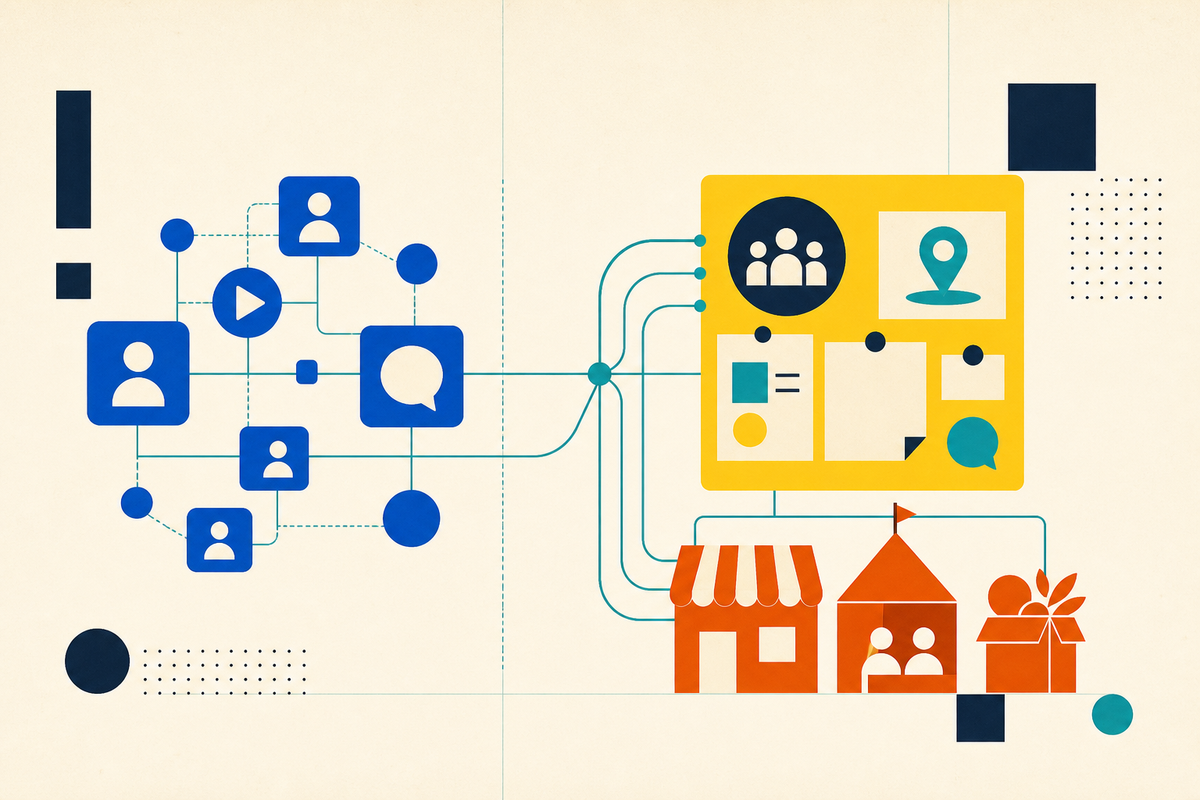
Groups, Events and local discovery turn shared identity or geography into an operating community.
Marketplace adds nearby supply, identity and messaging to an otherwise ordinary classified listing.
Reels, Pages and professional tools give creators distribution, feedback and several eligible earning formats.
Long-lived profiles and relationships give the network a store of personal context newcomers cannot manufacture.
If you spend time on Facebook, that time should make your life off Facebook better.Tom Alison, Head of Facebook
AI as the remover of annoying steps
The fashionable way to describe artificial intelligence is as a new destination. Facebook’s more persuasive use is smaller: remove the irritating step between intention and action. Photograph a lamp and get help writing the Marketplace description, choosing a category and suggesting a price. Ask a Group a question and surface relevant answers buried in old posts. Ask Creator Assistant why one video travelled farther than another, without translating a dashboard into plain English yourself.
Translation offers the cleanest connection to the original mission. By June 2026, more than half a billion Facebook users were watching AI-translated videos weekly. The system can translate speech while attempting to preserve the creator’s tone, with optional lip synchronization. That gives a cook, comedian or mechanic access to audiences beyond the language in which the clip was recorded. It is also a reminder that recommendation software now decides which strangers enter a user’s feed. The friend graph remains, but Facebook increasingly behaves like an interest network too.
Video is central to that shift. In 2025 Facebook said all new video uploads would become Reels, simplifying a tangle of formats while retaining audience controls. Longer clips have not disappeared: videos over a minute accounted for more than half of watch time among Reels made by creators with at least 10,000 followers. Facebook is competing with TikTok and YouTube without pretending every viewer wants the same length.
The business beneath the product remains advertising. Marketers buy impressions or actions such as clicks, directly or through agencies and resellers. In 2025 Meta generated $196.18 billion in advertising revenue across Facebook, Instagram, Messenger and third-party apps, against $200.97 billion in total revenue. Meta does not disclose Facebook as a standalone revenue line, so precision beyond the family level would be false confidence.
Meta total revenue / USD billions
Parent-company figures. Advertising supplied about 97.6% of Meta’s 2025 revenue.
Users are not the customers in that transaction, but calling them simply “the product” misses the exchange. People receive communication, entertainment, discovery and utility without a standard subscription. Advertisers receive access to attention plus measurement. Facebook’s expertise is operating the market between them: ranking content, predicting relevance, running auctions, measuring outcomes, policing abuse and serving the result quickly across wildly different devices and networks.
The advantage and the bill
Scale gives Facebook uncommon leverage. Meta’s Family of Apps averaged 3.58 billion daily active people in December 2025, though that figure combines Facebook, Instagram, Messenger and WhatsApp. The company employed 78,865 people at year-end and spent $57.37 billion on research and development. Its infrastructure, recommendation systems, ad tooling, integrity operations and open-source work such as React and PyTorch represent expertise few social companies can match.
Scale also enlarges every failure. The Cambridge Analytica disclosures made data governance a household subject. In 2019, Facebook agreed to a $5 billion Federal Trade Commission penalty and major changes to privacy oversight. Scams, impersonation, spam and copied content remain product problems because Facebook connects online behavior to real reputations, money and meetings. In 2025 the company removed more than 20 million accounts impersonating prominent creators. In July 2026 it introduced a free Facebook Verified badge based on a selfie check and account standards, particularly relevant to Marketplace, Dating and local Groups.
Trust is a product feature
Identity makes a local exchange more useful. It also raises the cost of getting safety, privacy or enforcement wrong. Facebook’s moat and its largest obligation come from the same source: real people acting in real contexts.
Competition arrives from every direction. TikTok and YouTube contest video time; Reddit and Discord host interest communities; Nextdoor owns a sharper neighborhood premise; Craigslist, eBay and OfferUp compete for listings; Google and Amazon compete for advertising and commercial intent. Facebook differs by joining these modes. A Page can publish a video, promote it, form a Group, schedule an Event, answer customers in Messenger and list an item without rebuilding an audience at each step.
That breadth is not automatically elegant. It creates clutter, overlapping controls and the occasional sense of several eras of the internet stacked on top of one another. But it also resembles a city: not new, never finished, sometimes irritating, and difficult to replace because so many unrelated lives already intersect there.
A network grows into infrastructure
Facebook began in 2004 as a college directory. News Feed turned static pages into a stream. Pages and self-serve ads made organizations legible. Groups gave communities rooms. Marketplace turned informal selling into a product. Reels pulled the app toward entertainment. Now AI is being threaded through the whole construction, less as a single attraction than as electricity in the walls.
The useful lesson is not that every product should become a super-app. It is that distribution can compound into capabilities. Once identity, relationships, messaging, content and local density exist together, a modest new tool can begin with an audience and context already waiting. Marketplace did not have to invent the people who buy used bicycles. They were discussing bicycles in Groups.
Facebook’s second act, then, is not a comeback to cultural freshness. It is a bet that mature networks can become practical layers of daily life. The app will still show vacation photographs, political arguments and clips from strangers. But its more defensible moments may be humbler: the sold sofa, the translated lesson, the full volunteer roster, the answer from someone nearby who has done this before.