Somewhere in a warehouse, a worker is walking past the same bin for the third time. Nothing is technically broken. The order exists in the warehouse management system. The inventory is where the database says it is. The worker has a scanner. Yet the route is wasteful, the carton is half air, and a supervisor is mentally reshuffling assignments while a forklift blocks an aisle. This mundane mess is Lucas Systems’ market.
The privately held company in Wexford, just north of Pittsburgh, does not manufacture shelving or forklifts. It does not ask a distributor to rip out SAP, Manhattan or another warehouse management system. Lucas sells the layer in between: software that turns orders and inventory data into the next useful action for a person, a mobile device or a robot.
Its central character is Jennifer, an assistant that began directing warehouse work by voice in 1998, years before consumers started chatting with Siri or Alexa. Today Jennifer is less a disembodied voice than an operating brain. She batches orders, calculates pick paths, sends instructions to Android devices, listens for spoken confirmations, watches work through scans and RFID, recommends where products should live, and helps decide how cases should be stacked on pallets. Managers see the progress in a web console.
The product is not voice. It is fewer bad decisions.
“Voice picking” is the convenient label. A headset tells a worker where to go and what quantity to take; the worker speaks a short code to confirm the slot. Hands stay on the case and eyes stay on the aisle. But voice alone is easy to mistake for a nicer replacement for paper. Lucas’s more consequential claim is that it can improve the work before speaking it.
Consider travel. In a conventional system, orders may be released in waves and picked in a sequence that looks tidy in the database. On the floor, that can mean repeated visits to one location, long returns to a staging point, or two pickers taking overlapping tours. Dynamic Work Optimization uses order priority, product clustering, worker location and a map of the building to group and sequence tasks again. Lucas says the latest version also accounts for the drag created by forklifts and cherry pickers.
The economic bet is simple: a few seconds saved per pick become serious money when the counter is moving millions of times a day. Founder and CEO Rick Brown said in 2024 that workers made nearly 17 million daily picks with Lucas technology. The company announced its cumulative 100 billionth pick that May; a 2026 partnership announcement put the count above 112 billion.
What failed first: the workaround
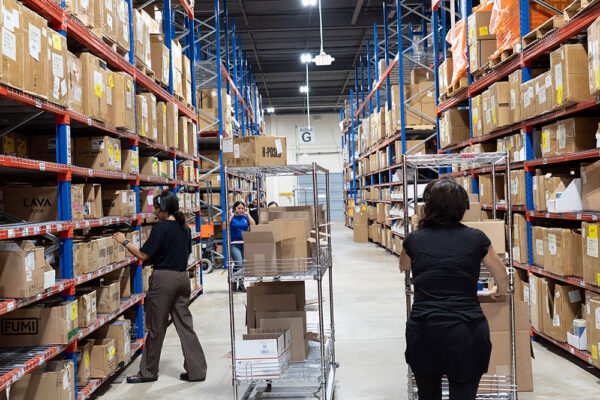
Lucas’s customer stories tend to begin before a spectacular failure. The first thing to crack is usually a workaround. Eby-Brown, a convenience-store distributor, was running paper processes and manual exceptions before adopting Jennifer. Southwire installed a new WMS, then watched productivity fall and added labor. Medusa Distribution first replaced paper picking with Deposco’s WMS and RF scanners. As order volume and complexity grew, packing judgment and pick routes became the next constraint.
Those examples explain what changes a buyer’s mind. It is rarely a sudden affection for artificial intelligence. It is the recognition that a WMS can accurately record the warehouse and still leave too much judgment in the aisle. At Veritable Vegetable, which handles split cases of organic produce, executives said Lucas won because its team understood the industry and could adapt to the company’s peculiar two-stage process. At The Container Store, employees preferred Jennifer’s human voice, five-minute voice training and adjustable prompts. The users helped choose the tool.
“Once we implemented Jennifer, we’ve pretty much had zero mistakes. It’s pretty incredible.”Operations director, Direct Relief
Direct Relief offers the cleanest picture of the mechanics. Medical supplies bring lot numbers, audits and expensive mistakes. Jennifer routes a worker to a bin, calls the quantity, then asks the worker to speak the last three digits of the manufacturer’s lot number. The software verifies that response almost instantly. The nonprofit reported a 20 percent increase in picking accuracy within a month and later extended Lucas into cycle counting, putaway and bin transfers.
At Medusa, the more revealing number was movement from 100 to 140 pick faces per hour. Lucas supplied voice-directed picking and live routing; Perseuss supplied cartonization; Deposco remained the WMS. Together, the systems selected a box, guided the pick directly into the final shipping carton and produced the shipping label. One handling step disappeared. This is how Lucas prefers to compete: as connective software, not an all-or-nothing stack.
Now the pallet gets a vote
In 2024 and 2025, Lucas widened the decision surface. Dynamic Slotting recommends which products should move closer together or farther apart, drawing on velocity, seasonality, item size, pick history and even the risk of confusing similar products. Dynamic Pallet Builder weighs dimensions, stacking rules, route order, safety, damage and travel. Best Pallet Matching chooses which two or three pallet orders belong in the same assignment.
The amusing part is how quickly a wooden rectangle becomes a data-science problem. Put heavy cases too high and the load becomes dangerous. Pick stops in the wrong sequence and workers handle the same case twice. Group pallets for the same store because it is administratively convenient and the selector may walk much farther than necessary. Lucas says its builder makes thousands of calculations a minute and recomputes as new work arrives.
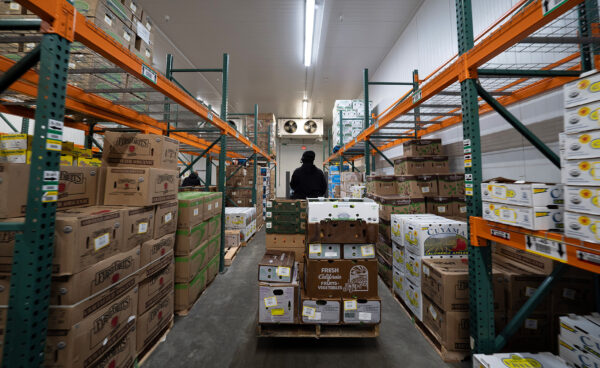
Veritable Vegetable tailored that logic to its trucks and delivery routes. The distributor reported 40 percent fewer errors, 60 percent fewer customer credits linked to those errors and 49 percent less paper - an estimated 23 trees a year. Those are the kind of outcomes that make “AI” feel less abstract: fewer replacement trips, fewer sheets on clipboards and fewer incorrectly built orders.
The bargain in the middle
Lucas occupies an interesting market position. Honeywell’s Vocollect made voice a warehouse standard. Zebra owns a broad mobility ecosystem. Blue Yonder, Manhattan and major ERP vendors sell their own execution and labor modules. Robotics companies promise to move goods with less human travel. A warehouse can also do nothing beyond improving its paper or scanner routine.
Fixed automation
High throughput for known flows, but often expensive to reconfigure when the assortment, layout or demand pattern changes.
Lucas’s software layer
Uses existing systems, devices and automation, then changes assignments and guidance as the live operating picture moves.
Lucas’s answer is hardware flexibility and warehouse-specific implementation. Jennifer runs on supported Android devices, communicates in more than 30 languages, and can mix voice with scanning, screens, smart glasses and RFID. The company’s newer Vecna Robotics partnership puts voice into a workflow where co-bot pallet jacks handle transport while people stay in smaller picking zones. Earlier work with Fetch Robotics followed the same logic: Lucas wants to be the translator between enterprise software, workers and whatever machine rolls in next.
That model also explains the business. Lucas is enterprise B2B software, sold with analysis, configuration, integration and implementation services. Public list pricing does not exist because the warehouse, modules, interfaces, devices and workflows change the job. The cost argument is therefore made through labor hours, errors, throughput and avoided capital. Eby-Brown said its voice system had already paid for itself before a later SAP migration. Resnick Distributors reported a 30 percent reduction in labor costs. These are customer and company accounts, not universal guarantees.
Where the math stops cooperating
A dynamic optimizer needs timely orders, credible inventory and repeatable confirmations. It has little leverage in a tiny operation where travel is trivial, in a building whose main limit is physical storage or dock capacity, or where integrations cannot return live data. Software can reroute around a forklift. It cannot widen the aisle.
The part worth copying
The useful lesson is not “buy a headset.” It is to measure the quiet waste before ordering machinery. Count steps per line, repeat visits to a slot, time to train a new worker, corrections per order and touches between pick and ship. Then pilot one constrained workflow. Direct Relief began with outbound distribution before expanding. Medusa connected three specialist systems instead of forcing one vendor to do everything. Veritable Vegetable kept its unusual split-case process and configured the software around it.
Lucas has lasted because it kept the human interface while steadily enlarging the decision underneath. Voice was sensible in 1998 because warehouse workers needed both hands. It remains sensible in 2026 for the same physical reason. The new opportunity is everything Jennifer can calculate before she speaks: the route, the batch, the slot, the pallet, the available robot and the tradeoff that changed two minutes ago.
The grand language of warehouse automation often imagines a dark building with no people. Lucas’s version is less cinematic and more plausible. The lights stay on. A worker listens, answers and keeps moving. The achievement is not that the warehouse talks. It is that, occasionally, it knows when to change its mind.