There is a peculiar moment in learning another language. You understand the person on the screen. You recognise the joke, follow the argument, catch the unfamiliar word from context. Then someone asks what you think. Suddenly, the language you understood so comfortably becomes difficult to assemble. EnglishCentral has built its product around that uncomfortable handoff, from recognising English to producing it.
- Short videos supply the subject; vocabulary and pronunciation tools supply the rehearsal.
- MiMi, an AI tutor, and live teachers turn that preparation into conversation.
- Individuals subscribe; schools and employers buy learning access and reporting tools.
The missing half of a video
Start with a clip that interests you. Mark words you do not know, practise them, then record yourself speaking lines from the video. EnglishCentral gives pronunciation and fluency feedback. You can discuss the subject with MiMi or take it into a live lesson. The company’s current homepage advertises more than 30,000 video lessons, with material matched to a learner’s level and interests.
That sequence explains its appeal more clearly than the label “AI-powered.” The video supplies a shared subject. A learner arriving at a conversation has already met some of the vocabulary and heard it used. There is something to say before the difficult business of saying it begins. Think of the clip as a small social convenience: it removes the need to invent a topic while also inventing sentences.
EnglishCentral calls this its “YouTube for Language Learning” approach. Its published pedagogy places motivation first: people need material interesting enough to keep practising over time. The useful distinction is the work attached to the entertainment. Watching another clip is easy. Recording an answer asks the learner to participate.
A microphone meets a teacher
Founder Alan Schwartz’s background helps explain the combination. His conference biography describes teaching English in China before working in speech technology, including at Nuance. In 2009, with Google Ventures’ support, he founded EnglishCentral. The classroom and the speech engine were both there in his career before they met in the product.
The company took a concrete step toward human instruction in September 2015, announcing its acquisition of online tutoring company Langrich. The consideration was shares: Langrich’s investors exchanged their holdings for EnglishCentral stock. The combined offering connected video preparation with private online lessons. A learner could study a particular video and then book a conversation about it.
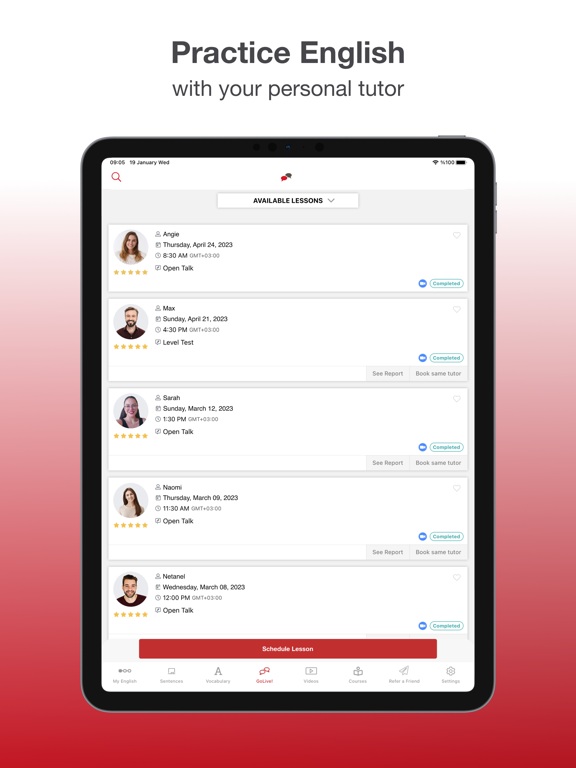
Today, private lessons run 25 minutes; the homepage also describes 40-minute group lessons. This gives EnglishCentral a position between a self-study app and a tutoring service. Someone can practise independently, then meet a teacher within the same learning system. For a buyer comparing subscriptions, the amount of teacher time included matters as much as the video catalogue.
Alternatives overlap. ELSA offers pronunciation feedback; Cambly offers live tutoring. EnglishCentral’s distinctive organising device is the video: it provides material for vocabulary work, recorded speech, and the conversation that follows. The appeal is having those activities connected.
Give the bot something to talk about
In spring 2023, EnglishCentral introduced a ChatGPT-powered version of MiMi, combining generative language models with its IntelliSpeech speech technology. Its launch demonstrations included conversations about Brad Pitt at the Oscars and Karlie Kloss discussing coding. These are pleasingly specific choices. The learner is invited to respond to a person or an idea, rather than confront an empty chat window.
A September announcement described questions that asked learners to share opinions, connect a video with their own experience, and practise tasks aligned with CEFR language levels. This is a different demand from repeating a recorded line. A pronunciation exercise offers words to reproduce; a conversation asks the learner to choose them. EnglishCentral now offers both kinds of practice.
My reading of the design is that context does much of the useful work. The chatbot has a topic, and the learner has just prepared for it. Product teams can borrow that principle without building a language school: make the next task use something the customer has already done.
The textbook is a distribution channel
EnglishCentral also sells through institutions. In December 2016, Japanese educational publisher Kirihara Shoten announced a $1.3 million strategic investment and an agreement to integrate EnglishCentral with textbooks used in more than 400 high schools. The distribution was as interesting as the funding. Speaking practice could reach classrooms through materials teachers already used.
“you can’t learn to actually speak English just from a textbook alone”
Satoshi Saito, Kirihara CEO · 2016 investment announcement
The company reports adoption by more than 1,000 schools, universities, and corporations across over 100 countries. A separate March 2023 announcement described a programme for more than 4,000 public-school English teachers in Brazil’s Paraná state. These are company-reported adoption figures, rather than evidence that every participant achieved a particular proficiency gain.
Employers buy another layer: customised study plans, business topics, and progress reporting through a learning management system. TestCentral, introduced in 2025, adds assessment options, including PROGOS speaking and Versant tests. The institutional customer wants practice to happen, but also needs a way to assign it and see what happened afterwards.
A rehearsal for the next real conversation
Consumer pricing depends on subscription length and weekly private-lesson frequency. School buyers request quotes. That structure makes comparisons personal: a learner seeking frequent tutoring is buying a different mix from someone mainly interested in independent practice. The sensible unit of comparison is the combination of usable content, feedback, and lesson time.
The latest additions carry the approach into more situations. EnglishCentral announced its Kids iOS app in May 2026, Science for Kids in June, and a beginner Meeting Basics course in July. The meeting course covers introductions, clarification, and sharing simple opinions. Each supplies a reason to speak beyond completing an exercise.
A learner can copy the routine: choose one manageable clip, prepare unfamiliar words, speak aloud, then discuss the idea. The limitation follows from the same design. A completed video or a pronunciation score cannot by itself establish ease in an unscripted conversation. The rehearsal earns its keep when the learner eventually has something to say, and says it.
Press play. Then answer back.
Explore the platform and see the practice in action.