Amin Mousavian had introduced his colleague. Loui Anastasopoulos took the stage at TMX’s 2024 investor day and allowed himself a small correction to the usual corporate script. “He was practicing my name yesterday,” he said. They had worked together for 15 years. The surname, apparently, still required rehearsal. It was an agreeable way to begin a presentation about capital formation: a reminder that even in a business full of abbreviations, people have names.
Then came the business. Anastasopoulos, CEO of Toronto Stock Exchange and Global Head, Capital Formation, described growth in three directions: outside Canada, beyond corporate issuers, and beyond listings. The last of those is particularly revealing. An exchange can put a company on its market. Anastasopoulos’s career invites a longer question: what happens to that company after the celebratory photographs?
The bell has an excellent publicist. The work that follows has rather less theatrical assistance. Shareholders need information. Companies need services. A business that has raised money once may need to raise it again. Much of his professional life has concerned those continuing relationships, which makes him an interesting guide to the days when nobody is cutting a ribbon.
The shareholder’s side of the desk
Anastasopoulos joined TMX in 2006. Before that, he worked at Scotia McLeod, National Bank Financial and a Toronto-based financial services start-up. He graduated from the University of Toronto. At TMX, his roles included relationship management, product development and global business development. Later, he led TSX Trust, the corporate trust, transfer agency and registrar business.
Those responsibilities bring an executive close to the administrative life of a public company. A share represents ownership, but that ownership has to be recorded and serviced. Corporate decisions have to reach the people entitled to vote on them. It is easy to admire a company’s ambition. Making its relationship with thousands of owners function is a different sort of accomplishment.
In April 2017, TMX announced a blockchain-based shareholder-voting prototype developed with Accenture for TSX Trust. Its purpose was specific: improve the efficiency and accuracy of annual-meeting votes and make participation easier. It was a prototype, with ambitions for a working process rather than proof that every shareholder meeting had suddenly changed.
A separate project that year made the practical question even clearer. TSX Trust collaborated with Lumi on a fully virtual annual and special meeting for a Canadian public company. Attendance and voting were authenticated and validated in real time. Anastasopoulos was then President of TSX Trust and Managing Director of TSX Company Services. The fashionable technology words were present. So was the old-fashioned obligation to count properly.
Taking Toronto on the road
On January 16, 2018, his remit expanded. He became President, Capital Formation & TSX Trust, taking responsibility for the listing functions of TSX and TSX Venture Exchange, company services and the trust business. Work that had included supporting public companies now also included persuading more companies to become clients.
By June, the Canadian exchanges were taking their public venture capital pitch to California. A roadshow travelled through San Francisco, Irvine and Santa Monica. Exchange representatives appeared alongside advisers from Canadian investment banks, accounting firms and law firms. The audience was early-stage US businesses considering how to finance growth.
The proposition depended on a useful peculiarity of Canada’s market: a venture exchange alongside a senior exchange. Smaller companies can enter public markets at an earlier stage and, if they develop sufficiently, move toward TSX. The roadshow offered entrepreneurs a chance to examine that route with people who worked inside it. Anastasopoulos described the US market as both a challenge and an opportunity.
A year later, discussing Mexico, he returned to the people around the market. His explanation of Canada’s mining appeal included lawyers, bankers, investors and a regulatory framework familiar with resource companies. In that interview, he said 126 companies with properties in Mexico were listed across the two exchanges. The distinction matters: those were companies with Mexican properties, a wider group than companies headquartered in Mexico.
The exchange’s address could remain in Toronto while the work reached well beyond it. A project has a location. The investors and specialists who can help assess it may be elsewhere. His international pitch followed that practical separation, making a case for bringing companies and capital into the same conversation.
A market’s favourites change
In February 2022, Toronto Stock Exchange opened trading from the Communitech Hub in Kitchener, the first such opening in Waterloo Region. Anastasopoulos spoke about the growth of technology companies there and across Canada. Communitech’s announcement pointed to D2L, Magnet Forensics and Thinkific, which had listed on TSX the previous year. The ceremony gave the exchange’s company-development argument a local setting.
It also supplied a useful contrast with the next year’s conversation. At the unveiling of the 2023 TSX Venture 50, mining and energy companies were prominent, while technology companies faced a more difficult market. Anastasopoulos discussed the change as part of the market cycle. He pointed back to 2021, when the technology sector’s market capitalization on TMX’s markets had, at one point, overtaken mining.
A person selling the merits of a market has to discuss both kinds of year. The promising company from yesterday does not receive a permanent exemption from changing investor tastes. His commentary kept the technology-company foundation in view while acknowledging that the money was finding different favourites.
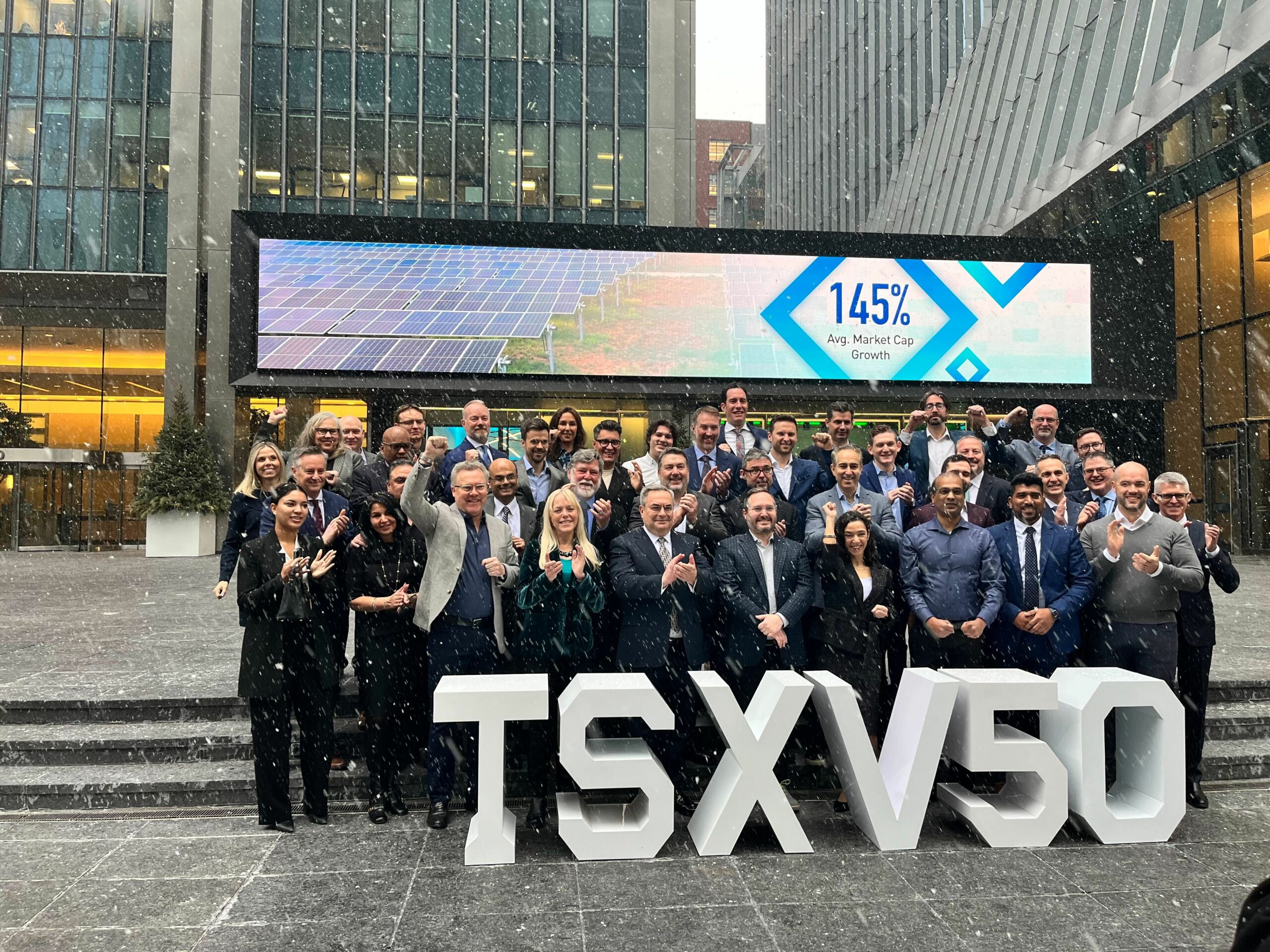
In a separate 2023 discussion of the Venture 50, he connected investor interest in critical minerals with the materials required for changing energy systems. Copper and lithium were among the examples. By February 2024, the next Venture 50 offered another view of that interest: its mining companies had posted substantial average gains in market capitalization and share price during 2023.
These recognition programs put faces and company names on market statistics. They also select successful performers. Reading them with that distinction intact gives his commentary more meaning: he is explaining where interest has appeared, rather than describing a result available to every company on an exchange.
The business behind the listing business
In August 2024, TMX acquired Newsfile, a provider of news distribution and regulatory filing services. Established in 1997, it served more than 2,500 public and private clients at the time of the announcement. Anastasopoulos placed the acquisition within the effort to “expand our offerings beyond listings.”
That phrase translates into fairly concrete work. A company has announcements to distribute and documents to file. Newsfile’s offering included SEDAR+ in Canada, EDGAR in the United States and XBRL filing solutions. Those tasks continue long after a market debut. Adding the business meant extending the services TMX could offer during that continuing public-company life.
TMX’s subsequent management circular credited Anastasopoulos with completing the deal. It also identified progress on private-company solutions through Markette Ventures, a joint venture with Canaccord Genuity, including an exempt market dealer licence secured ahead of a planned launch. Together, those developments describe a wider ambition: relationships with companies can begin before listing and continue through their recurring obligations afterward.
For someone whose earlier work included shareholder services, the connection is easy to see. The exchange group is trying to stay useful at more points in a company’s development. The opening-day photograph remains desirable. So does a filing completed on time.
“company-building must also be a national priority”
Loui Anastasopoulos, September 2026
The invention predates the executive
Another part of his remit comes with a history older than his TMX career. In March 2025, Toronto Stock Exchange celebrated 35 years of ETF innovation. The Toronto 35 Index Participation Units, known as TIPs, launched in March 1990 and provided a prototype for the modern exchange-traded fund.
Anastasopoulos used the anniversary to discuss how that Canadian invention changed the way investors interact with markets. The exchange’s account of the history included its first fixed-income ETF in 2000 and the first Bitcoin ETF in 2021. The dates keep the credit in the right place. His work is to support the continuing franchise, with earlier innovations inherited rather than personally invented.
It is a different customer relationship from attracting an operating company to list its shares. Fund providers bring products intended to give investors particular forms of market exposure. An exchange’s capital formation business has to understand those clients too. His investor-day discussion had explicitly included growth beyond corporate issuers. The anniversary supplied a tangible example of what that meant.
Fifteen graduates, one larger argument
In September 2026, the TSX30 announcement gave Anastasopoulos a number that suited his company-building argument. Half the 30 ranked companies had graduated from TSX Venture Exchange. That meant 15 names in a selected group of performers had come through the venture market before appearing in the senior exchange’s ranking.
Companies in the 2026 TSX30 that graduated from TSX Venture Exchange.
A selected performance ranking, not the graduation rate of all venture issuers.The ranking measured three-year dividend-adjusted share-price performance. Its companies recorded average returns of 785% and collectively added $225.7 billion in market value over the measured period. Those are figures for the ranked companies, not a return for the entire exchange. Anastasopoulos’s larger point concerned the route that some of those businesses had travelled.
At the September 9 market close, he joined representatives of the companies to celebrate the results. Here was the ceremony again, but with a longer history attached: smaller public businesses had become companies recognised on a senior market. It gave his argument about supporting growth a set of identifiable examples.
His own working history follows a similarly connected sequence of responsibilities. Shareholder relationships, company services, international business development and exchange leadership each concern a different part of the same journey. Taken together, they explain why his public-market story keeps returning to what companies need next.
The colleague who rehearsed his surname got a friendly joke. The companies receive a more demanding proposition: enter the market, meet its obligations, and use the capital to build. A bell can mark a beginning. Anastasopoulos’s work concerns how much useful life follows the sound.