Imagine buying a security and then waiting for the machinery behind it to catch up. The trade is agreed. Ownership must change. Money must move. Records must reconcile. In private markets, these chores can occupy days or weeks. Ironlight Group has chosen this interval as its business opportunity. The glamorous object is a blockchain token. The useful question is what happens after someone agrees to buy it.
- The business: issuance, trading and lifecycle infrastructure for institutional tokenized securities.
- The milestone: ATS approval announced in October 2025; a $21 million Series A followed in March 2026.
- The test: make existing financial products easier to administer without expecting institutions to abandon familiar workflows.
That question gives Ironlight a particular place in financial technology. It serves asset managers, issuers, brokers and investment advisers. Its offering connects the creation of a digital security with distribution, secondary trading and the work that continues throughout the asset’s life. A token can be produced remarkably quickly. A functioning market requires rather more dinner guests.
The transaction has two clocks
Ironlight’s architecture makes a useful distinction. Ironlight Markets is the registered broker-dealer and FINRA member operating the alternative trading system. Ironlight Technologies supplies software, including tokenization and settlement infrastructure. Trading happens through the venue; on-chain settlement happens off the ATS through the technology affiliate. Ironlight Markets’ disclosure says it does not hold investor funds or securities.
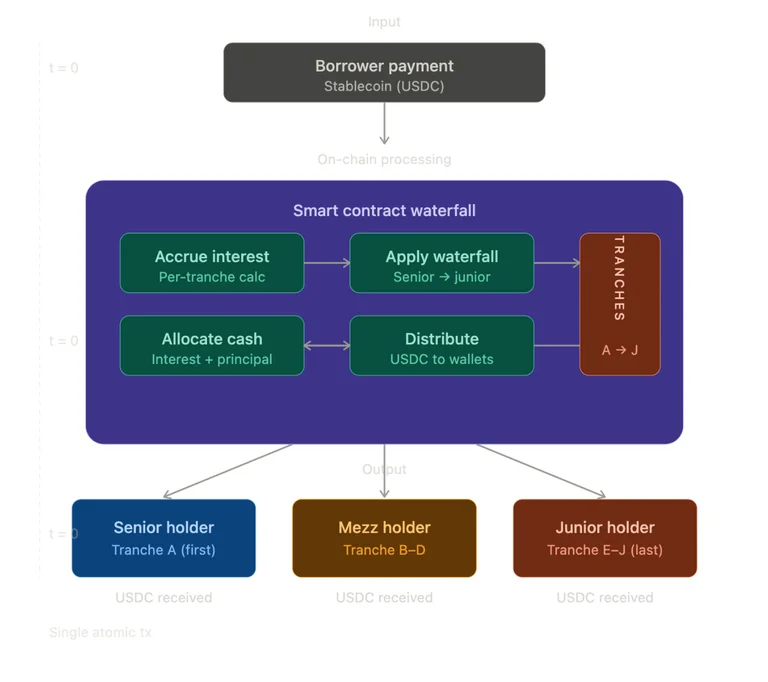
The company advertises order matching below 20 microseconds. That measures the matching engine, not the time required for an entire investment to become final. Atomic settlement addresses a different problem: exchanging the security and payment together. The intended outcome is delivery-versus-payment in a single transaction, where applicable. Wallet approvals, supported infrastructure and the requirements of the particular security still matter.
Security ↔ payment
A conceptual flow, not a measured settlement benchmark.
Its connection to institutional trading systems is deliberately familiar. Banks and brokers can use FIX, the established financial messaging protocol. Continuous trading and requests for quotes accommodate different market conditions. The interesting design choice is the mixture: a centralized order book connected to blockchain settlement. Institutions can bring existing systems to the door.
A banker’s route to blockchain
The founders’ experience helps explain that choice. CEO Rob McGrath previously led global trading at Schroders and the Abu Dhabi Investment Authority. President Matt Celebuski founded Trade Informatics, the trading analytics business sold to Abel Noser in 2021. CTO Jake Moilanen brings an IBM engineering background. This is a team approaching blockchain with memories of how established markets actually operate.
Greg Braca, the former TD Bank president and CEO, joined as adviser and board member in 2024 and became executive chairman in February 2026. The following month, Ironlight announced its $21 million Series A, backed by Braca, Sei Development Foundation and Laidlaw Private Equity. The stated use of proceeds was expansion of the ATS and technology infrastructure. Financing buys the capacity to build; it does not certify demand.
“Ironlight Group was built to modernize core market systems in a way institutions can adopt.”Rob McGrath / March 2026
The sequence matters. Ironlight’s public platform announcement came in May 2024. Its company timeline records broker-dealer membership in January 2025, followed by ATS authorization in October. Capital arrived after those regulatory milestones. For a business selling access to regulated institutions, permission to operate is part of the product’s usefulness.
When the coupon is due
April 2026 supplied a more tangible example. Halo Investing and Ironlight announced a collaboration to tokenize and list structured notes. Halo would handle pricing and management on its platform; Ironlight would provide the digital securities infrastructure. The proposition was reduced administrative complexity and broader availability for eligible investors. Each company brought a different part of the transaction.
Structured notes are an instructive proving ground because issuing them is only the beginning. Payments can depend on an underlying asset. Redemption must follow the terms. Someone has to calculate, distribute and record the result. Ironlight’s technical writing describes smart contracts that distribute received cash to holders’ wallets, with agent oversight available. Automation can preserve a familiar investment experience while changing the work behind it.
Twenty-six reasons to slow down
A smaller episode reveals the company’s engineering habits. In a March 2026 account, engineer Ryan X. Charles described migrating 155 software components from Svelte 4 to Svelte 5. The automated tool handled 129. Twenty-six remained. The shortcut had reached its limit.
The team used successive experiments to resolve the remaining components, dependencies and critical user flows. The practical lesson is portable: test a proposed shortcut against your actual constraints, record the gaps, then investigate them before committing. Ironlight calls its approach research-driven development. For software touching financial transactions, the decision record has value alongside the finished code.
The market still needs people
Ironlight’s commercial offering spans tokenization services, secondary trading and white-label infrastructure. An institution can deploy a branded investor portal and connect to the underlying stack. Its business model is B2B infrastructure and financial services. Issuers supply assets; intermediaries bring relationships and distribution. Competitors such as Securitize Markets and tZERO Securities also occupy regulated digital-securities territory. Ironlight’s pitch centers on connecting familiar execution workflows with on-chain settlement.
The constraint is plain. A transferable token does not guarantee a willing buyer. Eligibility rules, custody arrangements and the quality of the underlying investment still govern participation. Ironlight itself states that admission to its ATS does not guarantee trading or liquidity. Its proposition makes sense when institutions have suitable assets, approved participants and operational reasons to connect. Without counterparties, faster plumbing merely empties into a quieter room.
For an issuer or adviser, the useful starting point is a specific transaction: who may own this security, how will payment arrive, and who handles its next distribution? Ironlight is selling the machinery that connects those answers. The measure of success will be how much useful business passes through it.