A Galaxy shareholder can ask a brokerage to move shares into direct registration, complete Superstate’s onboarding, and receive those shares in a Solana wallet. The wallet looks like crypto. The asset inside it remains Galaxy’s Class A stock, with the same legal and economic rights. The curious part is how much ordinary financial machinery must cooperate before that apparently simple token appears.
- Superstate connects investment ownership to public blockchains.
- FundOS serves asset managers; Opening Bell serves equity issuers.
- Approved wallets and fund rules still govern what investors can do.
Superstate’s bet is that this machinery deserves a redesign. Robert Leshner, previously a co-founder of Compound Labs, started the company with Jim Hiltner and Dean Swennumson in 2023. Hiltner brought institutional sales experience; Swennumson brought operations and wealth-management experience. Their proposition pairs crypto’s programmable transfers with finance’s rather less glamorous duty: keeping an authoritative record of who owns what.
The clock inside the token
The first working example was deliberately straightforward. USTB launched in February 2024 as a private fund offering short-duration government-securities exposure to qualified investors. Someone accustomed to holding assets in a crypto wallet could hold a fund share there too. Treasury bills supplied the investment substance. Ethereum supplied a new way to record and move ownership.
But the fund carried a small embarrassment. Its subscriptions and redemptions initially relied on next-day settlement, and interest was calculated by the day. The blockchain kept running while the fund followed the old calendar. In October 2024, Superstate introduced continuous pricing: the displayed net asset value per share advanced by the second, and transactions used that continuous value.
December brought announced protocol minting and redemption for USTB, allowing shares and USDC to be exchanged within an Ethereum transaction. These changes address an operational problem, rather than a taste for fashionable technology. A token becomes more useful in an automated financial system when the processes underneath it can keep pace.
- 01OnboardVerify investor and wallet
- 02RecordMaintain legal ownership
- 03TransferMove within approved rules
The dress rehearsal gets new managers
The company subsequently added USCC, a crypto carry fund launched in July 2024. Its basis strategies seek to exploit differences between spot and futures prices; the fund also uses staking and government securities. This serves a different appetite from Treasury exposure. Its customers are Qualified Purchasers, including institutions that want a managed strategy with an onchain representation.
Then came the revealing handoff. In March 2026, Superstate announced Invesco as its first external asset manager, with USTB becoming an Invesco fund. Bitwise became USCC’s manager from June 1. Superstate continued supplying the infrastructure. The company had tested its machinery with its own products; established managers could now run investments on it.
That machinery is FundOS: a platform connecting shareholder registries, onboarding, subscriptions, redemptions and supported blockchains. Managers can retain existing custodians and service providers. Superstate’s current asset catalogue also includes Coinbase Asset Management’s CUSHY and Valinor’s VBDC. The commercial attraction is an additional distribution channel that fits around a manager’s operations.

A share with its rights attached
Opening Bell, launched in May 2025, takes the same ownership problem into public equity. Superstate works with issuers as an SEC-registered transfer agent. With Galaxy, the September 2025 Solana launch let existing shareholders tokenize actual registered stock. The rights belong to the share; changing its format does not turn the holder into a customer merely betting on its price.
That distinction matters in a crowded market. Securitize also builds regulated tokenization infrastructure. Ondo’s OUSG offers another route to tokenized Treasury exposure. Stock-tracking tokens address a related demand through different legal structures. Superstate’s equity pitch centres on issuer participation and direct ownership records. A familiar ticker alone tells an investor very little about the claim behind it.
“The future of investments are programmable, compliant, and transparent”
Robert Leshner · Series A announcement, November 2023
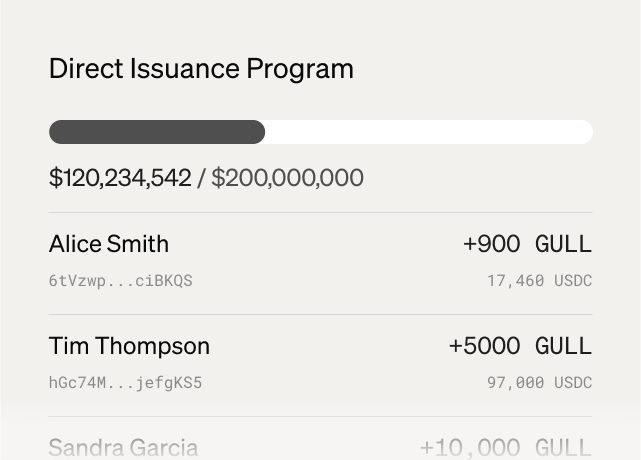
Opening Bell also offers Direct Issuance Programs: eligible public companies can sell new tokenized shares to approved investors using stablecoins. Issuers choose terms such as offering size and price limits. For a finance team, the useful feature is an ownership register that updates alongside issuance and transfers. The programme still requires the appropriate securities documentation.
The price of changing the plumbing
Superstate raised a $4 million seed in June 2023, announced a $14 million Series A first close that November, and closed an $82.5 million Series B in January 2026. Bain Capital Crypto and Distributed Global led the latest round. Those figures describe capital raised, not the cost of building the system. The company reported more than $1.2 billion in fund assets at that announcement.
For investors, USTB lists a 0.15% annual management fee, with a rebate on the portion of qualifying holdings above $25 million; USCC lists 0.75%. These product fees are distinct from Superstate’s infrastructure business. Opening Bell describes fixed administrative fees for direct issuance. The business now sits between asset managers, public issuers and investors, selling the ability to connect their records and workflows.
What survives outside the pitch deck
The practical lesson is to build a working product, notice where yesterday’s processes survive inside it, and repair those processes before offering the infrastructure to others. Superstate’s stated preference for pragmatic, no-hype work fits that sequence. The July 2026 contract-upgrade announcement continued the theme: modular components and simpler permission checks while preserving existing token addresses.
The limits are equally instructive. Allowlisting restricts who can hold and transfer assets. Fast transfers do not create buyers, and a token does not erase a fund’s redemption timetable: CUSHY lists quarterly redemptions. USTB’s protocol redemptions depend on available liquidity and transaction limits. Superstate’s opportunity is substantial wherever investors need these systems connected. The test is whether the connection makes an asset more useful after the novelty of its new address has worn off.