Consider a maintenance queue. One aircraft needs a part. Another needs a technician. A third is ready, except that its inspection slot belongs to the first. Add more technicians and perhaps nothing changes. Buy more parts and perhaps the queue merely moves. The expensive question is which intervention gets more aircraft flying.
That is an illustrative problem, not a reported customer incident. It captures the territory occupied by Lone Star Analysis: decisions whose consequences travel through a system. The Texas company sells software and expertise for investigating those consequences before a customer spends money, changes a schedule or commits to a bid.
- The work: simulate alternatives, forecast outcomes and recommend actions.
- The distinction: engineering knowledge and visible uncertainty can matter as much as historical data.
- The buyers: defense, aerospace and industrial organizations with costly operational choices.
- The new turn: Designer IQ applies generative AI to physics-based aerospace designs.
The average is a lovely fiction
An average task time makes a schedule look wonderfully civilized. Each job takes its allotted interval; each successor starts politely on cue. Actual maintenance introduces missing components, variable repair times and shared equipment. A modest delay in one place can become an imposing backlog somewhere else.
Lone Star’s TruProcess software addresses those complications by modeling task dependencies, uncertain durations and constrained resources. It asks where work piles up, how labor is used and which costs drive the process. The point is to compare possible changes while allowing inputs to vary. A tidy estimate may be easy to present. A range of possible outcomes is more useful when tomorrow declines to cooperate.
The company’s broader approach uses stochastic simulation: run the model across different possible conditions and examine what happens. For a planner, the useful answer may include both a likely result and its uncertainty. It may also reveal which assumption deserves further investigation. Buying information can then become a decision of its own.
expert knowledge
possible decisions
practical actions
An engineer before a data lake
Steve Roemerman’s background helps explain the company’s tastes. Before co-founding Lone Star, he worked at Texas Instruments and Raytheon. His career included systems engineering, program management and leadership of technology and weapons businesses. His biography lists work involving satellite navigation, communications and the F-117. These are environments where a relationship between physical components can matter more than a fashionable chart.
Roemerman started Lone Star with Matthew Bowers and John Volpi. Its histories date the business to 2004. Bowers is now president and chief operating officer; Eric Haney became chief technology officer after Volpi announced his retirement from that role in 2018.
In a 2021 interview, Roemerman described an early constraint: a small staff could not offer a broad range of services to a broad range of customers on its own. The response was to supplement employees with a larger pool of specialists. The company now describes a network of more than 1,500 subject matter experts. That figure describes expertise available to inform models, rather than payroll headcount.
Oilfield analytics provides a concrete example of the method. In published interviews, Lone Star executives described using knowledge of motors, pumps, fluids and electrical losses to build models, then applying machine learning where site-specific unknowns remained. Sensor streams arrived through existing monitoring systems, including ABB tools. The company supplied analysis; connectivity remained a separate part of the installation.
Here, the first difficulty is already present before the analytics begins: sparse measurements from equipment operating in an awkward place. A model informed by physics has something to work with even when the training data is meager. That makes the quality of the engineering assumptions especially consequential.
A range of possible outcomes is more useful when tomorrow declines to cooperate.THE DECISION PROBLEM
Four tools for expensive questions
TruNavigator MAX is the foundation. Generally available since February 2024, it brings earlier TruNavigator and AnalyticsOS capabilities together, with planning simulations, real-time asset analytics and Evolved AI. Models are built through a graphical interface. Lone Star describes deployment options spanning cloud, on-premises servers and lightweight processors at the edge.
The platform’s advertised transparency is central to its proposition. Customers can inspect equations, interconnections, inputs and documentation. A maintenance manager should be able to ask why a recommendation changed. An analyst should be able to identify the assumption behind it. Lone Star calls this a “glass box” approach. Transparency is useful because a surprising answer needs a route back to its reasoning.
MaxUp
Applications for fleet inventory, training, maintenance staffing and sustainment. ORDAIN addresses digital-twin maintenance analysis; MRO2 models maintenance and production processes.
TruProcess
Explore bottlenecks, resource limits and uncertain task times before changing a process.
TruPredict
Compare pricing strategies and competitor behavior for capture teams pursuing contracts.
TruPredict tackles another uncomfortable unknown: what someone else will bid. Its scenarios incorporate competitive positioning, risk tolerance and alternative strategies. The practical buyer might be a capture manager or pricing analyst who needs to change assumptions quickly. Software sits alongside Lone Star’s competitive intelligence, market research and strategic pricing services.
The customer brings a mission
Lone Star occupies the intersection of enterprise analytics, engineering simulation and specialist consulting. Its website emphasizes aerospace and defense, military and intelligence users, and international allies. Energy, transportation, logistics and industrial operations also appear in its published work.
Its homepage lists ABB, Raytheon, Lockheed Martin, L3Harris and the FAA among organizations that trust it. The UK subsidiary names the UK and Norwegian defense ministries in its European customer base. In July 2025, the company reported supporting more than 2,000 military aircraft globally. That is a company-reported scope of support, not a count of software seats or a measure of aircraft availability.
Military aircraft supported globally
Company-reported, July 2025
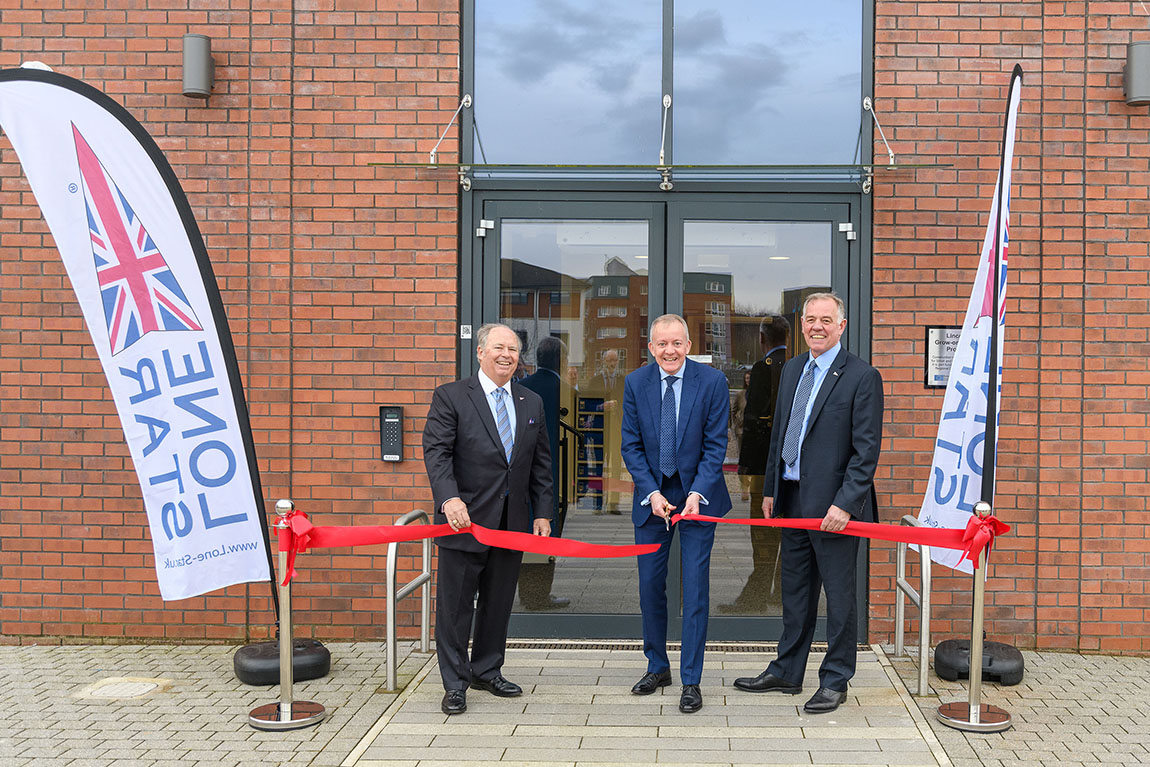
The UK footprint is unusually tangible. In February 2024, Royal Air Force Chief of the Air Staff Sir Richard Knighton opened Lone Star’s new Lincoln headquarters. Managing director Robin Adlam described the location’s proximity to RAF customers and the University of Lincoln as advantages. The subsidiary announced ISO 9001 quality-management certification in July 2025.
Capital arrives after the customers
The business model combines enterprise software with services: build a model, deliver an analytical engagement, support engineering work or supply an operational application. Product pages invite demonstrations and direct conversations. Those conversations matter because a fleet-maintenance problem and a contract-pricing problem require different expertise, inputs and implementation work.
HCAP Partners announced an investment in October 2019 and a follow-on in September 2021. Both deal values were undisclosed. The funding was intended for growth and research and development of enterprise software. In the follow-on announcement, Roemerman said the company had roughly doubled in size since HCAP’s initial investment.
The company later reported 83% revenue growth from 2020 to 2023 and a fourth consecutive Inc. 5000 appearance in 2024. Growth gives the story scale; it does not tell a buyer what a particular implementation will earn. The relevant cost calculation still includes software, specialist modeling, integration and the work required to act on recommendations.
The collaboration has an internal expression, too. Careers materials describe a “Zero Jerk Factor,” cross-disciplinary teamwork, chili cook-offs and theater outings. The phrase is amusing; the requirement behind it is practical. A model combining engineering, finance and operations needs experts who can disagree without making cooperation impossible.
Now the model can propose the aircraft
Designer IQ, launched in July 2026, extends this approach into generative design. Given incomplete information such as imagery, estimated dimensions or observed performance, the company says the product can construct physics-based representations of missiles, unmanned aircraft and other air vehicles. Analysts can examine estimated aerodynamics, propulsion, mass and flight performance, then revise the representation as information arrives.
The proposed output is an engineering hypothesis with consequences that can be explored. For threat assessment, multiple interpretations may be more useful than a single confident guess. For design work, the same machinery can compare concepts against objectives and constraints.
Another 2026 announcement concerned a patent for Vigorous Artificial Intelligence. Lone Star describes a method for coordinating multiple AI agents and balancing their perspectives as costs, benefits, risks and context change. A patent establishes protected intellectual property. Operational performance remains a separate question to assess in deployment.
Borrow the question before buying the software
The useful habit here is available without a purchase. Name the decision. Identify the constraints. Separate measurements from estimates. Replace uncertain point values with plausible ranges. Compare interventions and ask which unknown could change the preferred choice. These are editorial lessons from Lone Star’s approach, rather than a recipe promising its results.
The method needs credible assumptions and a decision someone can actually implement. If a model omits a binding safety rule, misrepresents a physical system or optimizes the wrong objective, more simulation will faithfully multiply the mistake. For a simple, low-cost choice, the effort of building a detailed model may exceed the benefit.
For expensive, connected choices, the attraction is easier to see. A recommendation becomes more useful when the customer can inspect the reasoning, test alternatives and understand the uncertainty. Lone Star’s business begins with that ordinary admission: there are things we do not know. The work is deciding which of them matter.
Explore the models
Company website · TruNavigator MAX · TruPredict · Designer IQ