A commodity forecast is a peculiar object. Everyone in the room wants one. Nobody quite trusts it. Then procurement commits a few million dollars to beef, pork, copper or coal, and suddenly the number on the slide has consequences. DecisionNext lives in that uncomfortable moment. The San Francisco software company takes market data, econometric models, machine learning and the judgment of people who have spent years watching a market misbehave. It produces forecasts, yes, but its real product is a structured argument about what a company should do next.
That distinction matters. A dashboard can tell a buyer what happened to cattle prices. A consultancy can offer a view of where prices may go. DecisionNext tries to connect the view to the transaction: buy now or later, choose spot or formula, lock a contract or remain exposed, cut a carcass one way or another, build inventory or draw it down. Then it keeps the assumptions visible so the decision can survive the Monday meeting and the quarterly postmortem.
The origin story starts with an educated guess
DecisionNext was founded by Mike Neal, Bob Pierce and Graeme Stanway. The company dates its operating story to 2015; LinkedIn lists 2014 as the founding year. Neal had already co-founded DemandTec, the retail pricing software company that became part of IBM, and SignalDemand, a commodity-forecasting business acquired by PROS. Pierce brought theoretical physics and econometrics. Stanway brought strategy work in resource-heavy industries. Their shared target was not the casual stock picker. It was the operating company making frequent, high-value commitments in markets that refuse to sit still.
The first thing to fail was the old decision process. Commodity teams had market veterans, public data, purchased reports and elaborate spreadsheets. They still leaned on gut feel when volatility snapped historical relationships. The founders’ bet was that software could remove some bias without removing the expert. That last clause became the company’s most interesting design choice: users can add their market knowledge, tune models and test assumptions instead of accepting a sealed prediction from a black box.
“Giving these executives powerful tools to simulate markets allows fine tuning of tactics ... while quantifying the risk.”Mike Neal, co-founder and CEO
Three layers, one expensive question
The current platform is organized as MarketView, Enterprise and Governance. The names are dry; the progression is smart. MarketView asks what the market is saying. It places machine-learning, futures-based, fundamentals and cutout-ratio forecasts beside one another, with backtests and accuracy scores. If the lines cluster, a buyer has more reason for confidence. If they split, the disagreement becomes a warning. The platform is not embarrassed by uncertainty. It gives uncertainty a chair.
MarketView
Transparent forecasts, context and model backtests.
Enterprise
Scenarios for timing, price, formulas, margin and mix.
Governance
Market-adjusted execution and enterprise exposure.
Enterprise moves from seeing to choosing. ScenarioLab changes assumptions. DecisionBuilder compares cash flows and commercial alternatives. MarketSim explores long-term shifts in supply and demand. YieldMax addresses a wonderfully tangible optimization problem: given expected prices and demand, how should a processor cut a carcass? MarketPosition connects inventory, production schedules and forward-bought or forward-sold positions. Below them sit tools for connecting data, adding expert views and building or tuning models.
Governance closes the loop. A result can look good because the team made a clever call, or because the market delivered a gift. MarketBenchmark tries to separate those two. Executives can compare execution against what the market allowed, across regions, products, customers and time. This turns forecasting from an occasional artifact into a management habit. Governance requires an Enterprise deployment, a sensible upsell and a clue to the business model.
The crisis that changed the choice
The best explanation arrives through a freezer. In early 2020, an Australian grass-fed beef producer had frozen inventory aimed at U.S. foodservice and cruise customers. Lockdowns made those channels disappear. Prices for foodservice-oriented cuts were sliding and the clock was loud. The producer and DecisionNext modeled four sales and procurement alternatives in Transaction DecisionDesk, comparing expected outcomes and risk.
The software did not foresee the pandemic. It helped after the premise had changed. That is a more credible promise. DecisionNext itself says true black swans cannot be predicted in advance. As fresh data shifts the baseline, models update; users can then stress-test a tariff, a supply reduction or another shock. The lesson to copy is practical: do not ask a forecast to be clairvoyant. Ask the system to make reaction time shorter and trade-offs explicit.
Model agreement is a signal, not a verdict
Conceptual view of the platform’s stated logic - not performance data.
A newer example is more numerical. DecisionNext says a regional beef processor avoided $2.3 million in losses by modeling spot-versus-formula alternatives across six volatile months. Another published case reports a 6 percent improvement in ad-plan margin. Those are company-reported outcomes, not universal benchmarks. Still, they show why this niche can support enterprise software economics. A modest improvement on a large commodity book can dwarf the subscription.
Who pays, and what they are really buying
DecisionNext sells enterprise SaaS through demos and tailored deployments; it does not post a public price card. The likely buyer is a procurement, pricing, sales, operations, finance or supply-chain leader with material exposure and enough repeated decisions to make a model useful. Customer-success staff work with teams on a weekly or biweekly rhythm for Enterprise deployments. This is software with a service layer, because a pork formula and an iron-ore contract do not become cousins merely because both fit in a database.
Public customer names concentrate in protein: Sysco, Buckhead Meat & Seafood, Teys, Johnsonville, Kilcoy Global Foods, Colorado Premium, Whetstone Distribution, Pre Brands, DON Smallgoods and Meat & Livestock Australia. DecisionNext also markets to mining and natural resources, covering iron ore, thermal coal, LNG, copper, nickel, zinc and shipping. Food gives the company vivid use cases; natural resources gives it a wider ceiling.
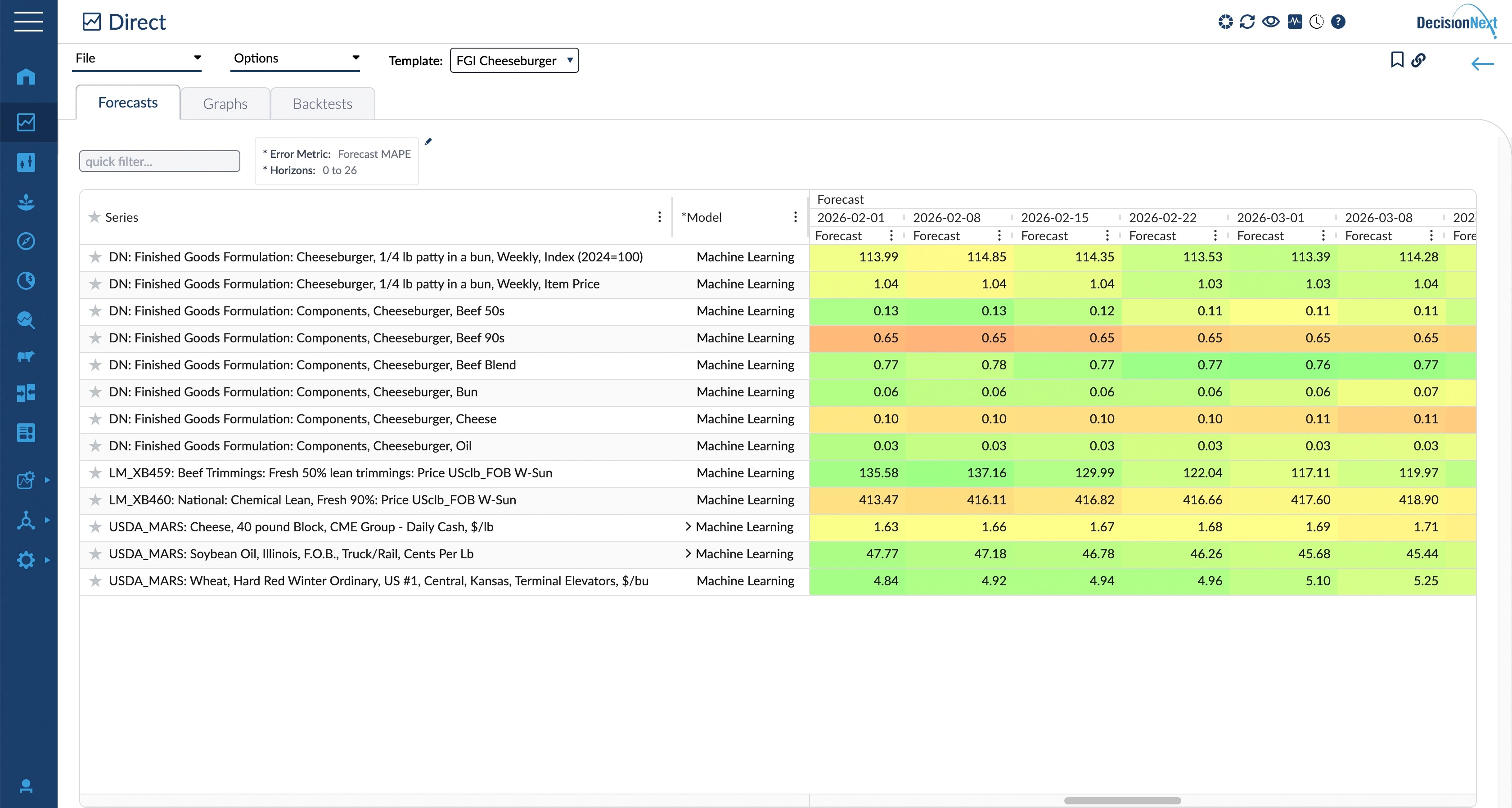
“DecisionNext Direct lets us compare up to four models side by side and run 26-week forecasts.”Scott Flanary, Colorado Premium
The competitive field is less a clean software category than a crowded meeting. Commodity intelligence providers such as Kpler, Enverus and Fastmarkets supply data and analysis. Planning platforms such as o9, Kinaxis and Blue Yonder handle broader supply-chain workflows. Consultants bring bespoke expertise. Internal teams bring spreadsheets, business-intelligence tools and data scientists. DecisionNext’s wedge is the complete chain from forecast to modeled transaction to market-adjusted scorecard, tuned for physical commodities.
What another founder can steal
First, choose a market where a narrow improvement has a large dollar value. DecisionNext does not need millions of seats; it needs a few decisions big enough to justify careful software. Second, let expert users challenge the machine. In high-stakes domains, transparency can be more useful than a tiny gain in benchmark accuracy. Third, preserve disagreement. Four models pointing in different directions contain information that a blended average destroys. Fourth, connect prediction to a workflow and then measure the outcome. A forecast without a decision is content. A forecast attached to a repeatable choice can become infrastructure.
Start with an expensive recurring decision. Expose several models. Show the backtest. Let experts adjust assumptions. Compare real alternatives. Record the rationale. Score execution against the market afterward.
The conditions matter. This approach works best when a company has recurring decisions, usable historical data, a meaningful planning horizon and experts willing to formalize their judgment. It weakens when the purchase is rare, the market has no stable drivers, data arrives too late or the organization will not change its approval process. It also cannot rescue a team that treats every model output as an instruction. DecisionNext is strongest as a disciplined second brain, not an oracle.
A small company in a large decision
DecisionNext has roughly 27 employees by supplied company data, while LinkedIn places it in the 11-to-50 range. It raised a $7 million Series A led by Dalus Capital in 2019; funding databases also report a $5.09 million extension in early 2023. In 2024 it joined AWS Marketplace. In 2026 it refreshed the three-layer product story and announced Buckhead, DON Smallgoods and Pre Brands relationships. The company remains private, focused and considerably smaller than the businesses whose buys it helps shape.
That mismatch is part of the appeal. Commodity companies already possess data, experienced people and opinions. DecisionNext is trying to turn those ingredients into an institutional memory: what the market suggested, what the models disagreed about, what the team believed, what it chose and whether that choice beat the opportunity available. The pitch is not that instinct disappears. The pitch is that instinct finally has to show its work.