Lokwon Kim likes a large ambition in a small power envelope. The founder of DEEPX talks about artificial intelligence as something that should slip out of the data center and into the ordinary machinery of life: a camera watching a factory line, a delivery robot negotiating a corridor, a drone reading the ground below. The intelligence may be grand. The electricity budget is not.
This is the wager beneath DEEPX, the South Korean fabless semiconductor company Kim founded in 2018. Its neural processing units, or NPUs, are designed to run AI inference close to where data is created. Its software converts and optimizes models so they can make the difficult journey from a roomy GPU environment into leaner hardware. Kim's second-generation project aims to run large language models below five watts. That is roughly the sort of constraint that turns philosophy into engineering: every flourish must eventually meet the meter.
Kim did not arrive at this problem by following a sudden fashion. His route runs through a UCLA doctorate, a visiting-scholar assignment at IBM's Thomas J. Watson Research Center, router-chip work at Cisco and processor design at Apple. At each stop, the machinery became more intimate. Supercomputers gave way to network equipment, then processors placed into watches, tablets and phones. DEEPX takes the pattern one step further. It asks what happens when AI belongs inside almost any physical object that can usefully perceive and decide.
Origin story
A research assignment that refused to leave
In 2010, while pursuing his doctorate in electrical engineering at UCLA, Kim worked as a visiting scholar at IBM. The assignment involved a neural processing unit for deep learning. Today's language makes that sound inevitable. In 2010, it was a more peculiar proposition. Neural networks had not yet conquered the public imagination, and specialized AI silicon was hardly a dinner-table category.
The idea stayed. Kim completed his doctorate in 2011, then joined Cisco, where he worked on modeling, design and verification for core chipsets in network routers. Cisco recognized him with an employee achievement award. In 2014 he moved to Apple, leading design and verification work on application processors used across products including the iPhone, iPad and Apple Watch. Public profiles connect his work to the A10, A11 Bionic and A12 Bionic generations. These were not speculative chips. They were processors expected to behave, at enormous scale, inside objects people carried all day.
Kim says he brought his AI processor idea to senior Apple executives. They declined. The anecdote contains no operatic door-slamming, just a useful hinge. The company already had priorities; Kim still had the question. He returned to South Korea and gave the question a payroll, a patent strategy and a name.
I want to be Morris Chang of Korea, by creating an AI company that will be so important and crucial to the future of South Korea.Lokwon Kim, 2023
Morris Chang is an unusually revealing role model. The founder of TSMC did more than create a successful semiconductor business after returning to Taiwan. His foundry model rearranged the industry and became strategically important to his country. Kim's comparison is audacious, and he makes it without shrinking. He wants DEEPX to matter to South Korea in a way that can be felt beyond quarterly revenue.
The product lesson
A fast chip still needs a decent road
There is a trap in semiconductor storytelling. The chip receives the glamour; everything required to use it is demoted to plumbing. Kim's customer conversations pushed DEEPX in the opposite direction. He said the company sat down with literally hundreds of global companies. Three recurring difficulties emerged: scalability, AI accuracy and power-performance efficiency.
Accuracy is the awkward one. A model trained with floating-point numbers on a GPU often needs to be compressed into lower-precision mathematics before it can run efficiently on an edge accelerator. That process, called quantization, can change results. A processor may look quick in a brochure while the customer's carefully trained model comes out the other side slightly less clever.
DEEPX responded by treating its DXNN software kit as part of the central product. The kit includes a compiler, model-optimization and quantization tools, a runtime, APIs, drivers and firmware. The goal is to move a trained model onto DEEPX hardware while preserving useful accuracy and making deployment less theatrical. Buyers do not merely need an engine. They need the bridge, the signs and a mechanic who answers the telephone.
The short commute for a machine decision
The edge thesis: keep time-sensitive inference near the device while cloud systems remain available for training, coordination and heavier workloads.
That architecture fits Kim's larger argument about access. AI concentrated in data centers can be expensive in electricity, network capacity and response time. Local inference does not abolish the cloud. It divides the labor. Training and giant models may remain centralized while selected decisions happen on the device. A factory camera need not send every frame on a round trip before recognizing a problem. A robot benefits from noticing the chair before a server in another region returns an opinion.
Commercial reality
The expensive distance between a demo and a device
In May 2024, DEEPX closed an $80.5 million Series C round at a reported valuation of $529 million. SkyLake Equity Partners led the financing, with BNW Investments, AJU IB and existing investor TimeFolio Asset Management participating. The money was assigned to an unromantic but decisive task: move the first product line into mass production and accelerate chips for on-device large language models.
The backing also carried symbolic weight. SkyLake was founded by Chin Dae-je, a former Samsung Electronics executive and former South Korean technology minister. BNW's chairman, Kim Jea-wook, had also held senior roles in Samsung's semiconductor business. For a founder who talks about building national industrial significance, approval from veterans of Korea's memory-chip ascent offered more than capital.
DEEPX's public record since then reads like a company crossing the tedious middle distance. In 2024 it said more than 300 companies had verified its 5-nanometer samples. In 2025 it reported entering mass production for camera modules, robots, drones, surveillance systems and edge servers, while signing distributor agreements across the United States, China, Taiwan and Europe. It also described collaborations around next-generation generative AI with LG Uplus, Baidu's PaddlePaddle and Naver Cloud.
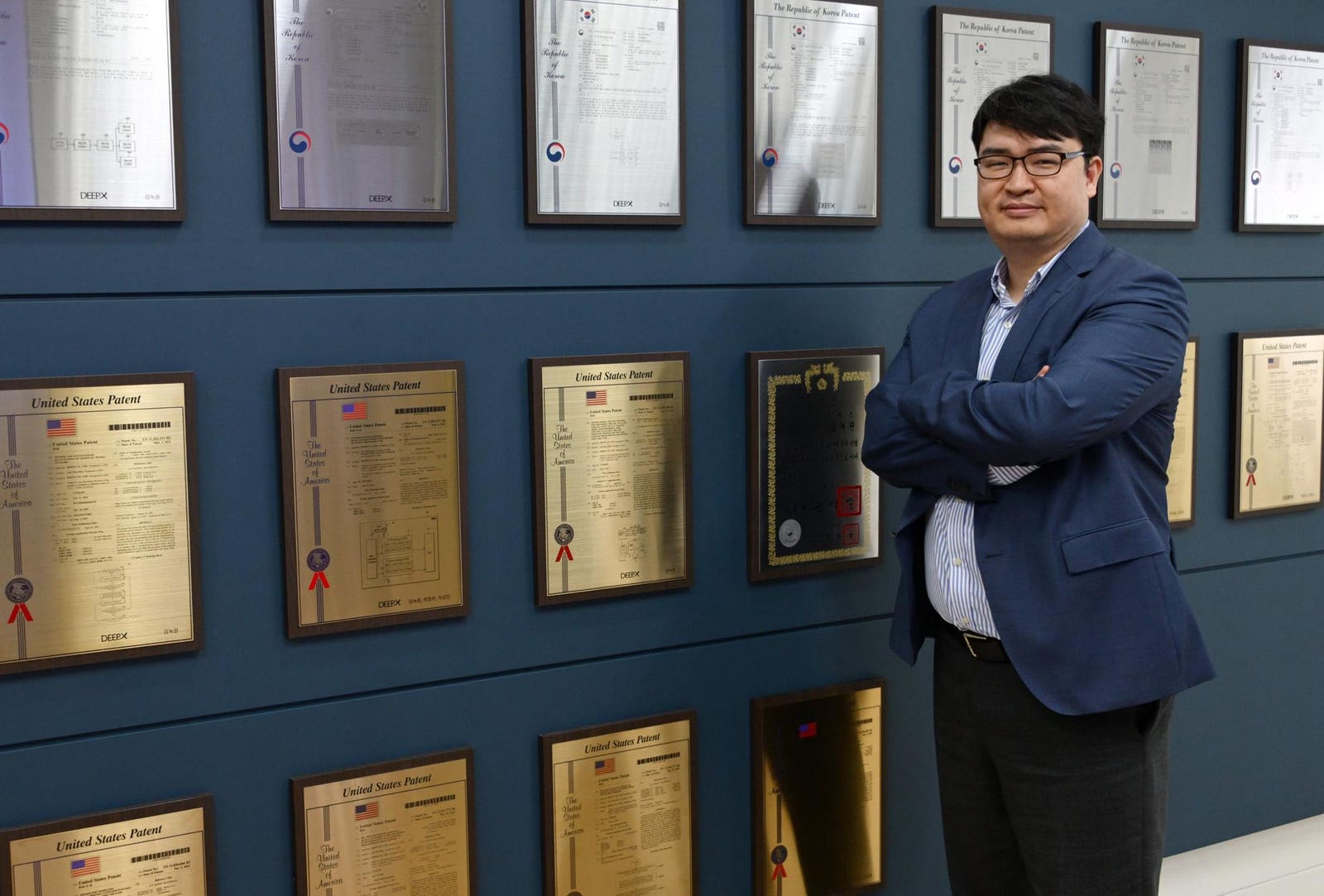
Awards have accumulated around the journey. DEEPX received a South Korean Presidential Commendation for patents in 2023, collected three CES Innovation Awards in 2024 and appeared on EE Times' Silicon 100 lists. The company now reports more than 400 patent filings and over 130 grants worldwide. Those figures are less romantic than the phrase “AI everywhere,” which is precisely why they matter. Semiconductor ambition is measured in documents, test results and manufacturing yield long before it is measured in cultural mythology.
The founder's operating system
Grand language, practical shoes
Kim can sound almost Victorian about the moral purpose of intelligence. DEEPX's company story says that human dignity stems from intelligence and argues that access should not depend on wealth, geography or connectivity. Then the same story mentions twenty exhibitions a year, two to four business trips a month and, on one occasion, a 3,400-kilometer drive over four days to meet a customer. The celestial mission comes with a punishing travel calendar.
That combination helps explain his public manner. An interviewer at the 2023 Embedded Vision Summit described Kim arriving with swagger and audacity. Yet his product account begins with listening. Hundreds of conversations are his evidence that edge developers care about accuracy, scalability and watts. His company culture says the best idea should outrank the title. For an executive with a conspicuously large title, it is a sensible rule to print on the wall.
Just as ARM dominated the CPU market with smartphones, the semiconductor company that dominates the edge will dominate the AI market.Lokwon Kim, 2024
ARM is Kim's other instructive analogy. Its power-efficient architecture flourished as computing moved from desks into pockets. Kim believes AI will undergo a comparable migration, leaving server racks for the physical world. The analogy gives DEEPX a compass, though no guarantee. Edge AI is crowded with incumbents and startups, customer qualification moves slowly, and an impressive chip must coexist with every other stubborn component in a finished system.
Kim's career suggests he understands the nuisance. He has worked on the parts of computing that users rarely applaud unless they fail: verification, reliability, networking cores, processor architecture. His present ambition is flamboyant, but the craft beneath it is repetitive and exact. Make the model fit. Preserve its accuracy. Cut the power. Test again.
The most interesting thing about his five-watt future may be its manners. Intelligence would stop insisting that every object maintain a constant audience with a giant remote machine. It would notice more locally, respond more quickly and consume less while doing so. The cloud would remain immense. The edge would become a little more capable. And somewhere between them, Lokwon Kim would still be asking a customer what broke.