There is a small, anxious theatre performance inside every ecommerce order. The curtain rises when the payment succeeds. A warehouse finds the item. A carrier scans it. A customer refreshes a tracking page and wonders why “in transit” can contain so many hours. If the box arrives late, dented or not at all, the retailer discovers that a finished sale was only a promise with a receipt attached.
Lokesh Kumar has made that uncomfortable interval his professional territory. He is a founding member of ClickPost, the logistics software company, and his work in business development requires him to speak two languages at once. One belongs to operations teams: carriers, serviceability, delivery attempts, routing, return-to-origin and reconciliation. The other belongs to commerce leaders: loyalty, margin, customer acquisition and repeat purchase. The interesting work begins when he shows that the two vocabularies describe the same customer.
Kumar is now based in the New York metropolitan area, but the commercial argument he carries was sharpened in India's fast-changing D2C market. He has written about hyperlocal delivery, the mechanics of reducing logistics costs and the little calamities hidden inside a failed delivery attempt. These are not subjects that normally receive a standing ovation. They do, however, decide whether the person who clicked “buy” feels looked after or abandoned.
Checkout is a beginning disguised as an ending
Retail websites are designed to make payment feel conclusive. Confetti may fall. A cheerful confirmation arrives. Behind the screen, the least theatrical work starts. The retailer has to select a carrier, produce the right promise date, watch exceptions, answer “where is my order?” and make a return tolerable if the product disappoints. Each task is owned by a different system until something goes wrong, at which point the customer regards the whole company as one person who has misplaced a box.
Kumar's public writing returns to this unity. In a 2021 essay about ecommerce shipping, he argued that post-purchase experience can make or break consumer loyalty. Five years later, his LinkedIn articles became more pointed. What if a brand's best customer starts a return and the returns platform does not know who they are? What if a small cohort is driving a large share of return volume? What if the least expensive return is the one prevented before the request begins?
“Returns aren't a logistics problem. They're a retention decision.”Lokesh Kumar
That sentence contains his sales case in miniature. A logistics problem can be sent to a warehouse queue. A retention decision forces the retailer to ask who is returning, why, what alternative might fit, and whether a refund should become an exchange. It also asks something less measurable: can the process preserve dignity? Customers are acutely aware when a company becomes colder after it has their money.
From courier plumbing to a decision layer
ClickPost's own company history dates the platform to 2017. Its first proposition was practical: give brands real-time shipment intelligence across carriers without making them replace their fulfilment operation. The broader company story began with experiments in courier aggregation and first-mile and last-mile tracking. The useful discovery was that customers were as interested in the technology beneath those experiments as in the services themselves.
Kumar's title matters here. He is publicly described as a founding member, not one of the two co-founders named in ClickPost's company history. It places him in the company-building cohort while keeping the distinction clear. In business development, he has helped steer market initiatives, shape strategy and assemble teams. A public recommendation from a former colleague describes him as energetic, persistent and foresighted, but also systematic and approachable. Sales mythology prefers the charming improviser. Enterprise logistics rewards the person who remembers what happens after the handshake.
Daily shipment scale, as reported by ClickPost
Bars show milestones, not a linear numerical scale. Figures are the company's reported shipments optimized per day.The scale changed the nature of the pitch. At ten thousand shipments a day, visibility is useful. At one million, a delayed scan is a pattern, a carrier choice is a recurring bet, and a bad workflow can manufacture an army of support tickets. ClickPost says it crossed profitability in 2020 and reached more than one million optimized shipments a day in 2024. That same year it raised a $6 million Series A led by Inflexor Ventures and Athera Venture Partners, with participation from Riverwalk Holdings and Rebright Partners.
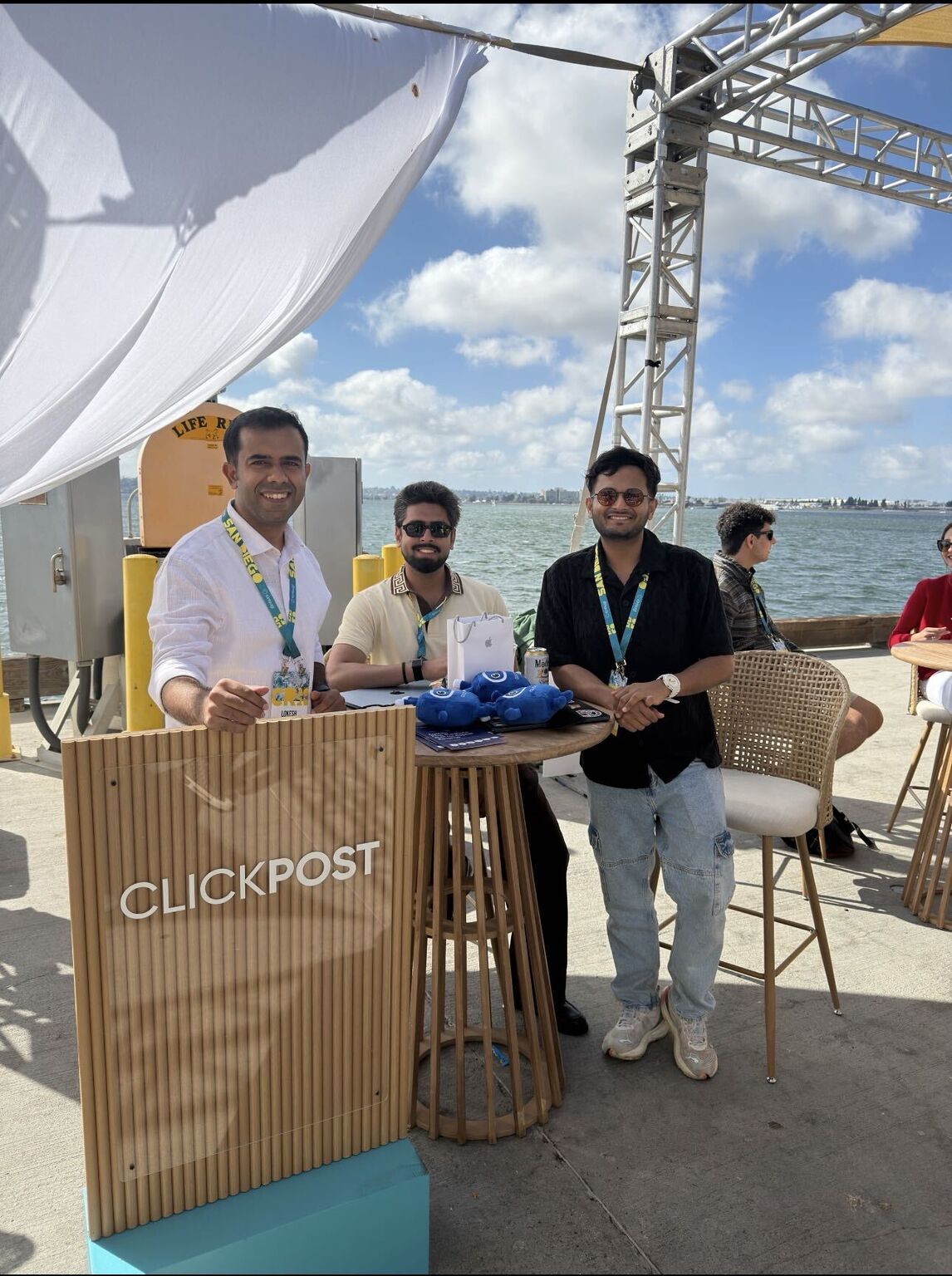
Capital is an announcement; expansion is a calendar. It means meetings, market translation, security questions, event booths and the disciplined repetition of a problem until a new buyer recognizes it as their own. Kumar's recent public presence shows that work moving west. In June 2026 he joined the ClickPost team at CommerceNext in New York. In September, he spent two days at Commerce Roundtable in San Diego speaking with D2C operators about returns, delivery and everything after checkout.
Speed impresses once. Reliability earns the encore.
In 2021, Kumar wrote about hyperlocal delivery while the model was racing outward from food into broader commerce. The attraction was obvious: source locally, shrink the radius, deliver quickly. His later work complicates the cult of speed. Fast delivery is helpful, but a brand is judged across the entire sequence. A precise estimate can be better than a boast. An honest notification can rescue a late parcel. A return that recognizes the customer's history can protect more value than a rigid policy saves.
This is where Kumar's public persona becomes unusually coherent. His subject is not technology for its own sake. It is the translation of operational signals into commercial choices. A carrier allocation model is interesting because it can improve delivery success or cost. A tracking page matters because customers visit it while waiting. A returns portal matters because it stands at the point where disappointment can become an exchange, a refund or a permanent goodbye.
The approach also explains his emphasis on people. His older professional summary describes a business-development leader who values grooming and growing talent. The recommendation on his profile says teammates relied on his solutions and found him approachable. Those observations are modest, but they match the work. Logistics software spans sales, implementation, product, carrier relationships and customer support. No single department can promise the experience alone.
Business development as translation
Enterprise sales can become a parade of nouns. Platform. Intelligence. Automation. Visibility. Kumar's more persuasive material begins with scenes: a high-value customer opens a return; a shopper checks a tracking page for the fifth time; an operations team pays for avoidable reverse logistics; a failed delivery becomes a second attempt. The nouns acquire meaning only after a person is inconvenienced.
His education gives the commercial route a conventional beginning. He studied commerce and later completed an MBA at Amity University Noida from 2008 to 2010. Indian corporate records list him as a director of Manya Technologies from 2015. By 2021, published articles identified him as ClickPost's vice president of business development. Today, the title on his profile is Founding Member, and his stated focus is helping D2C brands and retailers turn returns and post-purchase from a cost centre into something that supports retention.
There is a quiet shift in that sentence. Cost centres are defended. Growth channels are designed. If a retailer accepts Kumar's framing, the post-purchase budget no longer competes only on savings. It can be discussed beside customer lifetime value, exchange conversion and loyalty. The warehouse does not become a marketing agency, mercifully. It does become part of the brand.
A parcel is a product, a promise and a test of whether several systems can behave like one company.
The promise keeps moving
ClickPost's current ambitions reach toward predictive and increasingly autonomous logistics decisions: selecting carriers, anticipating delays, recovering failed deliveries and shaping return outcomes. Kumar's job is to connect that machinery to the commercial anxieties of retailers in several markets. The technology may grow more complicated. The customer test remains almost comically plain. Did it arrive when you said? Did you tell me when it would not? Did you make the next step easy?
That simplicity is why the after-checkout world has become a useful place to build a career. Advertising can polish a promise. Operations must perform it, repeatedly, through rain, wrong addresses, carrier handoffs and buyer's remorse. Kumar stands at the point where those messy facts have to become a credible business conversation.
The online store would prefer the story to end with the order confirmation. Kumar's work begins there, after the triumphant button and before the box reaches the door. It is less glamorous than the sale and more intimate than the spreadsheet suggests. Somewhere, a customer is refreshing a page. The relationship is still in transit.