A chocolate mousse is a lovely customer testimonial. It is a less convincing business model. Early in Loka’s life, founder Bobby Mukherjee tried a résumé tool that mixed machine learning with visual styling. A grateful user landed a job and sent dessert. The gesture was sweet; the question of how to sustain a company remained.
That tension gives Loka a useful origin story for the current AI moment. The company eventually found its footing by helping other businesses build and launch. Today, its portfolio reaches into doctors’ paperwork, investment advice, home security and laboratory research. The common thread is a practical one: getting technology to work inside somebody else’s complicated operation.
A résumé, a mousse, a change of plan
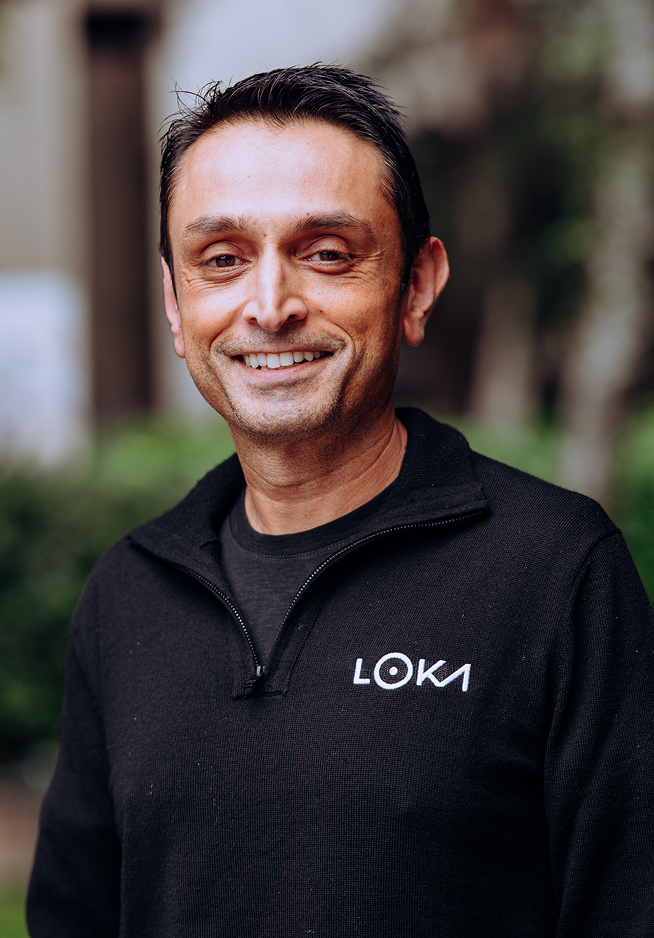
Mukherjee founded Loka in 2004. His wife supplied the name, a Sanskrit word meaning world. Several product directions followed, including user-experience software and search optimization. Meanwhile, engineering consulting brought in customers such as Cisco. By 2012, he had decided to make the sideline the company’s focus. Customers were returning, staying longer and buying more. His account of those years describes a change of mind driven by demand.
The point travels well beyond consulting. Founders can mistake an intended product for the business itself. Repeat customers provide a different kind of evidence: someone has a problem, trusts your work and is willing to return. Loka’s trajectory suggests that paying attention to that behavior can be more useful than protecting the original pitch.
The business behind the demo
Loka occupies the implementation end of the AI market. A customer brings an objective, existing software and constraints. Loka supplies people who can scope the work, design the experience, connect the data, build the application and operate its infrastructure. Its service range covers machine learning, data engineering, DevOps, design and application development. The buyer is generally an organization trying to ship or improve something.
That makes its commercial model a services business: consulting and engineering engagements, including teams that augment a client’s capabilities. An alternative might be hiring internally, choosing a specialist consultancy or using a larger systems integrator. Loka’s positioning combines broad engineering coverage with a particular concentration in healthcare and life sciences. The useful buying question is how much of a specific project that combination can actually cover.
AWS is a substantial part of the answer. Loka is a Premier Tier Services Partner, offers services through AWS Marketplace and helps eligible customers access AWS funding programs. That relationship can affect procurement as well as architecture. A buyer already committed to AWS can bring in specialist help within a familiar commercial environment, with funding eligibility assessed for the engagement.
Five minutes become fifteen seconds
At wealth-management software company Vestmark, the ambition was an assistant that could understand financial advisers’ requests, consult internal information and act through secure software interfaces. Loka built the AI Advisor Assistant using Claude on Amazon Bedrock, retrieval from company material and connections to existing systems. The company reports that proposal generation fell from ten clicks and five minutes to one sentence and 15 seconds. That is the specific workflow behind its 95% reduction claim.
Vestmark proposal generation. Reported by Loka; bars share the same scale.
The transferable lesson is to choose a bounded task and measure it. A vague request to make employees more productive leaves plenty of room for a charming demonstration. A proposal workflow has a beginning, an end and a stopwatch. It also reveals the less glamorous work: permissions, approved information and the ability to complete an action safely.
In urgent care, Loka’s Experity work pairs an AI Scribe with a Care Agent. The first turns conversation into structured notes; the second handles administrative workflows. Loka reports deployment with roughly 2,000 providers and reductions of five to 15 minutes per encounter. These are company-published outcomes, and the relevant unit is time returned to a clinician, rather than the fluency of an answer on a screen.
The bill matters, too
The Experity case puts average summary-generation cost at $0.017. That tiny number describes one operation. A buyer still has to account for integration, transcription, storage, monitoring and support. Treating an inference charge as the cost of an entire system would be like pricing a restaurant by the electricity used to toast the bread.
Loka’s cloud work offers a broader view of economics. An unnamed biotech client had a complicated AWS environment spanning laboratories, offices and multiple accounts. A pilot addressing spending and operations developed into six longer-term projects. Loka reports a 40% reduction in compute expenses. The work included infrastructure standardization, clearer cost visibility and deployment automation. The savings came from changing how the environment ran. The case study makes a good argument for inspecting the machinery before buying more.
For Ello, which develops an AI reading tutor, the obstacle included GPU capacity and reliable service delivery. Loka helped migrate and modernize its infrastructure from Google Cloud to AWS in six months. The work included testing, infrastructure as code and a cutover and rollback plan. Ello’s story is a reminder that a model needs a dependable home. Migration engineering can be central to an AI product even when the user never sees it.
A scientist still sets the question
Drug discovery gives Loka’s specialization a more demanding test. Nurix had historically built separate machine-learning models for individual discovery campaigns. Its scientists saw an opportunity to learn across a much larger body of DNA-encoded-library data. Loka worked alongside them on DEL-FM, a foundation model deployed on AWS SageMaker, intended to predict interactions involving previously unseen molecules and targets.
The division of labor matters. Nurix supplied scientific direction, proprietary data and its own technical expertise. Loka contributed machine-learning and engineering capacity to build and operate the model at scale. The collaboration helped prioritize experiments; its published account describes laboratory confirmation of candidate molecules against several targets. That is an early research result, with considerable work still separating a promising candidate from a medicine.
Inside LokaLabs, related ideas become tools and experiments. ADDA, the Advanced Drug Discovery Assistant, puts a conversational interface over databases, predictive models and research workflows. Clementine serves as an AWS documentation assistant and a blueprint for custom chatbots. Petunia applies machine learning to siRNA design. These projects give customers tangible examples of what Loka can build and give its engineers room to investigate ideas between client launches.
The passerby test
Some of the most instructive AI work concerns events that should be ignored. At SimpliSafe, human monitoring staff face large volumes of routine camera activity. Loka combined object detection, tracking and contextual video analysis to distinguish ordinary passersby from possible threats. The published project reports filtering 55% of non-relevant events, with the potential to reduce the workload on human agents.
The same account identifies difficult cases: nighttime scenes, unusual configurations, activity at the edge of the image and fast-moving threats. Those details give the result boundaries. Performance depends on what a system encounters, and human oversight remains part of the design. For buyers, the copyable practice is to inspect misclassifications by situation. A single accuracy number can conceal the conditions that most need attention. SimpliSafe’s case is useful precisely because those conditions are visible.
Every other Friday is spoken for
Loka’s working culture has an appealingly specific calendar entry: every other Friday off. Its careers material pairs that benefit with remote work, flexible hours, learning support and an Explore program offering time abroad. There is also a curiosity allowance. These are concrete parts of the employment proposition for people who move between demanding customer projects.
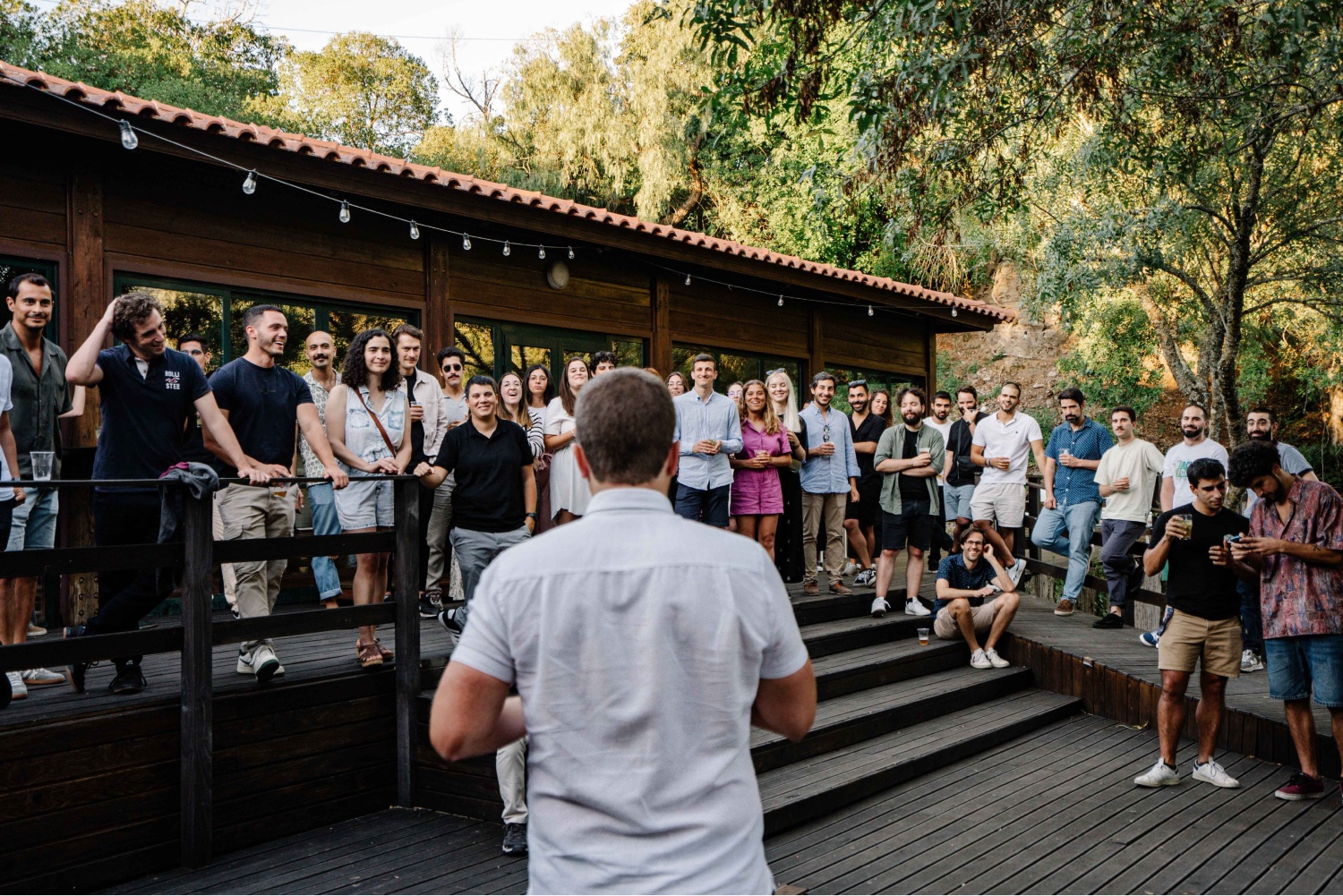
Remote work still benefits from occasions when people can meet. In a July 2025 account, Loka described a five-day, four-night global gathering in Greece, with employees spending time together beyond project calls. Tennis, dancing and excursions featured alongside the company gathering. The underlying management choice is straightforward: some of the savings and flexibility of distributed work can be reinvested in relationships. Loka presented the event as an investment in its culture, rather than a productivity calculation.
A bigger bet on the work underneath
The recent announcements point toward deeper specialization. In June 2026, Loka expanded its strategic collaboration with AWS and announced membership in Anthropic’s Claude Partner Network. In August, it promoted Sushmitha Regulapati to lead healthcare and life sciences as senior vice president, reporting that those sectors accounted for nearly 60% of its projects.
“Healthcare and life sciences leaders don’t have a pilot problem. They have a production problem.”
Sushmitha Regulapati · August 2026
That observation, in Loka’s promotion announcement, brings the story back to implementation. The company says it has delivered more than 500 generative and agentic AI projects since 2023, with about half in or moving toward production. Those are its own figures. They describe a business where experiments and deployed systems coexist, and where the distance between them is the work being sold.
For a prospective customer, the practical starting point is a troublesome workflow, a baseline and a clear owner. Bring the people who understand the data and the people who will use the result. Ask what success would look like in time, cost or service quality. Loka’s most persuasive examples begin there: a proposal prepared, a cloud bill reduced, a scientist able to run the next experiment.
Keep looking, listening, building
Visit Loka · Customer work · Engineering & company blog · News · GitHub
LinkedIn · Twitter/X · Instagram · Explore LokaLabs
Watch: Bobby Mukherjee on AWS Innovation AmbassadorsExperimentation, customers and the company’s AI work