The merchandise moves. A shirt leaves its rack. A pair of trousers returns to the wrong shelf. A customer orders an item that the computer believes is waiting in the store, and someone has to discover whether the computer is telling the truth. This is an ordinary retail problem, which makes it an interesting place to meet Llavan Fernando. The founder of Zone24x7 has spent much of his career bringing computing into contact with objects that decline to behave like tidy rows in a database.
His company’s autonomous inventory robot, AZIRO, gave that problem a mobile answer. It was developed in Sri Lanka, for RFID-based stocktaking, and won research and development recognition in 2015. AZIRO began with an idea from Fernando. Yet the route to that machine ran through several countries, a succession of engineering jobs, a co-founder with financial judgment, and a university laboratory. A robot has many parts. So does the career behind it.
The long way home
Fernando was born in Colombo and has roots in Kochchikade, near Negombo. His education took him from De Mazenod College in Kandana to John Ruskin Grammar School in Croydon, then to electrical engineering at the University of Reading. In 1979, after engineering work in Britain, he moved to California’s Bay Area. The geographical outline is simple enough. The professional thread is a preference for making technology do something beyond the screen.
His work would encompass digital signature capture, electronic signage and autonomous inventory management. These are technologies with public-facing consequences: a transaction recorded, information displayed, merchandise located. Their usefulness depends on cooperation between software and a physical device. A beautifully written program has to get along with the equipment. Engineering, like a dinner party, can be ruined by one participant refusing to cooperate.
Before Zone24x7, Fernando founded Mobinetix, which later became part of Zebra Technologies. In 2001, he was CEO of @POS. By the time he began his next company, he had worked on both the technical and business sides of technology. His next venture would put those experiences into an organization operating across the Pacific and Indian oceans.
“I was not afraid of trying things out.”
Llavan Fernando · reflecting on his early engineering work, 2022
A company with two beginnings
Zone24x7 began in the United States in 2003. Llavan and Saw-Chin Fernando were its co-founders. In 2004 came the advanced technology centre in Colombo. Those two dates describe different steps in the same enterprise: establishing the company and establishing the engineering operation in Sri Lanka. San Jose supplied one end of the connection; Colombo supplied another.
The arrangement made international customer work accessible to an engineering team on the island. The business developed consulting and engineering services covering hardware and software, with customers ranging from startups to large enterprises. Product development, embedded systems, data engineering and robotics could belong within the same engagement. That breadth matters when the customer’s problem crosses the boundaries between a device, its software and the data it produces.
Saw-Chin’s place in the founding deserves room in the story. Two names appear at the beginning of the business. A founder’s profile can easily turn a shared undertaking into a solitary achievement, especially when one founder is the public face. Here, the company’s establishment was a partnership. The engineering story has a business partner in it from the start, and the organization that followed has considerably more people.
Give the laboratory a door to industry
The relationship with Sri Lankan engineering acquired another address in September 2007. Zone24x7’s Electronic Systems Research Lab opened at the University of Moratuwa. The company had already supported undergraduate projects in the Department of Electronic and Telecommunication Engineering. The laboratory took that contact further, creating a place where graduates could contribute to product research while remaining within an academic setting.
The university provided the physical location. Faculty and experienced company staff could advise on research. Students and graduates gained access to equipment and problems with a connection to industry. The opening on September 6 brought together university leadership, faculty and industry figures, with the US ambassador inaugurating the lab. The ceremony marked the beginning of an arrangement whose practical value would depend on what happened afterward.
There is something refreshingly tangible about a laboratory partnership. Collaboration needs a room, funding, equipment and people who can help when the experiment stops behaving. The work also needs patience with business conditions that may change before a research project is complete. A university calendar and a customer deadline are different clocks. Putting them in the same room does not automatically make them agree.
For Fernando’s company, this partnership connected the engineering centre with a place that trains engineers. It gave the broader story a structure beyond recruitment: an opportunity to work together on the research component of products.
The robot has a stocktaking job
AZIRO made the company’s interest in physical systems visible. Its assignment was to take inventory using radio frequency identification, or RFID. Merchandise carries tags; a reader detects them. The robot brings the reader through the retail environment. The eventual result has to become information that a store can use.
In 2015, the machine won overall Gold at Sri Lanka’s National Best Quality ICT Awards, as well as Gold in the research and development category. It then won the R&D award at the Asia Pacific ICT Alliance competition in Colombo. The product had been designed and developed in Sri Lanka. By that point, two major US department-store chains were evaluating it. Zone24x7 had secured a US patent for AZIRO, alongside two provisional patents.
The recognition belongs to the organization and its engineering team. Fernando’s place in the account is the originating idea and the business that assembled the capacity to pursue it. There is a substantial distance between proposing an inventory robot and making one that can be evaluated in a store. Navigation, sensing and useful inventory data have to arrive together. An idea cannot wander down an aisle by itself.
AZIRO’s job also makes the company’s hardware-and-software approach easy to picture. The moving machine and the records it creates are parts of the same task. Each needs the other to produce something useful.
Count the consequences
A robot’s activity can be measured in more than movement. Zone24x7’s retail work included a ten-month field test in which an autonomous inventory robot scanned RFID-tagged products and estimated their locations. The reported results were a 60 percent reduction in in-store order cancellations and a 90 percent reduction in labour hours spent scanning inventory. Those are results from that field test, rather than a promise about every store.
The distinction gives the numbers their proper scale. They describe a particular deployment and a particular period. They also explain why inventory accuracy can matter to someone who has no interest in robotics. The consequences can turn up in an order that goes through and in the staff time required to check the shelves.
The same retail programme included self-service kiosks, product recommendations and remote monitoring. A shop contains several information systems, and the shopper encounters their combined behaviour. A kiosk can offer convenience; inventory records determine whether the promised item is there. Looking across those systems is a practical extension of the founder’s career in devices and computing. The customer experiences the whole transaction, regardless of how many engineering departments helped produce it.
There are people in this circuit
In June 2014, Zone24x7 celebrated its tenth anniversary at the Galadari Hotel’s Grand Ballroom in Colombo. More than 170 associates joined Fernando, then CEO, and company leaders including Neschae Fernando and Dr. Sankalpa Gamwarige. A photograph spread records the occasion in the familiar vocabulary of an anniversary: groups assembling, guests greeting one another, a cake awaiting its fate.
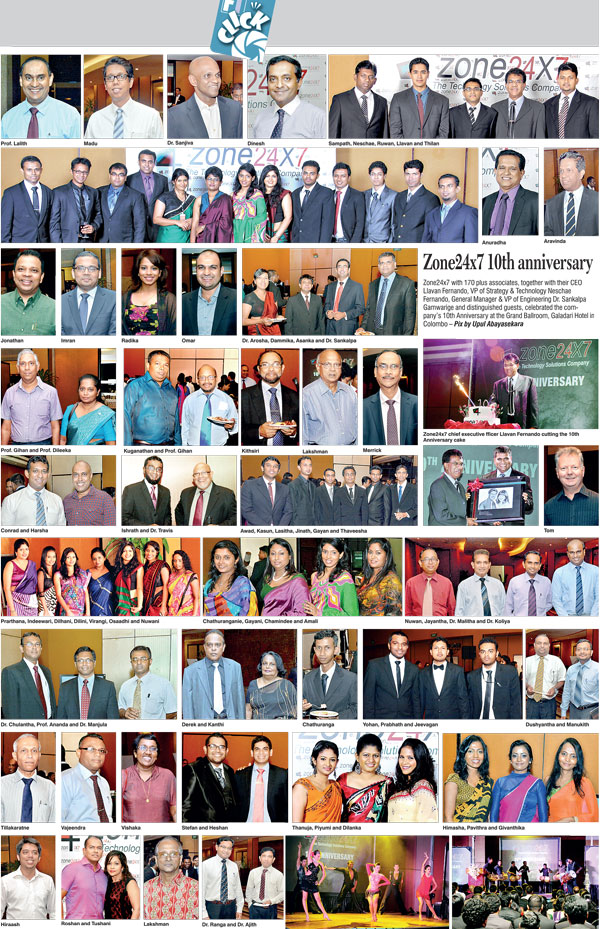
The pictures are a useful interruption to the language of systems and products. They show the human size of an organization that had spent a decade connecting international customers with engineering work in Sri Lanka. A company diagram might show reporting lines. An anniversary photograph shows people finding space beside one another. Both contain information, though the photograph allows better clothes.
Two years later, Zone24x7 received Presidential Export Awards for high-tech and innovative products covering 2014 and 2015. Fernando was also described at that time as an advisor to SLASSCOM, Sri Lanka’s software and services industry association. His work had a setting beyond his own company: a national technology sector trying to sell its engineering internationally. Export recognition placed the business in that wider economic story.
The work continues past the founder’s desk
Fernando’s current role is Founder and Chairman. Neschae Fernando is Zone24x7’s CEO. Saw-Chin Fernando remains on the official leadership page as a director. The present structure gives the story a further chapter: the founder’s company has an executive team carrying its work forward.
In February 2026, Zone24x7 reported seven awards across three technology competitions for 2025. The recognized product was an industrial vending machine developed for an Australian client. The awards included manufacturing recognition, an Internet of Things award and second runner-up at APICTA. The object has changed from the retail inventory robot, but the work still brings software and equipment together around a customer’s operational need.
Fernando’s own stated ambition reaches into the home. In 2022, he described a wish for an affordable robot that could handle everyday chores, including making tea and dealing with laundry. The list is appealingly ordinary. A robot that can cope with a shop floor is useful; one that can cope with the washing has an audience waiting.
His career gives that aspiration a context. It has moved between engineering, company building and institutions that develop technical talent. The route from Sri Lanka to Britain to California eventually helped create a working connection back to Sri Lanka. Today, there is a chairman, a CEO, a technology centre and a continuing collection of products. The long journey has left behind something people can go to work in.