Liviu Dragan had already spent more than two decades building a software company when he decided that experience could become an awkward companion. It knew the old answers. It had opinions about how things should be done. In a new company devoted to artificial intelligence, he wanted room for different questions. After TotalSoft, he said, he worked on himself to set aside his previous experience. Beginning again required more than a new company name.
In 2018, he founded DRUID. TotalSoft, the enterprise software business he had helped establish in 1994, supplied a substantial first act. A repeat founder might have treated that history as a ready-made instruction manual. Dragan described an effort to start with a blank sheet. There is something appealingly inconvenient about this: the reward for learning a business over many years was another business that required him to reconsider what he knew.
His explanation returned to a word that usually belongs to novelists: story. A company needed one to inspire its employees and customers, and he needed one to keep himself engaged. Across his interviews, the product changed, the markets expanded, and the sums grew. That personal requirement remained remarkably consistent. He wanted something worth getting up for.
“I am just following up on my dream.”
Liviu Dragan, 2019
Before the software, a picture
As a teenager, Dragan wanted to become a visual artist. He attended art school and studied painting, then decided that others were better at it. He chose the Polytechnic instead. The change is easy to compress into a familiar tale of practicality defeating imagination. His later life makes that reading rather incomplete. Drawing, visual art and writing continued to matter to him; the engineer never entirely cleared the painter’s desk.
His early professional world also had very different proportions from a modern laptop screen. At the university computing centre, he worked with a Felix computer large enough to occupy a room. He knew Fortran and learned other languages through courses and projects, including assembly, Pascal and C. Programming grew out of concrete technical work. The machine had physical presence; getting useful work out of it demanded sustained attention.
He spent ten years teaching at the university. Much later, when asked what other job he would choose, he returned to teaching. His father and grandfather had been teachers too. That preference adds a useful dimension to his career: he had experienced the pleasure of explaining things before he built businesses whose software would need explaining. A room full of students and a company full of colleagues offer different kinds of resistance, but both require someone to make an idea understandable.
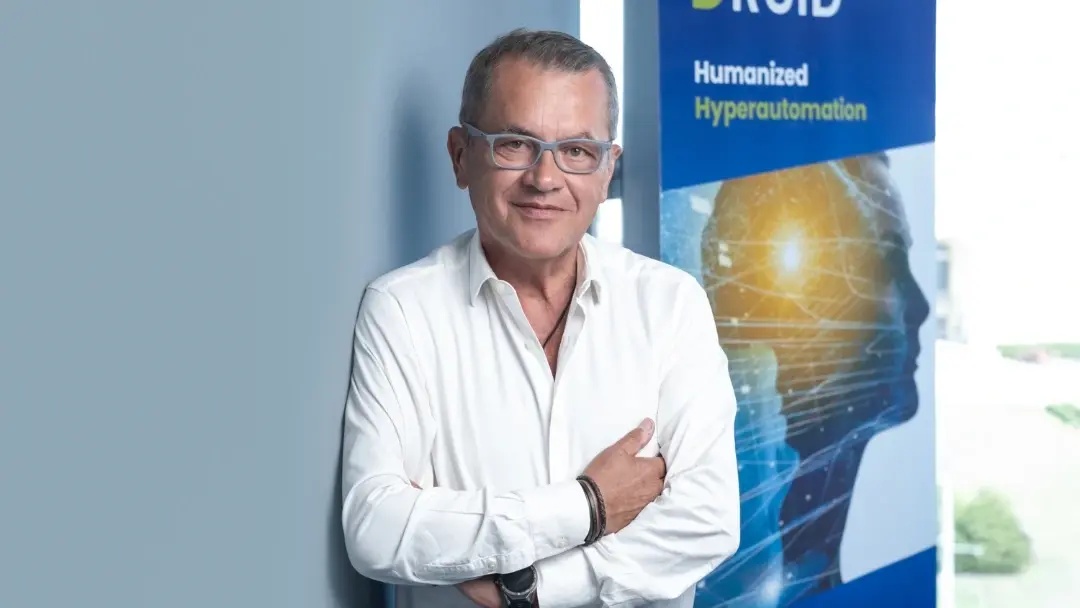
Returning with something to sell
Work abroad broadened his expectations. He spent time in Buenos Aires and Nigeria and worked in countries including Italy, Indonesia and Germany. He recalled uncertainty about returning to Romania after those experiences. The question involved working relationships and standards of living as well as employment. Returning meant choosing an environment in which to build, after seeing several others.
In 1994, he established TotalSoft with partners. The young business began with the distribution of Primavera project-management software. This was a commercial education as much as a technical one: software had to be sold into a market where the need for it could not simply be assumed. A functioning program was only part of the job. Someone had to understand why an organization would pay for it.
TotalSoft developed its own enterprise software business, with Charisma Enterprise launching in 2002. The name would become closely associated with Dragan’s career. Enterprise resource planning is an unromantic phrase for the systems through which organizations keep track of money, people and operations. Yet those ordinary processes are where a software company earns its place. A product that serves them well enters the everyday life of its customers.
He also helped found ANIS, Romania’s software-industry employers’ association, in 1998, and was elected to lead it in 2006. In 2003, he received Romania’s National Order For Merit at knight rank for his contribution to information technology and communications. His work had acquired a public dimension alongside the commercial one.
The customer who keeps you awake
Dragan’s account of leadership had a less glamorous centre than the usual conversation about growth. He described customer dissatisfaction as his particular fear. A customer had chosen the company on trust; failing that customer created pressure to act quickly. He attached value to fair play toward the organizations that had placed confidence in his work.
He also called himself ambitious and acknowledged his impatience. These observations sit comfortably together. An impatient founder can push a company forward, but a customer’s problem supplies a different deadline from an investor’s presentation. His description suggests a working standard rooted in the obligations that follow a sale. The successful pitch creates a relationship whose demands continue long after the applause has stopped.
That concern helps explain why enterprise experience mattered to his next venture. Corporate software lives among existing systems, habits and responsibilities. A new interface has to deal with what is already there. The elegant demonstration is the beginning of the conversation; the customer’s ordinary Tuesday is where the idea must continue to work.
By the time DRUID attracted a new generation of investors, Dragan had spent years with this practical side of the software business. He could imagine a different way of interacting with company information while recognizing the systems that held it. The new venture asked for a fresh start, but the problems its customers faced were familiar territory.
A question instead of a maze
DRUID’s founding idea was self-service: let someone obtain information or carry out a task without first finding another person to explain the process. Dragan imagined a conversational route through the organization. Ask for what you need, rather than discover which application, screen or colleague stands between you and the answer.
In an April 2024 conversation, he acknowledged that the company looked different from what he had originally imagined. The underlying purpose had survived. That distinction allowed the product to evolve without abandoning its reason for existing. Self-service supplied a direction; the available technology determined what could be built along the way.
The enterprise setting made partnerships consequential. DRUID worked with UiPath to connect conversational capabilities to robotic process automation. By 2020, partners in the United Arab Emirates and the United States were adopting DRUID technology for automation projects. Conversation could become a way into processes, rather than remain a little box answering questions at the edge of a website.
FAN Courier provided a concrete example. In July 2020, the Romanian delivery business announced a DRUID assistant for customer questions, with further support planned for its SelfAWB service. Parcel tracking is hardly a philosophical problem until a parcel disappears. Then the question becomes urgent, specific and repetitive. Such work gave the conversational idea a useful place to prove itself.
The bookshop exception
One customer brought his earlier interests back into the business. In 2021, the bookseller Cărtureşti adopted a DRUID assistant for customer support following a pilot at the end of 2019. The assistant handled common questions, taking routine work from the call-centre team. Dragan’s description of the partnership was unusually personal: his attraction to books, art and culture made it a project close to his heart.
The connection makes sense alongside his writing. On his personal blog, he reflected on his father, the engineer and academic Gleb Dragan. He wrote about admiration, modesty and the affection his father inspired. Business achievement receded from the foreground. The qualities he wanted to honour were dignity and honesty, and the example of a life that other people valued.
Another post described arriving late to a Romanian Academy gathering devoted to his father’s work. He entered preoccupied with traffic and his schedule, then became absorbed in the people speaking. The scene moved him because their warmth changed his sense of what mattered in that room. The executive’s timetable briefly lost its authority.
His own mornings made room for a different pace. He described reading several books across history, fiction and other subjects, reserving two or three quiet hours on weekends. Reading was a deliberate habit. A founder occupied with making information easier to retrieve still enjoyed spending time with words that asked him to stay.
The numbers grew. The purpose had to keep up.
In May 2022, DRUID announced a $15 million Series A led by Karma Ventures and Hoxton Ventures. The investment supported hiring and expansion across Europe and North America, together with further development of its conversational offering. Capital brought the means to reach more customers; it also brought a larger organization to manage.
A $30 million Series B followed in September 2023, led by TQ Ventures. New investors included Smedvig Capital, Endeavor and Verve Ventures. At that announcement, the United States accounted for 60 percent of company revenue. Those figures describe a business that had moved beyond its Romanian starting point. They also explain why the next phase of Dragan’s working life increasingly pointed west.
At the end of 2023, he discussed plans to manage DRUID from New York while continuing to travel to the Bucharest team and other offices. In his 2024 Endeavor interview, he was speaking from New York and mentioned using the organization’s offices. Access to its network mattered to him, and he expressed particular pride in Endeavor Catalyst’s investment.
His public remarks about investor responsibility were quite grounded. In 2024, he put meeting the company’s budget ahead of dwelling on valuation. It was another version of a recurring obligation: once other people trusted the venture, the founder owed them delivery. The story could attract people, but it still needed a feasible product and the money to build it.
A story other people can carry
Dragan’s death was announced by DRUID in May 2025. The responses from colleagues remembered a mentor as well as a founder. Cristina Calut, who had joined the company four years earlier, recalled his passion in their first interview and the trust he later gave her. Such recollections concern the small exchanges through which a company becomes a place where people choose to stay.
In September 2025, DRUID announced a $31 million Series C and Joseph Kim’s appointment as CEO. Its next chapter belonged to a team that included co-founders Andreea Plesea, Daniel Balaceanu, Bogdan Pietroiu and Bogdan Grigorescu. This is part of Dragan’s legacy with an observable consequence: the organization continued building and raising capital after its founding leader was gone.
The shape of his career resists a tidy progression from artist to engineer to executive. The teacher remained interested in explaining. The painter kept an attachment to art. The writer thought about emotional connection. The founder took those inclinations into businesses whose products had to withstand the much less poetic requirements of budgets, systems and customer service.
He had spent years accumulating experience and then made the effort to loosen its grip. That is the useful tension in his second beginning. Starting over gave him another story to work on; the people around him gave that story somewhere to go. A blank sheet, in his hands, was an invitation to build something others could believe in too.