A form is an unlikely place to look for a life story. It has boxes to fill, instructions to obey and very little interest in your feelings. Yet the form opens a useful door into Basit Hamid’s career. In 1985, he helped found a company around the work of making documents easier to create. The equipment has changed several times since. The problem has proved remarkably durable.
Hamid’s company, Elixir Technologies, began in the world of desktop design and production printing. He served as its CEO until 2019, then became co-chairman. Across that span, his story touches Los Angeles, Prague and Islamabad, along with a cast of programmers, business partners and colleagues whose contributions deserve more room than the usual founder photograph allows.
A document finds its desktop
Before Elixir came Intran, where graphical tools brought forms, fonts and images to the screen. Its software ran on specialist workstations. An early complete system could cost more than $100,000. Useful capabilities existed, but getting hold of them required a substantial purchase. The document might look modest. Its supporting machinery had expensive tastes.
Intran’s difficulties created the opening for another beginning. Hamid and Eric Searle left the company, moved to Los Angeles and founded Elixir in 1985. They set out to bring those document-design capabilities to the IBM PC/AT using Digital Research’s GEM graphical environment. By late 1986, Elixir had a working form designer and document converters.
The consequential choice was the platform. A tool becomes a different proposition when it can sit on familiar office hardware. The person buying it has fewer unfamiliar pieces to consider. The person using it can work at a desk rather than treating the production printer as the place to discover whether a design will behave.
That last distinction matters. Designing a document and printing it are related activities, but they need different kinds of attention. A screen gives the designer room to adjust. A production machine needs a job it can execute. Elixir occupied the connection between the two, where a small improvement in how people worked could make a large piece of equipment more useful.
Familiar office hardware.
Elixir brought graphical document-design capabilities to the IBM PC platform.
The company’s early work had several authors. Searle, David Simon and others built its initial tools. Bruce Damer joined in 1987 and worked on font and image editors and an integrating desktop. The names help restore the scale of the undertaking. A founder can choose a direction; a functioning product requires people who can make the details agree.
The office form goes travelling
In 1988, Xerox signed Elixir products for worldwide distribution under the Xerox brand. The relationship gave the young company a way to reach customers through an established printing business. It also placed its software in the very setting for which it had been developed: organizations producing documents in quantity.
There is a pleasing reversal here. The document appears to be the final, static object. Behind it sits a network of people moving between companies, cities and technical systems. Follow an ordinary statement backwards and the supposedly dull paperwork starts acquiring an itinerary.
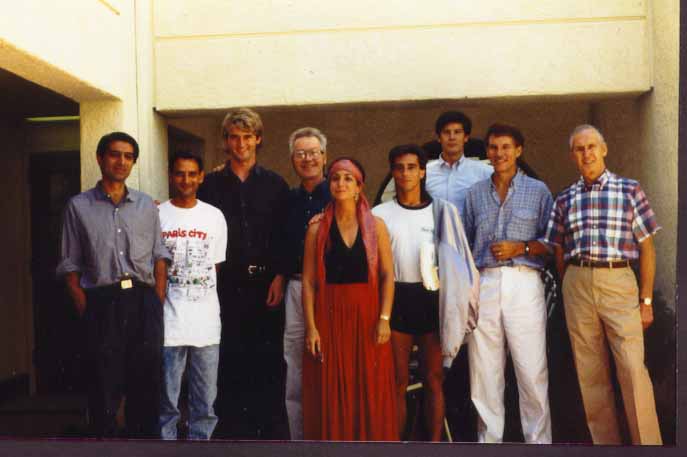
The Ojai team photograph from early 1989 gives this business a human scale. Hamid stands second from the left. Feroz Zaidi, Damer, Searle and other colleagues appear in the same frame. There are no product specifications to read. For a moment, a company that sells document tools is simply a group of people standing together.
Such photographs are useful correctives to the way business biographies shrink organizations. The founder gets a name in the headline, and everyone else risks becoming “the team.” Here they have faces. The software’s history becomes easier to imagine as a shared undertaking, with separate skills and relationships behind the finished product.
Prague, with a modem attached
The next phase required a different kind of construction. Elixir established a Prague engineering operation as it prepared to move its software into Windows. Hiring began in 1990; regular office operations followed in autumn 1991. By 1994, the Windows product line had reached the market. The transition depended on the Czech engineers who carried it through.
Damer’s recollections of that operation are refreshingly physical. The lab occupied a restored villa in Prague’s Bílá Hora district. Engineers worked in Prague and nearby towns. Monday meetings brought them together to merge code. Dial-up modems and Lotus Notes connected the work before the web became an ordinary part of office life.
The modem belongs in the story because international software development can otherwise sound weightless. The word “global” conceals telephone connections, office rooms, travel arrangements and the patient work of getting people to understand one another. A file has to reach the other end. Someone has to decide which version is the right one.
Monday meetings supplied a rhythm to the operation. Work done separately came back into a shared room and a shared product. That arrangement makes the lab feel less like a distant dot on a corporate map and more like a workshop: people bringing in what they had made and seeing whether the pieces fitted.
- 1985Elixir begins in Los Angeles
- 1988Xerox worldwide distribution agreement
- 1994Windows product line reaches market
- 2019Hamid becomes co-chairman
For Hamid’s biography, Prague supplies more than evidence of expansion. It shows how a company’s next stage can depend on finding people in another place, then doing the less picturesque work of sustaining that relationship. An international ambition still has to survive an ordinary working week.
The connection also complicates a simple story about invention. Elixir needed to keep useful software alive while its operating environment changed. That task asks for continuity as well as novelty. Existing customers have work to do; their documents do not become optional just because the software industry has discovered another platform.
A business that outlived its hardware
By 2017, Hamid was discussing cloud communications and data rather than only desktop tools. He spoke about helping customers move from legacy systems and making information useful across organizational boundaries. His concern with data silos fits the earlier history: a capability loses value when the people who need it cannot readily reach it.
“Elixir is one of the few CCM companies that is still private.”
Basit Hamid, 2017
The remark points to a business choice as well as a financial description. Hamid connected private ownership with the ability to make decisions quickly. For a company working through successive technical changes, the question of who decides has practical consequences. Product direction, customer demands and the time needed to carry out a change all meet in the same business.
A desktop tool and a cloud platform inhabit different technical worlds. Looking across them, however, makes one recurring concern visible: the distance between the work a business wants done and the machinery that will do it. A form designer narrows that distance at the screen. Better access to data addresses it elsewhere in the process.
This is a useful way to read Hamid’s career without treating every product generation as a separate identity. The office has changed its equipment. People still need to compose something, check it and get it to the right destination. The process can accumulate considerable complexity around a document that looks perfectly innocent when it arrives.
The colleague in the acknowledgments
Another part of Hamid’s story appears in the opening pages of Damer’s doctoral thesis. Damer thanked him for funding and logistical support, including travel and fees, and for encouragement over a friendship spanning twenty-five years. The acknowledgment extends a relationship that began during Elixir’s early product development.
It is a small piece of writing with a different purpose from a company announcement. A product release tells the world what is ready to buy. An acknowledgment records help that made another person’s work possible. Both describe contributions, but only one typically makes it into the business chronology.
Placed beside the early team photographs, that acknowledgment gives Hamid’s career another dimension. Colleagues can remain connected after the immediate job has ended. Their work may take them elsewhere, yet an earlier relationship continues to have a practical effect. A company’s history can leave traces in places well beyond its own products.
A different chair, another conversation
In 2019, Tarek Harry became Elixir’s CEO. Hamid moved to co-chairman alongside former president Feroz Zaidi. Harry had served on the board since 2014 and as chief operating officer since 2016. The succession brought a different arrangement to a company Hamid had led for more than three decades.
Then, on February 9, 2026, Hamid represented Elixir at FAST-NUCES Islamabad Campus. University leaders and heads of schools and departments joined the meeting, and Elixir expressed interest in closer cooperation. The event brings the story to a concrete recent setting: a founder in conversation with an institution that educates future professionals.
It is an apt place to leave him. Across the early PC business, the Prague lab and the later company, the work repeatedly comes back to people getting access to tools and opportunities. A form offers little personality of its own. Follow the people who made it easier to create, and there is quite a life behind the boxes.