A pizza box is an oddly demanding thing to sell online. The cardboard is straightforward. The customer’s ambition is less so: put my artwork here, show me what it will look like folded, let me order a small quantity, and please make the whole transaction feel ordinary. Behind that ordinary experience sit design tools, business software, printers and fulfillment providers. Each has its own idea of what an order ought to look like.
Distinct Packaging wanted to bring those parties together. Its proposition was short-run, customized packaging through a self-service portal, accessible to people without design expertise. Tecra supplied the AccuConnect platform and the systems integration architecture. A box that could be personalized in a browser had to remain the same box when it reached production.
- Tecra connects personalized communications and commerce to the systems that approve, produce and deliver them.
- Its offering combines enterprise software with integration, storefront design and template services.
- The useful lesson: inspect the handoffs, and give each user only the decisions they need.
The box had to survive the checkout
The packaging project makes Tecra unusually easy to understand. A manufacturer’s existing business-to-business infrastructure had to support a consumer-facing experience. The customer needed a real-time proof. The factory needed usable production information. The enterprise resource planning system, or ERP, needed an order it could recognize.
Tecra’s account describes a dedicated development team, a single point of contact, an HTML5-based 3D viewing and editing tool, and connections to ERP and fulfillment systems. It also describes coordinating partner teams in four US regions alongside offshore development. The work extended from the interface to the underlying architecture.
The portal launched in early 2018. Tecra reports that Distinct Packaging acquired hundreds of customers within months and began with more than ten packaging product categories. Pizza boxes shared the catalog with mailing boxes, beverage carriers and golf-ball sleeves. A small order could now enter a system designed to handle a much larger business.
“The work we have done creates significant barriers to entry for our competition”
Dwight Blaha, General Manager, Distinct Packaging
The practical insight is that a convincing preview is only one part of customization. Someone also has to preserve the customer’s choices through ordering, production and dispatch. A gorgeous storefront can still leave a person copying details into another system. Tecra’s work reaches into that less photogenic territory.
Four products, four places to intervene
Founded in 1998 and led by founder and CEO Giri Gondi, Tecra works across marketing communications, customer communications management and print fulfillment. Its customers include enterprises, marketing agencies and print service providers. Healthcare, financial services, insurance, utilities, franchises and real estate appear among its target markets.
AccuConnect is the ordering and marketing platform. It handles branded storefronts, approved assets, personalized templates, campaigns and fulfillment. A distributed team can adapt material for its own audience while operating within centrally defined brand rules. That makes it useful where local relevance and corporate consistency have to coexist.
Quickcoms addresses controlled customer communications: notices, documents and messages that require approvals, traceability and dependable delivery. Its published capabilities include role-based permissions, audit trails, visual workflow configuration and print, email, SMS and other channels. A communications team gets tools to change content while keeping the approval process visible.
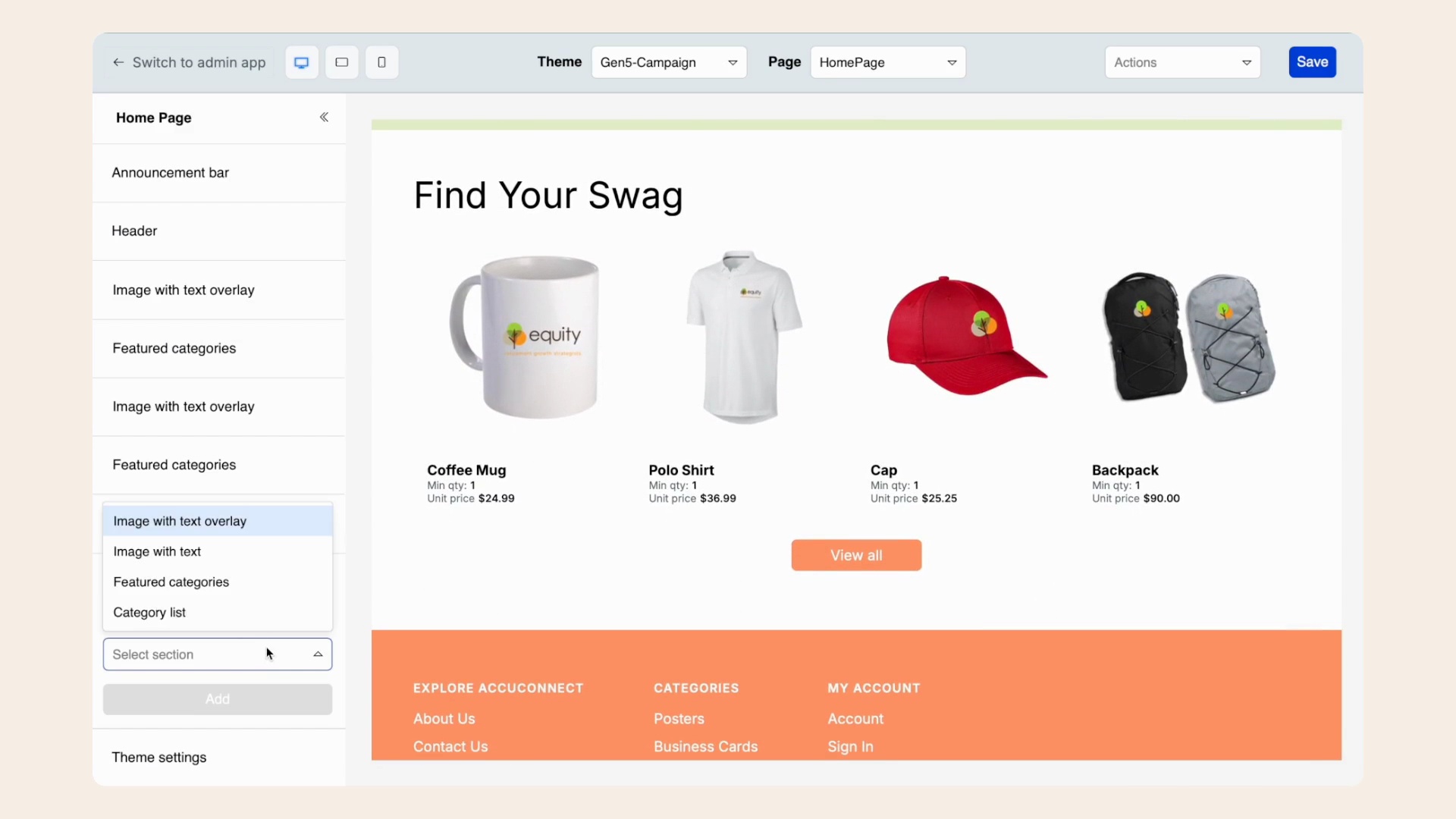
AccuLync extends storefronts a business already uses, including Shopify, BigCommerce and WooCommerce. It adds template-driven personalization, inline proofs, job consolidation, kitting and mail processing. For an operator receiving orders from several shops, the attraction is a common production process behind them.
PrintOps Hub moves further onto the production floor. Tecra describes automated facility routing, live job tracking, carrier rate shopping and incident monitoring. Its advertised AI routing considers production conditions and can reroute work when a press goes down or a facility reaches capacity. These are product capabilities, rather than measured outcomes from the packaging project.
- 01PersonalizeTemplate + customer data
- 02ApproveProof + permissions
- 03ProduceComposition + routing
- 04DeliverFulfillment + tracking
Different Tecra platforms cover different stages. Integration carries the information between them.
The advisor needed fewer choices
One of Tecra’s more instructive case studies concerns an unnamed financial services firm with more than 50,000 employees. Advisors needed personalized materials for client meetings. The ordering process offered too many customization choices and confusing print finishes. Asking someone to become a print buyer before ordering a brochure was a peculiar use of their afternoon.
AccuConnect was integrated with Salesforce, PeopleSoft and single sign-on. Location feeds and access controls helped direct people toward the materials available to their departments. The interface reduced customization to a few choices per product and turned frequently used options into templates.
Tecra reports a 50% reduction in ordering time and 83% fewer order mistakes. Those figures belong to this particular deployment. The mechanism is more portable: remove decisions that require specialist knowledge, standardize the recurring work, and keep enough flexibility for the user’s actual task.
fewer order errors after standardizing and simplifying print options
That same concern for repeated work appears in Tecra’s bulk-ordering example. An unnamed fast-casual chain managed 2,500 locations and close to 3,000 store-level orders per cycle. The procurement team had been filtering spreadsheets and routing requests manually. AccuConnect introduced location filters and bulk product assignment while retaining store-level billing. Tecra says the cycle fell from hours to minutes.
The software arrives with people attached
Tecra’s business model combines B2B SaaS with professional services. Its sales process invites a demo, and its implementation offering begins with discovery and an enterprise audit. Architects and developers connect systems; graphic specialists build templates and configure products; project managers coordinate delivery. The service work is part of making the platform usable in a particular organization.
Its partner network reflects that job. XMPie supplies document composition and variable-data capabilities. CHILI Publisher supports template editing and proofing. Shipping, payments, postal processing and customer data bring further integrations into the picture. Tecra has a long-term relationship supporting Office Depot’s enterprise ordering, and publicly describes relationships with Exela, 360insights and Xeikon.
In the broader customer communications market, Quadient Inspire also offers creation, personalization, delivery and governance across print and digital. Tecra’s distinctive emphasis is the combination of communications software, commerce, physical fulfillment and bespoke integration. The relevant comparison depends on the job: replacing a notices system is a different purchase from connecting several merchandise storefronts to one production operation.
The packaging case describes delivery on time and within budget. The restaurant case’s $300,000 in monthly orders measures purchasing throughput. Neither figure is a Tecra software price. For a buyer, the meaningful cost calculation includes platform access, integration, template work and ongoing support, weighed against manual handling, errors and production expense.
Before the draft, after the send
On September 24, 2026, Tecra published details of new AI features in Quickcoms: first drafts, campaign variations, content refinement, translation and natural-language exploration of reporting data. Those additions bring writing and analysis into the same environment as communication workflows. Their practical value depends on how well they fit the approvals and records an organization already needs.
Speed was already a concern. In Tecra’s title-insurance case, COVID-era remote work exposed the difficulty of manual document delivery. Quickcoms processed pre-composed documents, applied tracking codes and routed print-ready output to approved vendors. Tecra reports turnaround falling from days to four hours and operational costs declining by 40%. The intervention joined content handling to fulfillment visibility.
There is a useful buying test here. Take one real order or notice and follow it from creation to receipt. Count the places where someone retypes information, asks for status or makes a choice they do not understand. That exercise can reveal whether the problem is the template, the interface, the integration or the production queue.
The approach makes most sense when repeated work crosses several systems and the volume justifies configuring those connections. A simple shop selling fixed products has fewer moving parts. A workflow with unreliable data or undefined approval rules needs those foundations repaired before automation can carry it safely. Those are operational implications of the projects, rather than promises of another percentage saving.
For Tecra, the custom box remains a useful emblem. The customer changes a design, checks a proof and places an order. The machinery behind that small act has to agree on what was bought. When it does, personalization becomes something an organization can deliver repeatedly, with fewer people translating between its systems.
Follow the order a little further
Explore Tecra, AccuConnect, AccuLync, Quickcoms and PrintOps Hub.
Watch the Gen5 storefront demo or visit the product video library. Browse the company blog and follow LinkedIn, X or Facebook.