The interesting thing about an X-ray image is how many transformations happen before anybody can look at it. Radiation passes through an object. A thin layer of cesium iodide turns that energy into visible light. An array of photodiodes receives the light. Transistors, electronics and software coax the resulting signals into a picture. By the time the image appears on a screen, the detector has done its work and vanished from the story.
Liu Jianqiang noticed the disappearing act and built a company around it. His choice was neither the entire scanner nor the polished interface. It was the flat panel in the middle, where physics becomes data and a small failure can spoil everything downstream. CareRay Digital Medical Technology began in Suzhou in 2007 with Liu and a team of engineers. Nineteen years later, he remains its chairman, general manager and technical director.
This is a founder story about choosing a layer. It is also about the kind of temperament that layer demands: a tolerance for materials science, manufacturing yield, calibration, supply chains and progress measured in quieter units than applause.
A career arranged around invisible things
Liu studied at the California Institute of Technology from 1989 to 1995. His LinkedIn profile lists electrical engineering as his major and astrophysics as his minor. The pairing has an almost literary symmetry. Astrophysics asks what can be learned from faint light that has travelled a very long way. Electrical engineering asks how to build the instrument that listens.
His working life brought those questions closer to earth. Public company filings record a run as a senior engineer at GE Global Research in New York, followed by management of engineering at PerkinElmer Optoelectronics. He later held technical and executive roles at LS Technologies and Superimaging, where the work ranged across imaging, materials and displays. The job titles moved from engineer to manager to CTO and founder. The recurring problem stayed legible: capture a signal, reduce the noise, make the result useful.
“We believe the digital flat panel technology will ultimately revolutionize the medical diagnostic imaging business.”Dr. Jianqiang Liu · CareRay product brochure, 2014
Liu's own public introduction is delightfully unvarnished. He calls himself an entrepreneur and engineer who likes to invent and solve problems, and who likes a challenge. There is no personal mythology in it. The sentence reads like an engineer's label on a drawer: brief, accurate, more interested in the contents.
The quiet translation inside the machine
Four years from company to commercial proof
When CareRay was established in 2007, digital radiography was already a known direction. Liu's wager concerned control. The company developed its own direct-deposition process for building cesium iodide scintillators and paired it with signal processing, electronics and flat-panel design. Owning more of the stack meant accepting more ways for the stack to misbehave. It also created more places to improve it.
In 2011, CareRay launched what the company describes as the first commercially available direct-deposition CsI flat-panel detector in China. The importance of the date lies in the word “commercially.” A laboratory result can be charmingly singular. A product must repeat itself on a production line, survive shipping, integrate with somebody else's equipment and behave the same way on an inconvenient Tuesday.
This is where Liu's experience in both research and engineering management mattered. A detector is not one invention. It is an agreement among layers: the scintillator, the thin-film transistor and photodiode array, the readout electronics, the protective housing, the firmware and the calibration. Improving one while unsettling another is easy. Making them behave as a product is the work.
CareRay's useful strategic trick was to remain narrow in technology while becoming broad in application. The same core competence travelled into general radiography, mammography, fluoroscopy, radiotherapy, dental systems, veterinary equipment, industrial inspection and security. The company changed sizes, frame rates, housings and software while keeping the detector as its intellectual center.
The CareView 1500C offers a small example of how much has to gather around the sensor. The cassette-sized portable detector needed imaging performance, electronics, firmware, a protective shell and a form people could carry. In 2015, it received an Iron A' Design Award in the medical-device category. The published credits name Liu as CEO alongside a team spanning marketing, mechanical design, electronics, engineering and software. It is a useful correction to the lone-inventor portrait. Complicated hardware arrives as a relay race, and the founder's work includes assembling runners who can hand the problem to one another without dropping it.
That integration also explains why product generations matter. A lighter enclosure is not merely cosmetic if a detector moves between rooms. Wireless operation changes how it joins older equipment. Water and dust protection affect where it can work. Faster acquisition opens dynamic uses. Smaller pixels can help in one setting while sacrificing efficiency in another. The attractive answer is rarely “more” of every specification. It is the right arrangement of trade-offs for the image, dose, workflow and price a customer actually needs.
Electrical engineering and astrophysics at Caltech.
Engineering and leadership roles at GE, PerkinElmer, LS Technologies and Superimaging.
CareRay founded, followed by its first commercial direct-deposition CsI detector.
CareRay lists on Shanghai's STAR Market and Liu lectures at a state key laboratory.
A new global headquarters opens in Suzhou.
The founder at the whiteboard and the lectern
In February 2021, CareRay began trading on the Shanghai Stock Exchange's STAR Market under ticker 688607. Liu's message for the occasion was notably operational: improve internal management, strengthen the brand, compete globally and meet demand for core components and solutions. Even at the bell-ringing moment, the verbs were improve, build, compete and meet.
Later that year, he visited the State Key Laboratory of Particle Detection and Electronics at the University of Science and Technology of China with three CareRay technical leaders. The group discussed research needs and possible collaboration. Liu then gave an academic report on digital X-ray flat-panel detectors to faculty and students. The sequence tells you something. The chief executive still showed up as the technical director.
His curiosity occasionally becomes more playful in public. One item he shared on LinkedIn involved a CT reconstruction of a cup of candy canes. The hidden air bubbles were not round, as they often are in castings, but long, twisted tubes created by kneading and stretching. It is difficult to imagine a cleaner advertisement for an imaging engineer's mind: even holiday sugar contains a signal worth reconstructing.
What a 19-year bet looks like now
CareRay now has operating entities in the United States, India, Italy, Japan and South Korea, and says its products reach more than 30 countries and regions. The 2025 annual report recorded RMB 320.86 million in revenue, up 7.63 percent from the previous year. It also recorded a net loss attributable to shareholders. Public companies remove the luxury of telling only the smooth parts.
The company's current map is wider than flat panels alone. Its filings describe work on CMOS and metal-oxide sensors, intelligent beam collimators, high-speed dynamic detectors, photon counting and software that combines positioning, control and image functions. It is also developing a second line of business around AI-enabled equipment and services. The strategic risk is obvious: every new spoke can pull attention from the hub.
The financial record makes the tension visible. Revenue rose across 2023, 2024 and 2025, while research spending remained material and the bottom line moved into a loss in 2025. The numbers do not provide a personality test, but they do show the cost of running today's factory while funding tomorrow's detector. For an engineer-founder, the spreadsheet and the laboratory bench eventually become the same argument conducted in different units.
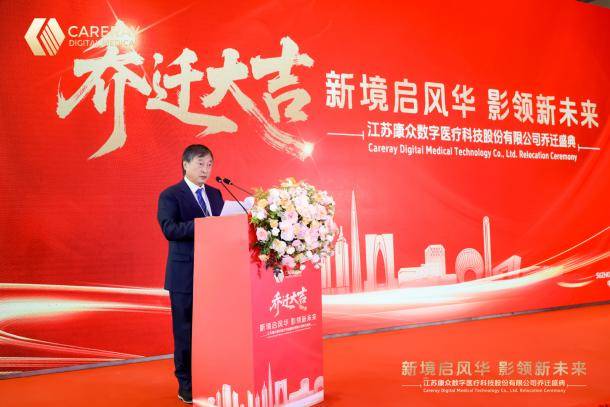
Liu's public language keeps returning to that hub. At the opening of CareRay's new global headquarters in Suzhou in April 2026, he called the move a milestone and described the site as a base for technical innovation, industrial upgrading and customer service. Three collaborations announced at the ceremony covered local CMOS detector manufacturing, intelligent diagnostic technology and information services. The building was new. The organizing principle was familiar: deepen the component, then connect it to more of the system.
There is a general lesson here for founders who work below the glossy surface of a product. The invisible layer can be an excellent place to build. Customers care because failure there is expensive. Competitors cannot copy it with a prettier landing page. Expertise compounds through process knowledge that is hard to photograph and harder to hurry.
A component can be small in the room and large in the strategy.The CareRay pattern
Liu chose a piece of the machine that most people never name. He spent years learning the physics, then more years making that physics repeatable in a factory. CareRay's story since 2007 has been the widening consequence of that choice.
The detector still disappears when the finished picture arrives. Perhaps that is the trick. Good infrastructure makes the difficult look immediate. Somewhere between the photon and the screen, Liu Jianqiang found enough work for a lifetime.