In October 2016, John Li agreed to transfer an entire company for one dollar. All of it: 100 percent of the shares in Salubris Biotherapeutics, a Delaware corporation established that August. The buyer was Chengdu Jinkai, a subsidiary within the Salubris group. Li had registered the company in his own name, carried out preliminary preparations, and was due to build its research team. A scientist’s new venture had arrived at a distinctly unscientific milestone: the paperwork was catching up with the plan.
The price had a practical explanation. The subscribed capital had not yet been paid in. Registering the company personally had allowed preparations to proceed and laboratory resources to be secured before the transfer. The dollar was the agreed price for that corporate handover. It bought the shares in a newly organized operation whose work still lay ahead.
Seven months later, Li would host its laboratory opening in Gaithersburg, Maryland, with officials from three levels of government in attendance. A mayor would give the company its own day. The distance between those two events measures a particular kind of professional change: an experienced scientist becoming responsible for the institution around the science.
A dollar, and a laboratory to secure
SalubrisBio was incorporated on August 11, 2016. Its formation belonged to the Chinese parent company’s effort to establish a research operation in the United States. Li, who had joined the group’s research organization that year, handled the preliminary company formation. The plan gave him another concrete assignment: assembling the team.
There is a useful modesty to this beginning. Before the company acquired a ceremonial ribbon, it needed a legal existence and somewhere to work. The initial arrangement addressed the timing of those tasks. Li’s personal registration of the company let preparations move ahead; the subsequent share transfer brought it inside the group’s ownership structure.
For a founder, that is already a different kind of work from leading an experiment. There are premises to secure and an organization to establish. The details are administrative, yet the resulting laboratory is where everyone else’s work must happen. In Li’s case, the responsibilities appear side by side at the beginning: organize the company, then organize the people.
100% of the newly formed company’s shares. An ownership transaction, with the laboratory and team still being established.
The education before the incorporation
Li came to the task with a career in research already behind him. He earned his bachelor’s degree at Fudan University and his doctorate at North Carolina State University. His professional biography places him in scientific leadership at Tanox, GlaxoSmithKline, and MedImmune before SalubrisBio. The academic route connected China and the United States well before his own companies did.
Those earlier employers give the founding story its scale. Li was entering company formation after working within established research organizations. The change in responsibility is plain in the job descriptions: a scientific leader at earlier employers, then the founding president and chief executive of a new operation. Expertise that had been exercised inside an institution was now part of the case for establishing one.
The two universities also remain useful markers in a career spread across company names and national borders. Fudan supplied the undergraduate foundation; North Carolina State supplied doctoral training. Later came research positions, then responsibility for a company and its staff. Each stage added a different institutional setting to the same professional life.
B.S.→NC State
Ph.D.→Industry
Research→Company
building
A city puts the company on its calendar
On May 1, 2017, Salubris opened its new research and development laboratory in Gaithersburg. Li hosted the ceremony as SalubrisBio’s CEO. The guests included Maryland Lieutenant Governor Boyd Rutherford, Gaithersburg Mayor Jud Ashman, Montgomery County Executive Isiah Leggett, and Salubris leader Kevin Ye. A venture with a Chinese parent was formally introducing its American operation to its neighbors.
The location had required its own professional work. Scheer Partners represented Salubris in finding the facility, negotiating the arrangement, and handling the build-out. Henry Bernstein represented the tenant. That is the less photogenic part of the opening-day picture: before people can assemble for a ribbon cutting, somebody has to locate the space and get it ready.
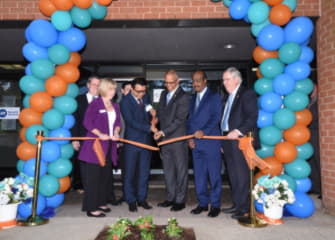
Ashman designated May 1 Salubris Day in recognition of the company’s contribution to the community. It is an appealingly literal welcome. A business registered in Delaware, backed through China, and operating in Maryland had acquired a place on a city’s calendar. International expansion had produced a local occasion, complete with the mayor.
Li welcomed the officials and thanked them for their support. His role that day was public and connective: the host bringing the company, its parent organization, and its new surroundings into the same event. The founding title had acquired a visible setting. There was now a laboratory to open and a community to address.
The second company brings a different problem
That year also put Li on a professional association’s program. The Chinese Biopharmaceutical Association scheduled him for a quarter-hour presentation in its global collaboration session, alongside other business and institutional representatives. The session was co-chaired by Ziping Wei and Jenny Zhao. His affiliation appeared simply as Salubris. After the laboratory opening, the company had a place in another kind of gathering: a program where people working across organizations and countries met to discuss collaboration.
Li’s next company-building chapter took shape at Latticon. Its Suzhou company was established in November 2020. By the 2023 Biotech Showcase, Li was listed as CEO of Latticon Antibody Therapeutics, the American company whose conference entry gave 2021 as its establishment year. Suzhou and Maryland both featured in the organization’s research footprint.
In 2023, Li spoke about a problem that required an answer outside the laboratory. Raising equity had become difficult. Investment institutions were cautious, fundraising took longer, and the interval between funding rounds could leave a young company short of operating money. He described the need for bank credit to help cover that interval.
There was a further complication. A research company can hold much of its value in intellectual property and technical work while owning relatively little conventional property to offer a lender. Li’s team needed funding for work in progress. The financing question was how that work could be understood as an asset by an institution accustomed to making lending decisions.
It was a different version of the responsibility he had taken on in Maryland. Establishing a place for research was one task. Keeping a research organization financed introduced another set of counterparties, documents, and decisions. In this chapter, the person arriving with a possible solution worked for a bank.
When the bank called
Agricultural Bank of China approached Latticon about financing backed by research-pipeline assets. Li said he had never encountered that kind of arrangement before. The bank, the Shanghai Technology Exchange, and the Yangtze River Delta technology-factor exchange organization worked on a structure that could register rights, assess value, and support a pledge.
“Finally, a financial institution truly recognizes the intellectual property value of our pipeline.”
John Li, 2023 · translated from Chinese
By May 2023, Latticon had obtained approval for RMB 10 million in credit. The first RMB 5 million loan was disbursed in digital renminbi. The collateral centered on assets associated with a research pipeline: a package that could include data, patents, and technical know-how. Knowledge accumulated through the company’s work had entered a bank financing arrangement.
A credit limit and an initial loan draw are different amounts. These figures describe company financing.
The numbers deserve to stay distinct. Ten million renminbi was the approved credit amount. Five million was the initial disbursement. The arrangement gave the company access to money under a lending structure; it also required a way to identify and evaluate the underlying rights. For Li, an unfamiliar banking product had become a practical part of running the business.
The exchange organizations had a specific role in making the transaction possible. Registering the assets and evaluating their value helped connect the company’s technical property with the bank’s lending process. The research team knew what it had been building. The financing arrangement supplied a formal route through which a lender could assess that work.
A career with more than one title
By 2026, conference coverage identified Li as Latticon’s founder and CEO. A July event report also identified him as its chairman. SalubrisBio’s current team, meanwhile, lists Sam Murphy as CEO. Li’s founding presidency and chief executive role belong to the earlier chapter of the company he established in 2016.
At the 2026 bioSeedin conference, Li appeared in a panel lineup alongside executives including Mingjiu Chen, David Shen, and Hong Ling, with Jinming Gu moderating. The listing placed him among fellow company founders and research leaders, this time under the Latticon name.
Putting those titles in sequence makes his career easier to see. There is the university-trained scientist, the research leader employed by established companies, the founder handling a new American corporation, and the executive explaining a funding problem in Suzhou. The settings change. So do the people he needs to work with: research colleagues, a corporate parent, local officials, exchange specialists, and bankers.
One dollar transferred the shares in 2016. A ribbon marked the opening in 2017. A credit agreement supplied another company with operating funds in 2023. Each event has its own scale and purpose. Together they give Li’s professional story something more tangible than a string of executive titles: the arrangements through which a scientist helped make room for people to work.