A publicist telling a room of aspiring founders to worry about the product sounds rather like a tailor suggesting that the customer first learn to stand up straight. Sensible advice, with a slight risk to the sale. In 2015, Lisa Frank made that argument to Cornell Tech students discussing how brands get built. Before the story could do its work, the thing being sold had to deserve it.
“The product has to be there. It has to be amazing, or why are we even talking about this brand”
Lisa Frank · Cornell Tech, 2015
Frank was then an executive vice president at Derris & Company, the agency she had helped establish two years earlier. The panel included people from Casper, Red Antler, Tumblr and Niche. Branding had plenty of advocates in the room. Frank supplied an entry requirement. There was little point making something sound appealing if the customer’s experience would promptly contradict the introduction.
It is a useful opening to a career spent close to consumer businesses. Frank would help expand the agency’s strategy and creative capabilities, work within a partnership that brought it into a larger group, and become CEO in March 2024. Across those changes, the practical problem remained familiar: a company needs something people can believe in after they have finished reading about it.
The partnership that took eight meetings
Frank’s route to founding an agency included Burson-Marsteller and LaForce + Stevens. At the latter, she worked on the Target account, including the retailer’s designer collaborations. Those assignments placed her in the everyday traffic between companies and editors, where a carefully prepared announcement can meet a journalist with other plans.
Lauren Sherman remembered that traffic from the journalist’s side. She recalled leaking details of Target’s closely guarded collaborations while working with Frank, and later travelling to Vancouver for Lululemon. The recollection includes a bargain pair of Céline trousers. Business relationships sometimes survive on strategy; a good shopping anecdote appears to help.
Neil Blumenthal, the Warby Parker co-founder, introduced Frank to Jesse Derris. Blumenthal had known both of them and sought their advice individually before their agency opened. The introduction connected people whose judgment he already trusted. Warby Parker became the firm’s first client.
Agreement took time. Jesse later told Sherman that he had met roughly 20 people while searching for a consumer-side partner, and that persuading Frank required eight meetings. The number gives the founding story an agreeable resistance to the usual instant revelation. A partnership needed discussing before it needed announcing.
In 2013, Frank and Derris began working from a small shared workspace on Manhattan’s 55th Street. Jesse would later give her substantial credit for making the company happen. The agency bore his surname, a convenient arrangement for the stationery and an incomplete account of the labor. Its co-founder was there helping turn the premise into a working business.
A customer and an investor walk into the same story
Derris grew alongside the direct-to-consumer businesses that became familiar names in the 2010s. Its relationships included Warby Parker, Everlane, Reformation, Harry’s and Glossier. The category supplied a particular communications problem: explaining a product also meant explaining a different way of doing business.
The firm combined consumer and enterprise communications, considering the buyer and the business audience together. Positioning became the starting point for work that could travel through different channels. Over time, established companies including Lululemon, Theory, J.Crew and Google also came to the agency.
That approach put Frank’s work near the decisions preceding a press release. A company’s customer and its investor may be interested in different aspects of the same operation. The company still has to be recognizable to both. It cannot keep a spare identity in a drawer for each meeting.
Frank’s comments about fashion made the requirement plain. Beautiful design alone no longer settled the question of whether a label could find its audience. As she put it, “every brand needs a reason for being.” A founder needed to explain that reason clearly. Taste was part of the proposition; a reason to choose was part of the business.
An editorial illustration of the relationship between substance, positioning and channels.
More ways to make an idea tangible
The business expanded geographically as well as in the kinds of work it could do. In January 2019, Derris acquired London agency Sample, run by Giorgina Whittaker and Naomi Meitiner. Sample took the Derris name. For clients looking outside the United States, the agency could now offer people working in the market they wanted to enter.
Frank also became a co-founding partner of Amity Supply, alongside Jesse Derris and Julie Halpin. Investment added another connection to early-stage companies. Her involvement placed her within a business concerned with backing founders as well as advising them on how to introduce themselves.
The agency’s partnerships extended the range further. Project Mercury, a venture with Mythology, offers pro-bono strategy, positioning and branding to underrepresented founders. Those services arrive while a business is still defining itself, when advice can influence the premise as well as the presentation.
In Person, a collaboration with hospitality specialists thank you, works on retail and experiences. Its remit includes temporary and permanent shops, customer experience, design and construction. A brand can be encountered as a room, a shop or an event. In those settings, the audience has the inconvenience of being physically present. The details have to cooperate.
By the time Frank appeared at the 2023 Future Focus conference, her responsibilities included building the agency’s core brand strategy capabilities and scaling its creative, content, experiential and influencer marketing businesses. She was president and partner. The work had become broader than managing the passage of a story into print.
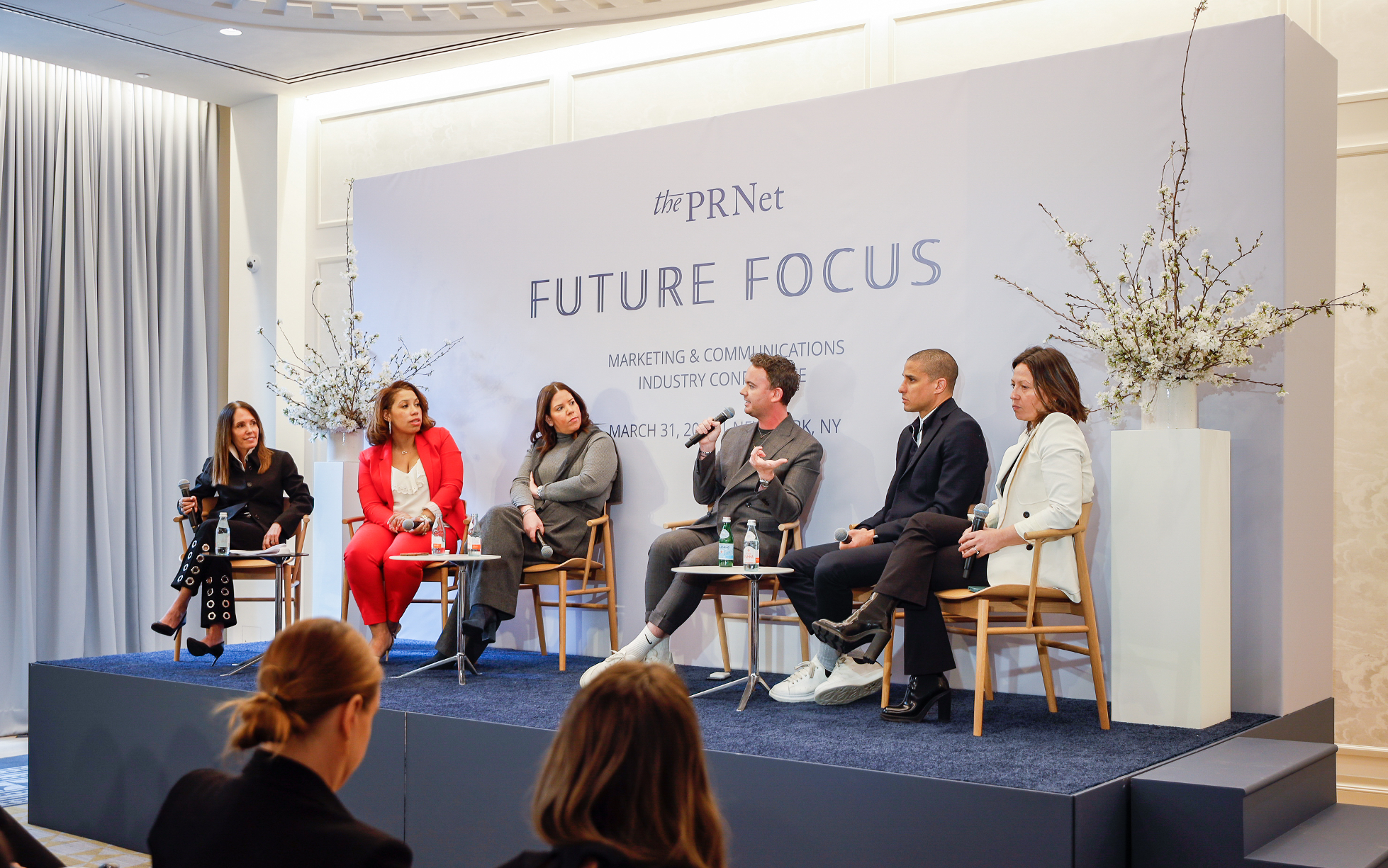
The conference question was “Is Traditional PR Dead?” Frank joined a panel with communications leaders including Elizabeth Harrison, Gabrielle Gambrell and Karina Sokolovsky. Her own brief already illustrated why the definition was under discussion: the agency was organizing around several ways a business could reach people, each requiring its own skills.
The people behind the succession
In 2022, BerlinRosen took a majority stake in Derris. The transaction kept the agency’s executive team in place while giving the business access to additional capabilities. Frank remained in the company she had helped establish, with a larger organization around it.
The next significant change came in March 2024. Frank became CEO. Jesse moved into the chairman role at Derris and a chief strategy officer position at Orchestra, the newly named parent group. The partners were changing the allocation of responsibility after more than a decade of building together.
Jesse’s public explanation of the transition paid particular attention to the people Frank had developed inside the business. He named Abby Dixon, Julie Brown, Lena Griffin, Lindsey Gilchrist and Samantha Weiss. They were ready to lead, he said, and the timing reflected that readiness.
The names matter. Agency stories are often told through a founder and a list of clients, leaving the people between them to materialize mysteriously whenever something needs doing. Here, the explanation for a new chief executive included a team that had grown within the company. The succession depended on more than finding someone for the top job.
The agency figure reported in April 2024, when several senior leaders were described as having started in entry-level roles. A historical snapshot, without a published measurement period.
The retention figure gives a dated glimpse of that continuity. It does not explain every working relationship inside the firm. Alongside the internal promotions, though, it helps make the leadership announcement legible: Frank was taking over an organization in which people had already spent years developing responsibility.
A new role in a familiar company
Frank described the CEO appointment as a chance to continue changing while staying with the business. The attraction was room to evolve her own role. That is a different career move from leaving one organization for another, with all the novelty that an unfamiliar desk and a fresh set of passwords can provide.
Her announced responsibilities included the agency’s newer lines of business and international growth. Today, Derris describes offices in New York and London and a team of more than 75. Orchestra lists Frank as a partner on its executive committee. The shared workspace has acquired considerably more colleagues.
One glimpse of her public activity returns to those colleagues. On LinkedIn, Frank shared a team member’s account of a Bath & Body Works campaign involving Hilary Duff. The work ranged from communications strategy to experiences and mailers. It is a compact example of the different formats now involved in putting a consumer brand’s story into circulation.
The CEO title gives Frank responsibility for the organization behind such work. Her earlier remarks give that responsibility a useful measure. A brand needs a reason to be chosen. A product needs to support the promise. And an agency needs people capable of keeping the various parts in conversation. The announcement arrives near the end of that process. Frank’s career has been spent helping build what comes before it.