Before Lindsey Carnett had a marketing agency, she had a soccer trip to pay for. At 16, she was offered the chance to represent Washington State in China, playing against girls training for the Chinese Olympic team. There were car washes to organize and money to raise. She and her teammates contacted the local press. Feature articles followed. So did thousands of dollars.
The connection was unusually easy to see: tell people a story, give them a reason to care, and something happens. In China, thousands of spectators watched the teenagers play. Afterward, fans came onto the field asking for autographs on posters of famous American women. For a girl from Washington, it was a rather extravagant introduction to the possibilities of an audience.
Carnett would eventually build a company around a more demanding version of that early lesson. Attention has to lead somewhere. A newspaper appearance is pleasant; a trip that actually gets funded is better. At Marketing Maven, the agency she founded in 2009, the question following a piece of publicity became a business habit: what did it accomplish?
A BlackBerry on the team bus
College gave her two fields to play on. At California Lutheran University, Carnett studied Spanish and communications, with an emphasis in advertising and public relations, and captained the women's soccer team. An internship at a Los Angeles PR agency supplied a third kind of education: finding journalists, pitching stories and arranging interviews for clients who needed somebody to take an interest.
The working day did not always respect the athletics schedule. Traveling to and from games, she could answer journalists and arrange interviews on her BlackBerry. The team bus doubled as an office, though presumably without much control over the seating plan. She enjoyed being able to work while moving. A student athlete's hours, already spoken for, could still contain a small professional life.
She recalls securing a client's front-page Wall Street Journal feature while still in college, above the fold on a Monday. The detail she remembers is revealing. Placement, day, prominence: she was already noticing the particulars that distinguish a result from a general feeling that things are going well.
Her early career moved through agency work, a marketing role at a Scandinavian company and a job building a PR division inside a Los Angeles direct-response advertising agency. Direct response supplied a practical discipline. An advertisement asked a customer to act. The business then had to handle the order, the payment, the delivery and the consequences of whatever it had promised.
That experience widened her view of publicity. A story could help make a sale, but a business also needed the machinery to receive it. Call centers, production companies, fulfillment operations and media buyers belonged to the same picture. The publicist's work did not end neatly at the newspaper clipping.
A story earns attention. A business needs to know what that attention does next.
The guest bedroom and the three-hour commute
There was also a less philosophical reason to start a company: Carnett wanted her time back. Her daily commute had reached three hours. In 2009, at 26, she left the advertising agency and started Marketing Maven from a guest bedroom. She opened a business checking account with $100. It was an unassuming headquarters for an enterprise with a fairly pointed opinion about its industry.
The opening balance in Marketing Maven’s business checking account.
Her proposition was PR for direct response. She wanted the accountability she had seen in advertising applied to public relations. She approached contacts she had developed in her previous work and built the business organically. A Los Angeles office followed in 2010; a New York office came later. The spare room had acquired a considerably longer reach.
The financing was less polished than the proposition. Carnett initially regarded a business loan as a bad sign, so she put business expenses on personal credit cards. Later, through the Goldman Sachs 10,000 Small Businesses program, she learned more about financing and reconsidered that decision. The lesson she passes along is refreshingly unheroic: ask for help.
That is a useful interruption to the usual founding story. Confidence can get a business started while leaving its owner poorly equipped for parts of the job. Carnett's account leaves room for both things to be true. Knowing how to sell a service did not automatically mean knowing how best to finance the company providing it.
“Doing what you say you're going to do is everything in this industry.”
Lindsey Carnett
Camarillo, with room to grow
Her base remained Camarillo. In 2018, she described the appeal in terms any commuter could appreciate: friendly people, good weather and a short journey to work. There was a business argument too. Universities and colleges in the surrounding region supplied candidates, and internships could become larger roles inside the agency.
One early colleague had known her long before there was anything to put on a business card. Aljolynn Sperber, who became Marketing Maven's managing director, had been a friend since the two played soccer at 13 in Poulsbo, Washington. Sperber encouraged her to launch the company. Their connection gives the origin story a longer runway than its 2009 incorporation date.
The company also acquired external recognition: Entrepreneur's 360 list in 2016, followed by the Inc. 5000 in 2017 and 2018. In 2025, it appeared on Inc.'s Pacific regional growth list. These were different milestones in different years, rather than one uninterrupted victory lap. They trace the agency's persistence as its services and the marketing market changed.
Within the office, Carnett made learning part of the proposition. She has described sponsoring employee education and sending emerging leaders into development programs. Her own financing mistake makes that emphasis less abstract. A company benefits when its people can learn something before an expensive experience insists on teaching it.
Her account of workplace mistakes follows the same logic. Staff are asked what they learned, and the lesson can be passed on. Quarterly and annual Maven awards recognize employees who embody company values, with colleagues voting on the annual award. There is something appealingly practical about giving culture a place in the calendar and a budget.
Three steps before the victory lap
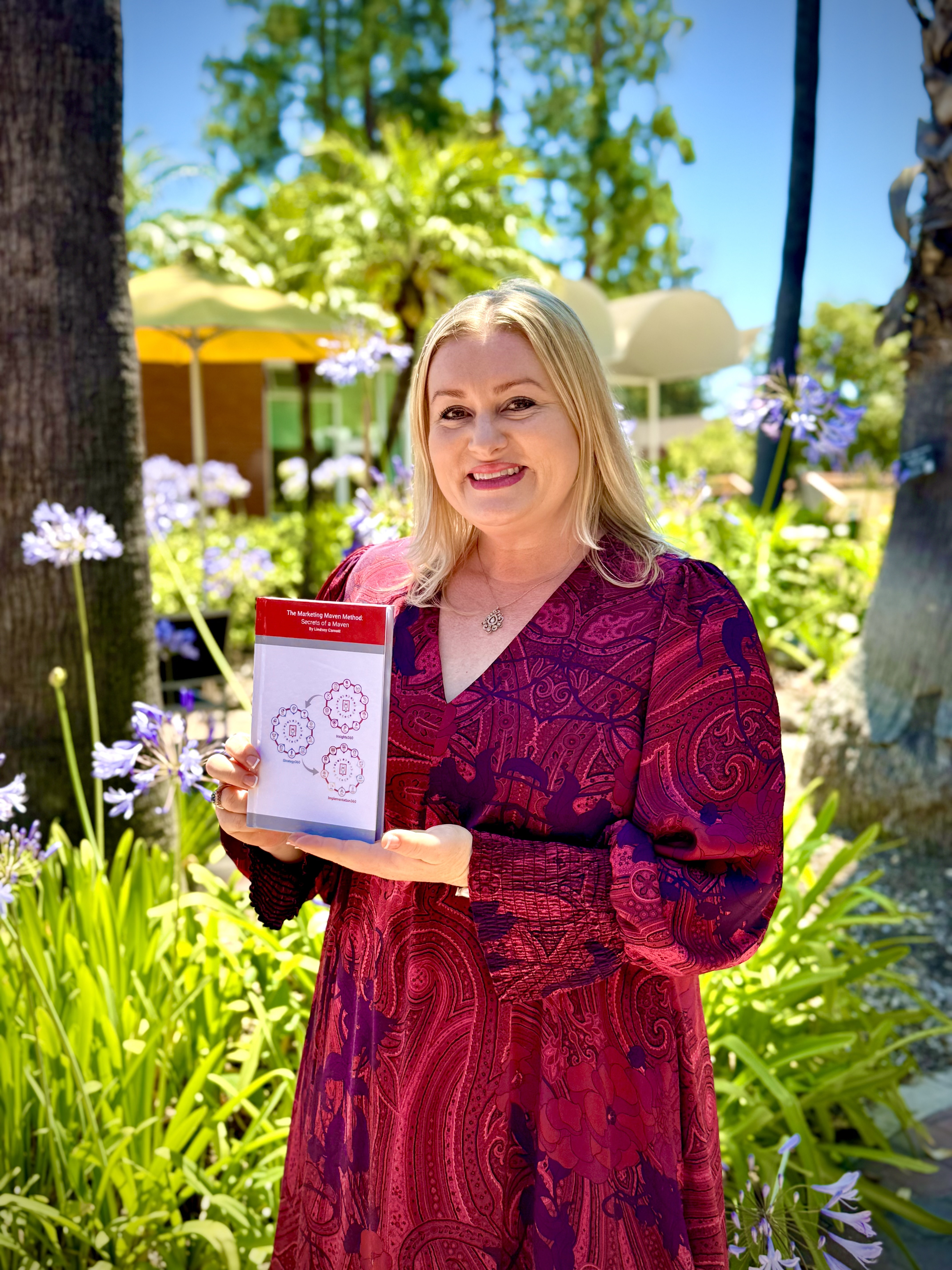
Marketing Maven began with public relations and expanded into research, digital advertising, social media, influencer work, email, creative services and websites. More tools created a need for a clearer order of operations. Carnett organized her approach into three stages: Insights360, Strategy360 and Implementation360.
Research comes first: understand the business, its audience and its competitors. Strategy turns that information into a plan. Implementation puts the plan to work. The names have the tidy symmetry of a business book. The underlying discipline is more ordinary and more useful: resist buying a collection of marketing activities before deciding what the business needs them to achieve.
RESULTS INFORM THE NEXT ROUND ↵
She turned that process into The Marketing Maven Method: Secrets of a Maven, published in 2023 and promoted through a book-launch announcement in August 2024. Writing it brought a working practice out of the agency and into a form another owner could examine, argue with and use. An approach that lives entirely inside its founder's head is difficult to share.
Her public discussions of measurement have also allowed for nuance. On the March 2025 Funnel Vision podcast, the conversation included the relationship between brand building and performance marketing, and the role of trust. Counting immediate leads is one task; understanding whether a company has become easier to buy from is another. A useful scorecard needs to know which question it is answering.
The daughter of a reading specialist
Teaching has become another outlet for that appetite to explain. At Academy of Art University, Carnett taught social media content development. Her advice to aspiring practitioners included bringing a complete campaign case study to a job interview. Show the thinking, the work and the outcome. It is a fairly demanding alternative to announcing that one is passionate about brands.
At California Lutheran's Center for Nonprofit Leadership, she works with leaders making marketing decisions. The return to her university has a pleasing continuity: the student once arranging interviews between soccer games now helps other people decide where to put their limited communications resources. The audience changes; the practical questions remain familiar.
Her interest in learning extends beyond professional training. Carnett is the daughter of a reading specialist and the granddaughter of a librarian. She has read in English and Spanish for National Read Across America Day in Ventura County. Her two daughters also supplied an introduction to kidSTREAM, the children's museum where she became a board member: a niece's birthday party gave them a chance to explore.
Those details make the board biography feel less remote. A family outing connects to a civic commitment. Spanish, one of her college subjects, becomes a way to read to children. The lines between education, work and community are visible without requiring a grand declaration about purpose.
A bigger room, the same question
In September 2026, Elevate announced Carnett as the keynote speaker for its October 15 Inspiring Women in Business event in Moorpark. The announced subjects included limiting beliefs, leadership, mentors and coaches. For someone who once mistook borrowing for failure, the emphasis on other people's guidance has a particular weight.
The teenage soccer player needed newspaper readers to help get a team to China. The founder needed customers, colleagues and eventually better financial knowledge. The author put her working method into circulation. Across these episodes, Carnett keeps returning to a concrete exchange: someone pays attention, and then has a reason to act. Keeping score begins with deciding what ought to happen next.