Lindsay Sanchez has spent a career in rooms where complicated technology is explained to people with expensive decisions to make. She began on the observer’s side of the table, studying markets and advising technology companies, telecom providers, investors and enterprises. Twenty-five years later, she is chief marketing officer at Pricefx, a software company devoted to a subject that every business understands until someone asks how it actually works: price.
A price looks tidy on a shelf or a proposal. Behind it sits a small republic of competing interests. Finance wants margin. Sales wants velocity. Product wants value recognized. Customers want fairness and clarity. Regional teams see local conditions. Executives want an answer before the market changes again. Pricing software promises to make those voices computable. Sanchez’s job is to make the promise comprehensible.
Pricefx describes her remit broadly. She leads marketing and business development, shapes the brand and category narrative, and helps connect pricing AI with enterprise growth. The language is polished, as corporate language tends to be. The more interesting clue is her own long-running preoccupation: the internal borders that prevent a company from seeing customers whole.
“The results will always improve when you create a dialogue, not a diatribe.”
The analyst learns to enter the arena
The college version of Sanchez expected something else. At Middlebury College, she studied international studies, political science and Latin American studies. She graduated cum laude in 2000, with College Scholar and Dean’s List recognition. Her first job, at the mobility research group then known as Yankee Group, gave those interests an unexpectedly technological address.
As an industry analyst and consultant, she examined competitive trends and go-to-market strategies. The work placed her near vendors, service providers, investment firms and enterprise buyers without binding her to any single one. She later recalled falling for technology’s pace, its appetite for innovation and its habit of challenging yesterday’s sensible answer. The observer wanted into the arena.
Analysis also teaches a useful kind of modesty. A forecast is an argument with a date attached, forever vulnerable to a customer, competitor or new technology behaving unexpectedly. Marketing has the same comic predicament. It deals in plans while the audience retains the right to wander off. Sanchez’s later insistence on direct customer and prospect contact reads like the operator’s answer to that uncertainty. A dashboard can describe behavior. A conversation can uncover the reason behind it. She has kept both within reach.
Citrix became her long apprenticeship. She joined in 2006 and moved from market intelligence and product innovation research into desktop product marketing, then solutions and industry strategy. By 2014 she was speaking publicly about cloud infrastructure and the unusually distributed environments large organizations had to support. Her subject was technical, but her focus was already behavioral: how people preferred to work, how organizations made access practical, and how a product fit the reality around it.
Then came a series of broader mandates. At financial technology company D+H, now part of Finastra, she led marketing and business development. At Kore.ai, she became CMO during an earlier wave of enthusiasm for conversational AI. In 2017 she returned to Citrix, this time working across global partner marketing, Microsoft business development, integrated planning and the office of the CMO. Eventually she led Americas marketing while serving as acting vice president of digital sales.
That last pairing matters. Marketers and sellers share a revenue target but can resemble neighbors arguing over a fence. Running close to both functions gave Sanchez direct exposure to the point where a promising story becomes a live commercial conversation. It also helps explain why she resists the narrow idea of marketing as a machine parked at the top of a funnel.
The customer journey has no org chart
At Khoros, where Sanchez became CMO in 2023, the product category brought her philosophy into clear relief. Khoros sold tools for digital customer engagement, online communities, service and social media management. Sanchez argued that a community could do far more than absorb support questions. It could reveal customer needs, improve retention, invite peer help and generate ideas for new products. It was both gathering place and listening device.
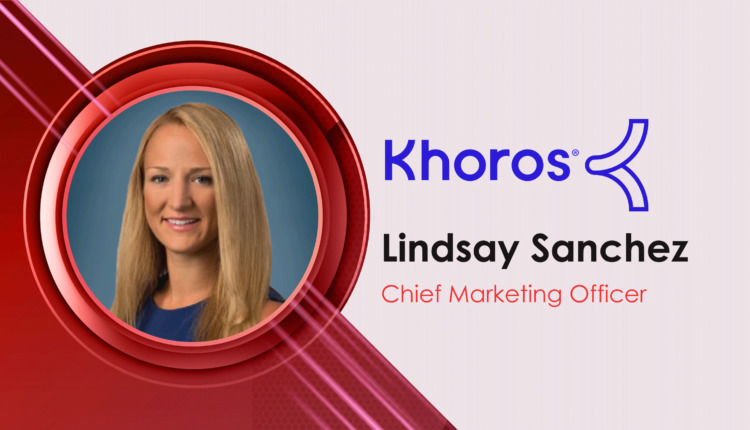
Her compact phrase from that period was an instruction to create “a dialogue, not a diatribe.” It is memorable because so much corporate communication resembles a dinner companion awaiting their next turn to speak. For Sanchez, listening has structural consequences. When internal teams arrange themselves around their own responsibilities, customers receive duplicated efforts, disconnected messages and awkward handoffs. The org chart wins; the experience loses.
Her proposed repair asks marketing, sales and post-sale teams to work backward from what a customer needs at each stage. Marketing continues after purchase through onboarding, adoption, loyalty and expansion. Service becomes part of the brand. Sales gains useful air cover during a deal instead of another stack of indiscriminate leads. None of this is especially theatrical. That is part of its appeal. Sanchez’s marketing doctrine is closer to municipal planning than fireworks: connect the roads, remove the bottlenecks, make it easier for people to reach where they were going.
Start with the customer’s need and preferred touchpoint, then organize the teams.
Define success first. Use data to test a hypothesis, including what should stop.
Treat onboarding, adoption and retention as part of marketing’s responsibility.
Use AI with brand knowledge, domain expertise and clear guardrails.
A skeptic of vanity, an optimist about data
Sanchez is fond of data and suspicious of the way marketers sometimes use it. Her distinction is surgical: use numbers to test a hypothesis, rather than to prove or justify what has already been done. Page views and link clicks may have a role, but they can also become ornamental vegetables pushed around a plate. Start with the business outcome, she advises, and work backward.
That stance grew more relevant as generative AI entered every marketing presentation. In 2023, Sanchez described the technology as rich with possible business applications while insisting on due diligence and guardrails. Product evaluation, architecture, security, legal risk and customer value all belonged in the same conversation. A year later, discussing AI-powered loyalty, she argued that technical teams should work with the people who actually know how customers speak and what the brand sounds like.
This is a useful tension in her thinking. Data should become more precise; the customer should never feel reduced to a number. Automation should accelerate the interaction; the interaction should still sound as though a person expected another person to answer. The trick is neither worship nor refusal. It is orchestration.
That word matters in enterprise software, where one product can touch dozens of teams and still belong emotionally to none of them. Sanchez talks about marketing as one cog in a larger wheel. The image resists the cult of the lone department and the heroic launch. Product, sales, customer success and services have to turn together. When budgets tighten, she sees a prompt for simplification: inspect the data already owned, decide what to stop, what to start and what deserves to continue. Restraint, in this account, is a strategy rather than an apology.
“Customers want to feel like something other than a number.”
Now, the quiet lever gets a microphone
Pricefx appointed Sanchez in March 2025 after a period in which the company reported 38 percent year-over-year subscription revenue growth and customer retention above 97 percent. Her assignment covered awareness, acquisition, expansion and retention across regions, company sizes and industries. It was a broad customer journey attached to a deceptively narrow word.
Pricing is well suited to her career. It combines analysis with narrative, product with sales, global systems with local judgment. It can expose the cost of poor coordination with unusual speed. A mismatched message is embarrassing; a mismatched price arrives directly in the margin. When Sanchez describes pricing as an executive mandate for growth and profitability, she is elevating the category while also giving it a wider set of participants.
Her first year included the large Pricefx Accelerate gathering in Munich and a place on the company’s team at SAP Sapphire in Orlando. Entering 2026, she publicly celebrated Pricefx’s momentum and the colleagues behind it. Her role now sits where AI enthusiasm meets commercial scrutiny. Customers want measurable effects, and the board wants them on a clock.
There is a personal footnote to all this disciplined coordination. Sanchez is a former downhill ski racer and has served as an assistant coach for a nationally ranked girls’ travel team. One role rewards a committed line through changing terrain; the other demands that individual effort become collective motion. Metaphors should never be made to work overtime, though these two have suspiciously good résumés.
Her colleagues describe a leader who sets a demanding direction while keeping the work compassionate and fun. That squares with the public voice: direct about silos, wary of vanity, animated by customers, and still willing to say she “fell in love” with an industry. Sanchez’s career has moved from watching markets to shaping how companies enter them. At Pricefx, the translation continues. A number becomes a decision. A decision becomes a story. And, if she has arranged the room properly, the customer gets to speak before the story is finished.