The deal was simple enough to fit on a sticky note: get the company to number one in Google, and the boss would buy Lily Ray a drum set. This was around 2011. Ray had already been drumming for years; the reward was aimed squarely at her. She found a way to move the rankings, buying links at a time when that could work with alarming speed. Then came a Google update. One day, the company appeared near the top for many of its chosen searches. The next, the rankings were gone. The bargain had turned into an expensive lesson, though probably not the one either party had intended.
Ray has spent much of the time since examining what happens when search engines change their minds. A website may look secure until its traffic graph falls off a cliff. The search analyst’s job begins where the neat explanation ends: which pages moved, what they have in common, and whether the supposed fix is another trick with an expiry date. That early collapse gave her a reason to be suspicious of easy victories. It also gave her a subject she could keep returning to as the internet reinvented its front door.
Before the browser, the beat
Her first instrument was percussion. Ray grew up in Marin County, north of San Francisco, in a family comfortable with computers and creative work. Her father worked as an engineer at Sun Microsystems and Oracle; her mother was a technical writer. She began with hand drums at six, got a rock kit at ten, and played in an all-girl band by thirteen. One of her teachers was Dave Getz, who had played with Big Brother and the Holding Company. It is a peculiar childhood credential: a direct line from school-age lessons to the San Francisco rock era.
By the time she left for New York University at eighteen, she was playing in two Bay Area bands. One, Elephone, had performed at SXSW. New York had called for years, partly because her parents were originally from the city. The move meant choosing a university path while music still had real momentum. At NYU she studied politics and Spanish, spent time in Buenos Aires, and tried to find her place in New York’s music scene. The drums eventually gave way to turntables: headphones and a couple of USB sticks are easier to carry across the city than a full kit.
Search entered her life through a paid student job at an online education company in 2010. At first, the work looked like the era itself: keywords added to pages, posts passed around social sites, experiments whose meaning was not yet obvious. Then her boss opened Google Analytics and showed her the traffic. Something she had done on a page had changed how strangers arrived there. Ray has described that moment as the point when she fell for SEO. Politics and Spanish remained her subjects at university; search became the profession that could hold her interest in language, writing, technology, and the behavior of people she would never meet.
A ranking is a temporary arrangement
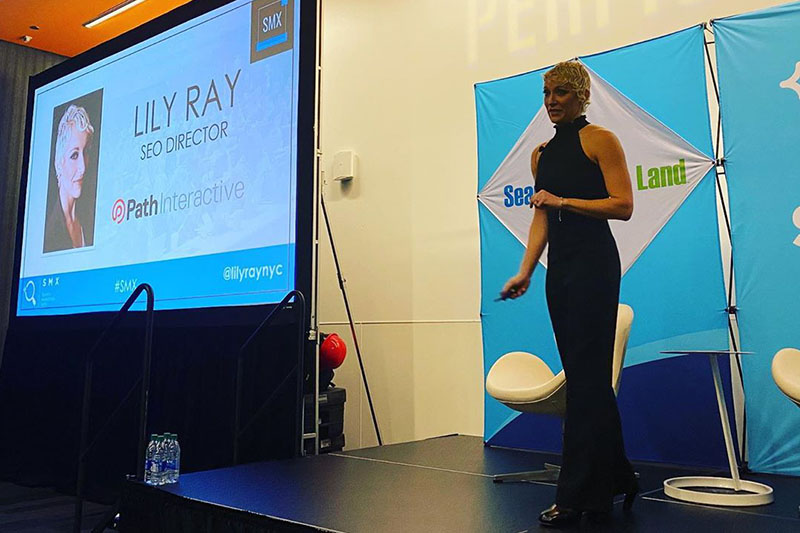
After the education startup, Ray worked on in-house SEO for a small-business finance company, where she could test ideas and see their consequences directly. She later moved into agency work at Flying Point Digital, which became part of Women’s Marketing. She was among the early SEO hires there and helped build the department as its client list grew. Path Interactive followed; that agency became Amsive. The job titles changed, but the central task did not: interpret a platform that tells publishers some of its rules, reveals others through behavior, and can alter the balance overnight.
The 2012 ranking loss did not make her hostile to experimentation. It made the length of the experiment matter. A tactic that wins the month and ruins the year is a poor bargain. Her work became closely associated with Google’s quality signals, algorithm updates, and E-E-A-T: the shorthand for experience, expertise, authoritativeness, and trustworthiness. Those words can sound like a conference slide until a business discovers that its pages have lost their audience. Then each one becomes a practical question. Who wrote this? What do they know? Would anyone choose this page if the search engine did not place it first?
“That was my first experience with algorithm updates, and that probably informed a lot of how I approach SEO to this day.”Lily Ray, on the 2012 ranking collapse
Ray’s answer is rarely a single switch to flip. In discussing what she calls digital empathy, she has asked practitioners to follow a visitor’s path, notice confusion, and think about why the person searched in the first place. A page can satisfy a keyword and still fail a reader. She has also described E-E-A-T analysis as the opposite of a fixed checklist, drawing together page details, reputation, content, and performance. Her technical inheritance shows here, but so does the writer’s instinct: the evidence has to make sense as a human story, not merely a row in a dashboard.
Two jobs, one name with a backbeat
In April 2026, Ray opened Algorythmic, a consultancy for selected SEO and AI search projects, training, workshops, and speaking. She kept her vice presidency at Amsive, where her biography says she works with a team of more than 35 SEO specialists. The two roles give her different scales of work: a large agency team on one side, direct one-to-one projects on the other. She describes the arrangement openly, including the intention to refer projects better suited to a full team to Amsive.
The company name came from a long-running joke among colleagues. They had invented an imaginary SEO deli called The Sub-Domain, complete with a band called the Algo-Rhythms. Ray turned the pun into Algorythmic, joining the two currents of her life in a single word. It is hard to imagine a plainer consultancy name carrying quite as much autobiography. The drummer from Marin County, the New York DJ, and the person studying algorithm changes all get a syllable.
The musical career never became a nostalgic footnote. Ray plays melodic house, techno, and disco, and lists sets in New York and Berlin, including Brooklyn Mirage, Elsewhere, and Renate. She has talked about the practical demands of late-night bookings, which can end when other people are starting work. During the pandemic she streamed DJ sets and said the donations helped local businesses and later campaigns. The link between music and SEO may be less mystical than it sounds: both reward close listening, preparation, and the ability to respond when the room changes.
The next search box
AI answers have given Ray another shifting surface to study. A brand can rank well in conventional search and still be absent from a generated answer. The old questions about quality and reputation have acquired new places to appear, while the temptation to manufacture visibility has returned in fresh packaging. Ray has tested how easily playful claims can enter chatbot answers, including absurd awards for colleagues. The joke lands because the underlying problem is serious: a machine can repeat a claim long before it has established whether the claim deserves repeating.
Her public analysis now ranges from Google updates to Discover and AI search visibility. In interviews and articles, she keeps returning to the durability of the work. Technical access matters, as do page structure and clear information, but she places weight on expertise that exists beyond a brand’s own website. It is a position informed by that vanished ranking graph from the early 2010s. The tools have changed. The risk of mistaking a short-lived opening for a lasting advantage has not.
There is also a personal consistency beneath the changing subject matter. Ray has said she likes sharing findings publicly, a habit she connects to growing up around an open-source-minded engineer father. She writes, speaks, answers questions online, and recommends other specialists by name. In one interview she praised a colleague on her team as someone whose technical work deserved wider notice. Expertise, in this telling, is not a costume one wears alone. It is built in public, corrected by peers, and passed along.
The contrast in scale is striking. A teenage drummer can tell at once when a room has slipped out of time. A search consultant may have to sift through thousands of pages before the same kind of shift becomes clear. Ray has lived with both forms of feedback: the immediate response of a dance floor and the delayed verdict of a search result. Neither offers much sympathy for a performer who ignores the audience. Her career has made that observation useful, especially when a new technology promises to make the old work effortless. She asks what can be measured, what can be trusted, and who is on the other side of the screen.
Ray once offered a simple piece of advice: “Stay true to yourself. Do not sacrifice core components of your personality in order to succeed.” It fits the unusual continuity of her working life. The drums did not disappear when the search career began. The search career did not disappear when she opened a consultancy. The name on the new door is a small joke that remembers both. In an industry where today’s winning tactic can become tomorrow’s cautionary example, that may be the most sensible rhythm to keep.