The first patient did not receive an anti-aging pill. In June 2026, a participant in a Phase 1 study received ER-100, Life Biosciences' experimental treatment for diseases of the optic nerve. The company that set out to address the biology of aging had arrived at a very particular place: retinal ganglion cells, the neurons that carry signals from eye to brain. In drug development, a grand theory often gets its first serious hearing in a small room.
In brief / the wager
- ER-100 is in a human safety study for open-angle glaucoma and NAION, two optic-nerve conditions.
- It aims to reset patterns of gene expression in damaged cells using three reprogramming factors, called OSK.
- Animal results brought the company to the clinic. Whether patients benefit remains an open question.
Glaucoma treatment usually centers on reducing pressure inside the eye. That can slow damage; it does not rebuild a lost connection to the brain. NAION, a sudden loss of blood supply to the optic nerve, has no approved treatment, according to the company. Life Biosciences is pursuing the injured neuron itself. Its idea is that some of a cell's decline may be reversible if the instructions governing its behavior can be reset.
Three letters with a very large assignment
The shorthand is OSK: OCT4, SOX2 and KLF4. These are transcription factors, proteins that help control which genes a cell reads. They are three of the four factors associated with the original cell-reprogramming recipe. Life Biosciences uses controlled expression of those three to pursue partial reprogramming - enough change, in theory, to restore function without stripping a cell of its identity. ER-100 is designed to deliver that instruction to retinal ganglion cells. The therapy is investigational, and a mechanism that works in a laboratory remains a hypothesis in a patient until the clinical data say otherwise.
The last step is a clinical question, not a reported result.
That distinction matters because Life Biosciences has impressive preclinical material. In 2023 it reported improved measures of visual function and optic-nerve axon survival in a nonhuman-primate model resembling NAION. In 2025 it reported additional ocular data and results for ER-300 in a mouse model of MASH, a liver disease. Those studies helped frame a platform spanning organs. They did not show that a human eye can recover lost sight.
“This clinical study represents the first opportunity to test whether restoring that information can ameliorate human disease.”David Sinclair, co-founder, on the first ER-100 dosing
How the large idea learned to fit a trial
David Sinclair, a Harvard genetics professor, and investor Tristan Edwards founded the Boston company in 2017. The early Life Biosciences was an umbrella for approaches to several pathways of age-related decline. Its 2019 $50 million Series B funded work across what it called daughter companies; the round was twice its initial $25 million target. By January 2022, after an $82 million Series C led by Alpha Wave Ventures, the company described three platforms: mitochondrial uncoupling, chaperone-mediated autophagy and epigenetic reprogramming.
The first aimed at metabolic disease with oral molecules. The second sought to improve cellular cleanup, with neurodegeneration among its possible applications. The third, the OSK approach, would become the lead clinical story. The company said in 2022 that a first human study might begin as early as the end of that year. It did not. Its first ER-100 participant was dosed in June 2026. Public announcements do not tell us which experiment, manufacturing step or regulatory discussion accounts for that interval. The dates do tell us something less dramatic and more useful: moving an aging theory into a human trial took years longer than the initial forecast.
Two practical choices stand out. First, the company attached a sweeping biological claim to a defined disease, observable cells and established measures of visual function. Second, it built the less photogenic machinery around the idea. Forge Biologics agreed in 2023 to provide viral-vector process work, toxicology, manufacturing and analytics. The FDA cleared the investigational new drug application in January 2026, allowing the clinical program to proceed. An IND clearance is permission to study a treatment, not approval to sell it.
The customer who cannot buy anything yet
Life Biosciences is a clinical-stage drug developer, not a supplement brand or a consumer longevity clinic. ER-100 has no commercial customers. The people who can interact with it now are eligible participants in a regulated study; their eye specialists and study teams are part of that process. If the therapy eventually succeeds and wins approval, patients with optic neuropathies would be the intended beneficiaries. That future depends on evidence the company has not yet produced.
This makes its business model familiar despite its unusual science. Investors finance years of research, manufacturing and trials in the hope of an approved medicine or valuable partnership. The April 2026 $80 million Series D was earmarked for the Phase 1 study and additional platform candidates; the company said it would support operations into the second half of 2027. Terms of a future medicine, its price and its route to market remain unknown. An estimate of corporate revenue cannot be mistaken for sales of ER-100.
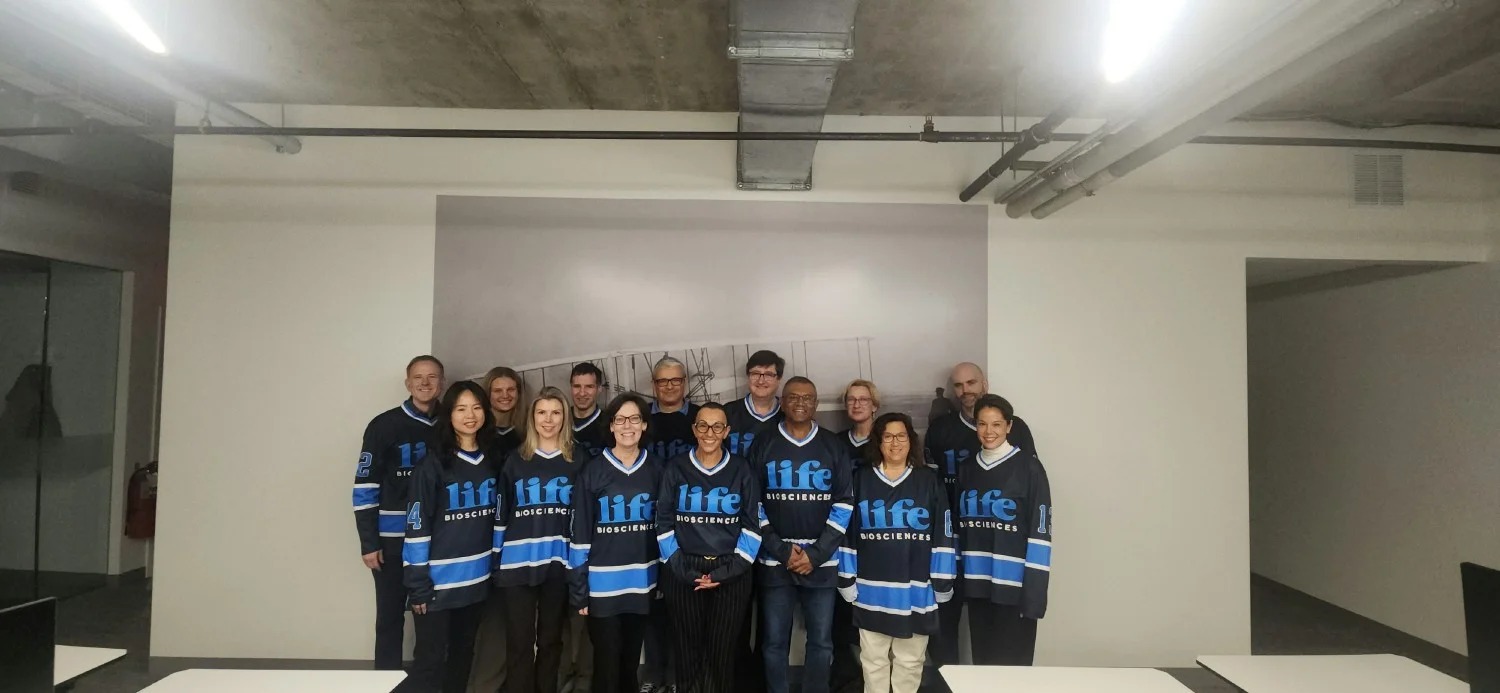
The company describes a benefits package with health coverage, unlimited vacation, transit help and a monthly fitness benefit, and it received Great Place To Work certification for 2026-2027. Its clinical effort is led by CEO Jerry McLaughlin and chief scientific officer Sharon Rosenzweig-Lipson, with Sinclair as chairman and co-founder. A 2025 research memorandum with Singapore's REMEDIS aims to explore other organ systems, while preclinical ER-300 work suggests one possible route into liver disease. These are expansion paths, not approved therapies.
The most interesting result is still missing
The field around Life Biosciences is crowded with different bets on aging biology. Altos Labs and NewLimit also work on reprogramming; Retro Biosciences explores other cellular routes. Life Biosciences' particular position is unusually concrete: a named gene-therapy candidate, an optic-nerve indication and a human trial. That is a sharper claim than “we treat aging,” and therefore a claim that can be tested.
The Phase 1 study's primary business is safety and tolerability. Because it enrolls patients rather than healthy volunteers, it can also look for signals in visual function. A favorable safety profile would be necessary for further testing; a promising vision signal would need rigorous follow-up. The reader who wants to copy something from this company should copy its narrowing of the question: take an ambitious theory, choose a disease with measurable outcomes, make the manufacturing real, and let a trial ask what the press release cannot answer.
That discipline also marks the boundary of the story. Results in mice or primates cannot guarantee a person's neurons will respond in the same way. Controlled reprogramming may be hard to deliver safely or consistently. Optic-nerve disease itself may prove more complicated than the platform's model. If ER-100 fails to show acceptable safety or meaningful benefit, the elegance of OSK will not rescue it. For now, Life Biosciences has accomplished a significant but limited thing: it has put an aging hypothesis within reach of a human verdict.
Follow the work
For trial status and eligibility, use the study record. For company announcements, use its newsroom. Social feeds are useful for updates; the clinical record is the place to check the protocol.