In July 2018, Legion’s account managers celebrated ten years in business aboard a private yacht on San Francisco Bay. There was dinner, there were drinks, and there was a commemorative video. For a company selling promotional campaigns, the occasion offered a revealing picture: the people who carried the message were themselves the guests of honor. Legion’s director of operations, identified in its announcements as Alon, described the cruise as a way to thank the team. The celebration also hinted at the company’s central business problem. How do you grow a service that depends on the person delivering it?
- The work: researched, customized promotions and direct customer outreach.
- The customers: sports, entertainment, hospitality, telecom, and local businesses.
- The mechanism: consumer incentives, trained representatives, and a path toward office management.
The offer that starts a conversation
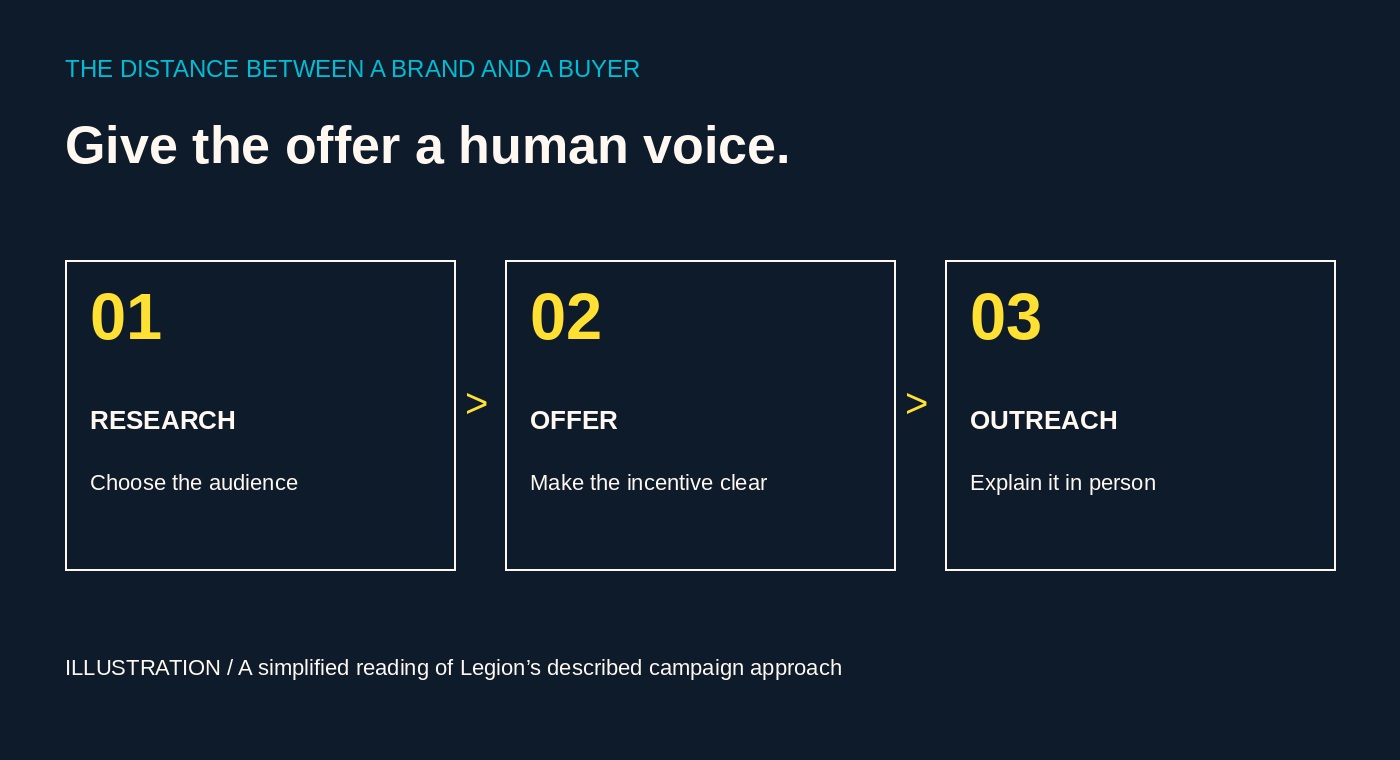
Legion’s public description begins with a familiar frustration. A business has something to sell, but its intended audience has plenty of other things to notice. The firm positions its interactive marketing against indirect advertising, including television and radio. Its proposed advantage is contact: put the message in front of a selected audience through a personal approach. That is a positioning claim, rather than a published comparison of campaign results.
The company’s July 2018 hiring announcement makes the work more tangible. New representatives, it said, worked alongside experienced colleagues promoting local clients through discount packages and consumer incentives. They learned demographic research, campaign development, and work in a B2B setting. Here, “interactive” has an ordinary meaning. Someone can explain an offer, hear an objection, and respond before the potential customer walks away.
For a sports or entertainment business, the problem is more specific than being remembered. A person must have a reason to act. A discount package gives the representative something concrete to discuss. Legion’s service combines the planning of that approach with its execution. The buyer is purchasing marketing work delivered by people, with consulting and research supporting the encounter.
A new market needs new people
In April 2016, Legion announced a telecom division. Alon said the industry had interested him for some time. The announcement paired that move with recruiting and anticipated expansion into new regions. Read together, the decisions expose the mechanics of the business: a new category of client creates a need for people who can represent its services.
A month later, Legion announced that an associate named Leah would become manager of a new office and team. The company linked the promotion to additional geographic reach and campaign capacity. That connection is more informative than an abstract promise to scale. Its expansion plan ran through someone who had learned the work and could teach it to others.
By June 2017, the company was reporting expansion into additional California markets. Its ninth-anniversary announcement also recalled starting during the recession. The sequence of anniversary releases, including ten years in 2018 and eleven in 2019, places its beginnings around 2008. This was a business whose own account of growth emphasized a wider client portfolio, more locations, and the development of staff.
“Our signature outreach model is our centerpiece.”Alon, Director of Operations · June 2017 company announcement
The training room is part of the product
The details of a 2016 promotion sharpen the picture. Christopher A., moving into assistant management, would learn hiring procedures, background checks, payroll setup, and administrative work. He described telecom responsibilities involving research, distribution, and California compliance. Campaign leadership, in this account, included the less photogenic work that keeps a service business functioning.
Legion’s January 2017 goals announcement described managers checking in on associates’ progress and adapting training to their objectives. Networking ambitions might prompt classes on first impressions or elevator pitches. This suggests a practical way to organize coaching: start with a task someone needs to perform, then build instruction around it. A general pep talk supplies less direction than a specific skill to practice.
The company also emphasized recognition and social time. Its February 2019 account of a holiday gathering described people from different offices exchanging stories about their work. In Legion’s telling, these occasions helped colleagues become more comfortable solving problems together. The anniversary yacht belongs to this same management philosophy: shared experiences were intended to support cooperation back at work.
There is another perspective to consider. An anonymous 2018 Glassdoor review criticized pay, hours, and the amount of training involved. Those are an individual’s allegations. In its published response, Legion defended a model in which employees learned different levels of the business before moving into management. The disagreement makes the practical questions plain. What is the job today? How is training compensated? What must someone demonstrate to advance?
Count the whole conversation
For a prospective client, the useful comparison is between ways of acquiring a customer. An internal sales team, another field agency, and an indirect advertising campaign each ask the business to organize its spending differently. Legion’s distinction in its own materials is researched, customized outreach carried by representatives. That proposition should be evaluated at the level of the particular offer and audience.
Then check margin, repeat purchases, and the staff time required. Attention alone cannot settle the bill.
A buyer can copy the discipline without copying the whole organization. Define who the campaign should reach. Make the incentive easy to explain. Set an observable next action. Agree how outcomes will be counted before the first pitch. These are practical implications of the model, rather than reported Legion performance figures.
The conditions matter. A conversation is useful when questions stand between interest and purchase. It is harder to justify when the offer has too little margin to support the effort, the audience cannot be reached efficiently, or the incentive attracts people who never return. Staff preparation matters too: a representative who cannot explain the terms can turn curiosity into confusion. The enduring question behind Legion’s pitch is wonderfully concrete. After all that human effort, did the right customer take the next step?