A movie theater asks people to do something rather inconvenient. Leave the house. Agree on a time. Pay for a seat. Sit beside strangers. Lee Roy Mitchell spent much of his working life making that invitation attractive enough to accept. Long before Cinemark became an international circuit, his first theater was the Village Drive-In in Ennis, Texas. The customers arrived with their own seating arrangements. Everything else still had to work.
Mitchell’s early businesses included auto sales and roller skating rinks. There is a pleasing continuity in that assortment: wheels, wheels, then pictures that moved while the customers stayed put. It was an education in selling people an outing. Later, his career would involve public markets, international managers and a Belgian royal ceremony. The useful place to begin is the smaller transaction: somebody choosing how to spend an evening.
A drive-in, then another beginning
In 1962, Mitchell was working at a Ford dealership in Forney when his father invited him into the purchase of an Ennis drive-in. His father already owned theaters in Bastrop and Elgin. Further acquisitions followed, including work with his brother, J.C. In 1966, Mitchell sold theaters to Interstate. He then built another business, Texas Cinema Corporation. A sale was part of the sequence, rather than the closing credits.
The Cinemark name appeared in his theater ventures beginning in 1977. Cinemark Corporation and Texas Cinema Corporation combined operations in 1979. More sales and purchases followed. This early history is less tidy than a single founding date on a brass plaque. It contains businesses formed, joined and sold, with Mitchell returning to the same trade. Repeated beginnings help explain why the later company arrived with experience already attached.
One early project had room for a sizable audience. The Lake Air Drive-In in Waco opened in July 1965 with capacity for 785 cars, showing Genghis Khan. Its announced cost was $200,000. Those details have the scale of a local business and the ambition of a spectacle. A drive-in could be a piece of land, a screen and a ticket booth; it could also be a town’s destination for the night.
Lee Roy and Tandy Mitchell co-founded the Cinemark business in 1984. Tandy belongs in that sentence as both wife and business partner. The company’s anniversary timeline also records developer Paul Broadhead in its formation and the acquisition of a small Utah chain. Cinemark USA was formed in 1987. The dates mark different steps in a business assembled over time, through partnerships as well as theaters.
“Eventually, you have to go out on the limb, because that’s where the fruit is.”
Lee Roy Mitchell · 2011
Where the audience was waiting
Former Cinemark CEO Tim Warner described Mitchell’s focus as building modern theaters in underserved markets. In the United States, that meant smaller regional cities and the suburbs of major cities. Internationally, the approach could mean places as large as São Paulo, Mexico City, Lima and Buenos Aires. A large population did not necessarily come with a plentiful choice of modern cinemas.
That distinction makes the expansion easier to understand. The opportunity was a gap between an audience and the facilities available to it. Warner joined Cinemark to develop its international business, at Mitchell’s invitation. He brought exhibition experience from the United States, while acknowledging that international work was new territory. The assignment involved building businesses in different countries, with all the practical learning that required.
Buildings multiplied alongside the geography. Cinemark’s 2014 anniversary timeline records 229 new screens built in 1990, half the screens constructed in the United States that year. It also records an Art Deco design introduced at a Texarkana theater in 1987 and the arrival of the cartoon mascot Front Row Joe in 1988. Expansion had architecture and a face. The face, obligingly, needed no executive compensation package.
- 1962Ennis drive-in venture
- 1984Lee Roy and Tandy co-found Cinemark
- 2007Cinemark goes public
- 2023Mitchell leaves the board
A theater chain also needs people who understand where those buildings stand. Cinemark’s 2018 annual report described international offices led by local citizens familiar with their countries’ cultural, political and economic conditions. That arrangement gives a practical shape to an international company. A corporate address in Texas can hold the organization together; it cannot supply every piece of knowledge needed to run a theater elsewhere.
A founder with room for other people
Mark Zoradi, who became Cinemark’s CEO in 2015, credited Mitchell with establishing a family approach and an emphasis on guest service. Zoradi had known the company as a Disney client before joining its board. When the chief executive role opened, he saw an established business whose culture he wanted to continue. Mitchell’s influence was something a successor encountered in the way the company already operated.
Zoradi’s examples of service were revealing: the welcome associated with Disney and the treatment of customers at Chick-fil-A. Both concern the small encounters around a purchase. In a cinema, the film comes from elsewhere. The greeting, the transaction and the visit belong to the exhibitor. Those ordinary moments give a theater operator something to improve even when the movie itself is beyond his control.
Architect and Cinemark executive Matt Dupler offered another view of Mitchell’s influence in a 2022 interview. He described encouragement to find the work people did particularly well and develop it. He also described a flexible company that supported employees’ growth alongside its own. This is a colleague’s recollection of a working environment, and it adds texture to a career otherwise easily reduced to a screen count.
In 2014, Mitchell gave that interest in developing people a formal setting. He created a Chairman’s Advisory Committee for ten people outside Cinemark’s employee ranks. The design called for two-year terms and five meetings annually. Members would offer feedback to management and gain business experience. The committee made a place for younger leaders to contribute before they belonged to the company’s established hierarchy.
Applicants were asked to show leadership through school, employment, volunteering or even hobbies and sports. The range matters: useful experience could be acquired beyond an office. Mitchell described the goal as “mutually beneficial.” A founder with decades in exhibition was offering access to his experience and asking for something in return. Advice could travel across the table in either direction.
A medal for the projection booth
On December 6, 2016, Princess Astrid of Belgium presented Mitchell with the Order of the Crown medal at a ceremony near Austin. The setting was Cinemark Tinseltown 20 and XD in Pflugerville. A cinema had briefly acquired a royal guest. The distinction recognized Cinemark’s longstanding relationship with Barco, the Belgian company whose technology helped put pictures on its screens.
The relationship had substantial physical reach. Following an exclusive digital projection agreement in 2010, Barco had equipped more than 5,500 Cinemark screens in the United States and Latin America by the time of the honor. The partnership also involved commercial laser projection and Barco Escape. Behind the ceremonial moment sat years of equipment, collaboration and investment in what an audience could actually see.
The distance from a Texas drive-in to digital projection is considerable. Yet both ends of Mitchell’s career turn on exhibition: creating the conditions in which other people’s films can be shown. Hollywood supplies the names above the title. A theater owner supplies the place, the equipment and the evening’s welcome. Occasionally, that quieter work receives a medal of its own.
The seats he gave up
Mitchell’s exit from Cinemark’s leadership happened in stages. His CEO tenure ended in 2006. He had chaired the board since March 1996, and stepped down as executive chairman on May 19, 2022. Carlos Sepulveda succeeded him as chairman. Mitchell remained a director for several more months. The changes separated responsibilities that are often bundled together when a company is young.
On February 15, 2023, he left the board. His son Kevin succeeded him as a Mitchell Investors designee. Kevin had an exhibition career of his own: he founded and led ShowBiz Cinemas, combining bowling, movies and other entertainment, before selling his interest in December 2021. A family connection helped explain the succession; operating experience was also part of the appointment.
The company at Mitchell’s departure had 517 theaters and 5,835 screens, spread across the United States and 15 countries in South and Central America. He had also spent 20 years on the executive committee of the National Association of Theatre Owners. His working life included the shared business of exhibition, beyond the boundaries of the company bearing the Cinemark name.
A different kind of admission
There were other ways to help people get started. In 2021, the Mitchell Family Foundation funded Texas Business Hall of Fame awards for two University of Texas at Dallas students: Mercedes Johnson and Rohit K. Shenoy. Each award provided $15,000 in unrestricted funds. Their ventures concerned finding food trucks and delivering meals to students. The industries differed from cinema; the recipients were building businesses of their own.
Dallas Baptist University has also documented an annual scholarship supported by Mitchell for a qualifying business student. His connection with the university includes the Russell H. Perry Free Enterprise Award, received with Tandy in 2015, and support for its business school capital campaign. These are specific commitments to education and enterprise, alongside the theater business that made his name familiar.
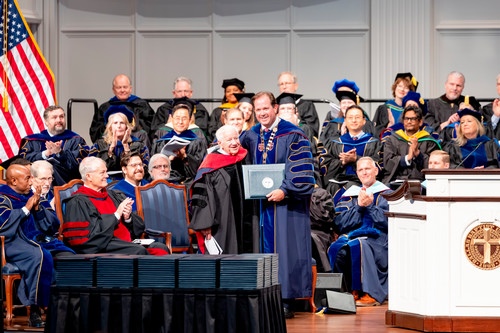
On May 15, 2026, the university conferred an honorary Doctor of Humanities degree on Mitchell. The photograph puts him in academic robes, receiving recognition for a career largely conducted elsewhere. It is a later scene in a story that began with local businesses and grew through partners, managers and audiences. The boardroom seat has changed hands. The invitation to help somebody else begin remains a fitting part of the picture.