A vintage car and a legacy software system share an inconvenient truth: the part everyone admires is rarely the part that demanded the most judgment. A polished hood catches the light. A clean interface wins the demo. Underneath either one sits a tangle of inherited decisions, obsolete components, hard-won fixes and connections that cannot simply be wished away.
Lee Mainman works on both kinds of machinery. In his spare time, the Edmonton executive restores vintage cars and takes on home projects, with a loyal dog often nearby. At work, he is chief marketing officer of Bits In Glass, the technology consultancy he joined in 2007. The company helps enterprises automate processes, connect applications and data, and modernize systems. Mainman's role is to make that complicated work legible to the people who must approve it, buy it and live with it.
His career has unfolded across several vocabularies for the same stubborn ambition. Businesses once talked about systems integration and business-process management. Then came low-code software and robotic process automation. Now the terms are data activation, generative AI, agents and legacy modernization. Each wave arrives with a fresh promise. Each eventually meets an old database, an approval chain, a risk committee and a person whose ordinary Tuesday depends on the existing system.
Learning the client before selling the future
Before Bits In Glass, Mainman built management, consulting and sales experience at TELUS, Robert Half Technology and VCIO. By the time a 2019 corporate overview described his work, he had more than 25 years in sales, including the direct management of teams and major client relationships. The document listed him as vice president of sales and marketing, a partner and the Blue Prism practice lead.
Edmonton supplies the geographic through line. Mainman's public education record places him at the University of Alberta from 1983 to 1987. His professional profile still locates him in the city, and Bits In Glass still counts Edmonton among its Canadian offices even as the map has widened. That continuity gives the expansion a specific shape. The work traveled, the partnerships multiplied and the platforms changed, but the executive telling the story remained connected to the place where the firm began its climb.
Those titles put him in the useful middle of a consulting company. Sales hears what a client says it wants. Delivery discovers what the client's systems will permit. Marketing has to turn that gap into a story honest enough for both sides. Mainman helped expand the sales and marketing department tenfold, reaching major cities across Canada and the United States. The growth was geographic, but the more interesting expansion was conceptual: he moved between the commercial promise and the technology practice meant to fulfill it.
“Collaborating with Solace has helped us deliver innovative solutions that drive meaningful transformation for our clients.”Lee Mainman, on Bits In Glass's work with Solace
Two public recommendations add texture to the corporate language. One client recalled that Mainman personally confirmed the GoBigEvent registration platform could meet the organization's data, storage and payment needs, then continued to support the account. A business associate praised his ability to find creative ways to complete deals while protecting the client's interests. Neither anecdote describes a grand strategy. Both point to the smaller behavior on which a services business compounds: answer the question, make the arrangement work, stay after the signature.
A long tenure through short technology cycles
Remaining at one firm from 2007 through the present can look like stasis on a résumé. In enterprise technology, it means living through repeated changes in what clients think they are buying. Mainman arrived when Bits In Glass was still a comparatively small Edmonton consultancy. Today it describes offices in Edmonton, Calgary, Toronto, Denver, Dallas, Hyderabad, Pune, Mohali and London. His own titles have moved from vice president and practice lead to chief marketing officer. Public records also place him as a director of the UK business and an officer of the U.S. company.
TELUS, Robert Half Technology and VCIO provide the sales, management and consulting foundation.
Mainman joins Bits In Glass and becomes part of its executive team.
He is listed as vice president of sales and marketing and Blue Prism practice lead after helping scale the commercial team.
He is appointed a director of Bits In Glass UK Ltd.
As CMO, he becomes the media contact for the Capital Square Partners investment.
His public work centers on Boomi, Pega, AI and legacy modernization.
That continuity matters because consulting firms sell institutional memory even while discussing disruption. Clients need people who remember why the old process exists, which workaround carries a hidden dependency and where a previous transformation stalled. Mainman's vintage-car hobby makes an apt counterpoint. Restoration is not nostalgia without constraints. It is a sequence of decisions about originality, safety, performance, cost and use. Replacing everything can destroy the object one hoped to preserve. Preserving everything can leave it unable to run.
The transaction that changed the horizon
In February 2024, Capital Square Partners made a significant investment in Bits In Glass. The plan was broad: accelerate organic and acquisition-led growth, expand globally, support innovation and add to the service portfolio. Mainman served as the media contact for the announcement. It was an unusually visible marker in a career mostly documented through company roles, conference appearances and partner communications.
Private equity changes the grammar of a company. The questions move from whether a service works to how quickly it can scale, which capabilities belong together and what operating discipline will support expansion. For a CMO, the assignment is larger than promotion. The company needs a coherent explanation of what it is becoming, one that can travel among clients, employees, technology partners and prospective acquisitions without collapsing into slogans.
Bits In Glass calls itself a global boutique. The phrase contains a productive tension. Global suggests reach, capacity and a shared pool of expertise. Boutique suggests attention and proximity. Mainman's career has sat inside that tension since the company began moving beyond Edmonton. His sales background favors relationships; his practice-lead experience keeps the conversation close to delivery; his current title asks him to make the combined model distinct.
Where the new tools meet the old estate
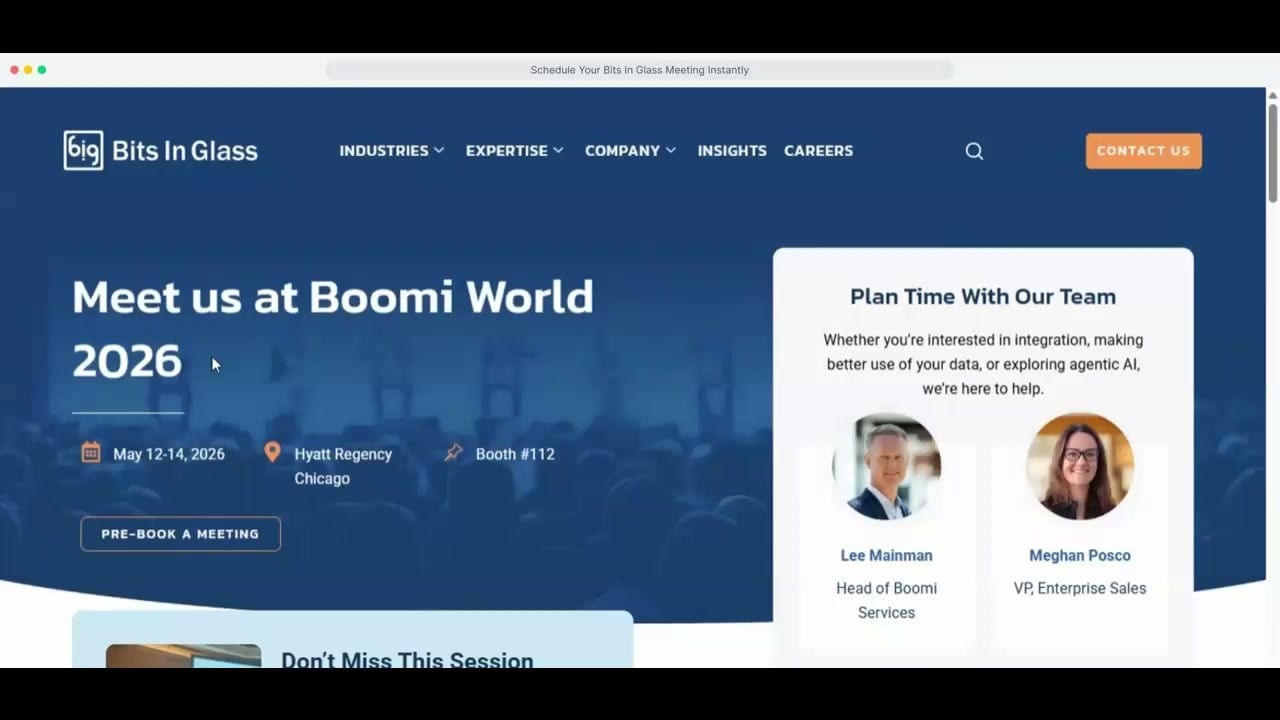
In 2026, Mainman's public attention followed the enterprise software calendar. Ahead of Boomi World in Chicago, he wrote about learning how companies want to activate their data. Bits In Glass identified him as head of Boomi services alongside his CMO role. At PegaWorld in Las Vegas, he was particularly interested in AI and legacy modernization. Afterward, he highlighted a customer initiative using AWS Transform with Pega Blueprint AI.
“It's not just the GSI's working in this space,” he wrote, using the industry shorthand for global systems integrators. He added that Bits In Glass was in the middle of a customer modernization initiative using that approach. The remark was commercial, but it also revealed the positioning he has helped shape: a smaller global consultancy claiming a place inside projects normally associated with much larger firms.
The strategic thread is connectivity. AI models do not arrive in enterprises as independent objects. They need data that can be found, trusted and moved. They need workflows that can be observed and governed. They need access to applications built in different decades. They need people willing to change their habits. Integration, once treated as plumbing, becomes part of the product.
Mainman's recent language stays close to those dependencies. He talks about activating data rather than merely collecting it. He talks about modernization rather than novelty. He talks about partner ecosystems because no single platform owns the whole enterprise. That vocabulary fits someone who has watched several technologies move from conference stage to implementation queue, where every bright idea encounters the sober test of daily use.
The patience to keep building
There is little celebrity machinery around Mainman. His public profile is mostly the residue of the work: an old company overview, corporate filings, event pages, partnership announcements, a few direct posts and recommendations from people who dealt with him. The absence of a cultivated founder mythology makes the operating pattern easier to see.
He has stayed close to clients. He has changed vocabulary without discarding the underlying discipline. He has taken on formal responsibility as the company crossed borders. He has become a public translator for a business whose output is often invisible when it works. And outside the office, he returns to projects where progress can be held in a hand: a fitted part, a repaired surface, a machine running again.
That is a credible way to understand the next chapter at Bits In Glass. The company has new capital, a wider footprint and a market racing toward AI. Mainman's task is to keep the story attached to the work. The future still has to connect to the installed estate. The polished result still depends on patient choices underneath. Somewhere in Edmonton, an old car offers the same lesson in steel.