The most consequential screen in crypto may be smaller than a postage stamp. It does not stream video, hail a car or suggest what to have for dinner. It asks one grave little question: do you really want to do this? On a Ledger hardware wallet, that screen is separated from the laptop or phone proposing a transaction. Malware can lie to the browser. The device is meant to show what will actually be signed, then wait for a physical tap.
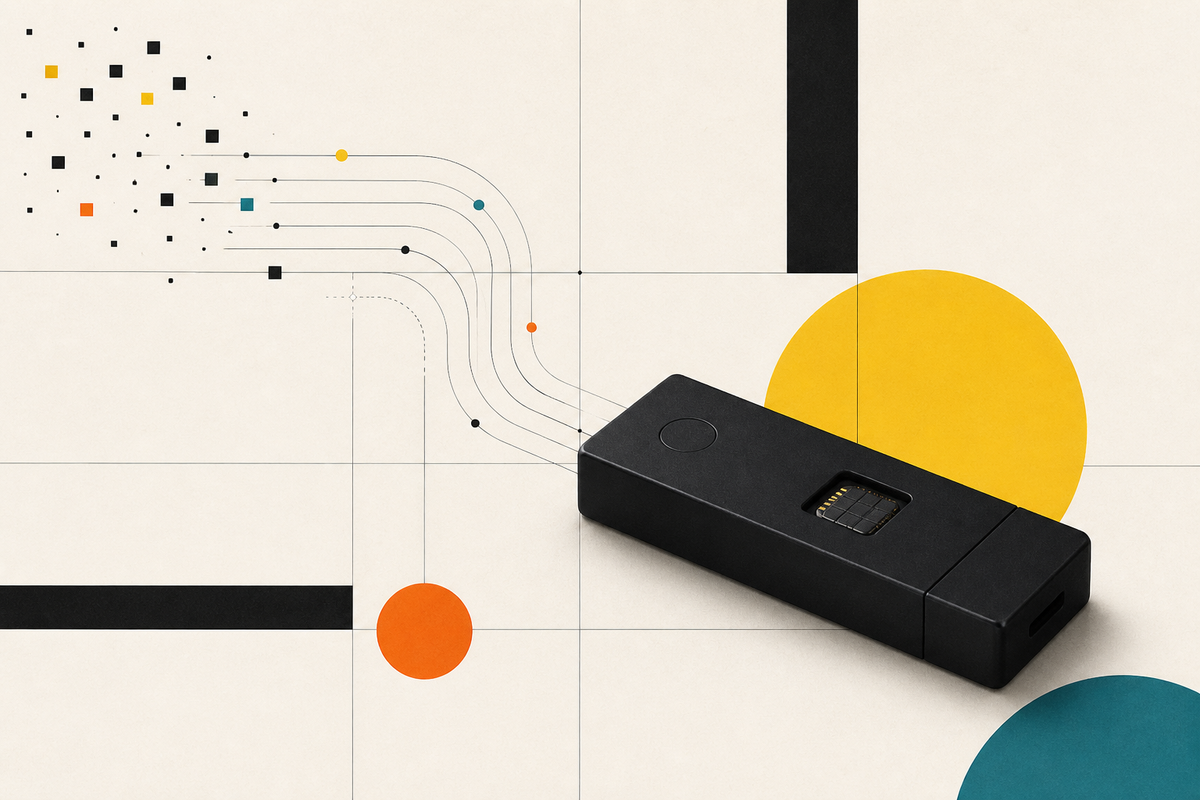
That moment of friction is the heart of Ledger. The Paris company is usually described as a hardware-wallet maker, which is accurate in the way that calling a bank a building is accurate. Ledger sells Nano devices that resemble clever USB sticks, and newer Stax and Flex signers with E Ink touchscreens. But the company’s deeper product is a protected boundary between private keys and the noisy internet.
Crypto assets do not sit inside the device. They remain entries on a blockchain. What Ledger protects is the private key that authorizes movement, using a Secure Element chip, a proprietary operating system and an on-device approval ritual. Lose sight of that distinction and Ledger looks like an expensive thumb drive. Understand it and the odd shape of the business comes into focus.
A French answer to an unfriendly problem
Ledger began in 2014, assembled from three early French ventures and an unusually crowded table of eight founders. Éric Larchevêque and Thomas France brought experience from La Maison du Bitcoin, a physical cryptocurrency shop. Nicolas Bacca’s BTChip worked on secure smart-card hardware. Joël Pobeda’s Chronocoin delivered Bitcoin on USB keys. David Balland, Cédric Mesnil, Vanessa Rabesandratana and Olivier Tomaz completed the founding group.
The timing was awkward. Mt. Gox had collapsed, Bitcoin’s future looked questionable, and self-custody came with a user manual written in fear. A private key stolen from an online computer could be gone forever. A recovery phrase lost by its owner could produce the same ending. Ledger saw a security problem and a product-design problem occupying the same chair.
France offered a useful inheritance: decades of expertise in smart cards, the tiny secure computers already embedded in payment cards and passports. Ledger adapted that tradition for keys that control blockchain assets. Its operating system runs applications inside the protected device, while its Donjon team attacks hardware and software to find weaknesses before criminals do. Consumer polish sits on top of an adversarial engineering culture.
Ledger’s real product is not cold storage. It is a trusted place to say yes.
One box becomes an ecosystem
The product ladder now stretches from the Nano S Plus, a USB-C signer, to the Bluetooth-enabled Nano X. Stax, designed with iPod co-creator Tony Fadell, wraps a curved E Ink touchscreen around a credit-card-size body. Flex uses a flat E Ink touchscreen at a lower position in the range. The screens are not decoration. More room makes it easier to examine addresses, amounts and smart-contract instructions before approving them.
Ledger Wallet, the app formerly known as Ledger Live, is the companion control room. Users can see portfolios, send and receive assets, and reach third-party services for buying, swapping or staking. The device remains the signer. This split lets Ledger participate in everyday crypto activity without becoming the custodian of the user’s keys.
Recovery is where the philosophy gets complicated. Traditional self-custody asks owners to protect a 24-word phrase, often on paper or metal. Ledger Recovery Key offers a PIN-protected NFC smart card that remains offline. Ledger Recover, an optional subscription provided by Coincover, takes a different route: the device encrypts and splits recovery material into three fragments held by independent companies, and restoration requires identity checks. One is physical redundancy; the other trades some privacy and procedural independence for convenience.
The Recover launch in 2023 drew sharp criticism from users who believed key material could never leave the device under any circumstances. Ledger stressed that the service is opt-in and encrypted. The argument exposed the company’s permanent balancing act. The safest system on paper can fail when an owner loses the paper. The friendliest rescue can make purists wonder whom they are being asked to trust.
Selling picks, shovels and policy
Ledger’s revenue model mirrors its widening stack. It earns money from hardware and accessories, from the recurring Recover subscription, and from commercial relationships around services reached through Ledger Wallet. On the institutional side, Ledger Enterprise sells technology to exchanges, custodians, funds, companies and on-chain organizations that need several people, rules and audit trails around asset movement.
Ledger Enterprise is not itself a custodian. It is a control plane for organizations that hold their own keys or protect client assets. Governance can require multiple approvals, limit destinations and separate duties. Enterprise Multisig, launched in 2025 on Safe infrastructure, adds Clear Signing to multisignature accounts. An on-premise HSM model announced in 2026 keeps signing hardware in a customer’s data center while Ledger hosts orchestration and governance.
The bars describe product breadth, not revenue share. Ledger does not publish a current audited segment breakdown.
That combination separates Ledger from a tidy set of competitors. Trezor, Tangem, Keystone, BitBox, GridPlus and Foundation compete for hardware-wallet buyers. MetaMask and Phantom make software wallets easier to start. Exchanges and custodians offer to hold keys for customers. Fireblocks and Anchorage Digital court institutions. Ledger’s position bridges these categories: branded consumer electronics, a wallet interface, a security research lab and enterprise governance built around the same hardware-rooted approval model.
Founders, not a typo. Ledger emerged from a small ecosystem of Bitcoin retail, secure-chip engineering and physical crypto-delivery experiments. The cap table started crowded because the idea started as a collision.
The next signer may approve an agent
The company has raised close to $600 million across its publicly reported primary rounds, including a $380 million Series C in 2021 and a €100 million extension in 2023. That extension held Ledger’s valuation at €1.3 billion. Capital bought time to develop a broader product line through crypto winters, shipping delays and the costly reality of making certified hardware at scale.
In 2026, Ledger opened a New York office, expanded its enterprise architecture and proposed its most ambitious adjacency yet: security for AI agents. The roadmap includes hardware-anchored agent identity, command-line tools, transaction intents, policies and proof of human approval. MoonPay has already demonstrated an agent that can propose a trade while a Ledger device keeps the key and requires a physical button press.
The idea is less strange than it sounds. Useful agents need access to money, credentials, files and accounts. Give software that much authority and the old wallet problem returns in a larger costume: how can a human verify what a machine is about to do? Ledger’s answer is familiar. Put identity and policy close to secure hardware. Translate the request into something intelligible. Preserve a final human checkpoint.
There is no guarantee that a device company becomes an AI-security standard. Agent architectures are young, software-only controls move quickly, and physical confirmation can become irritating if demanded too often. Ledger must prove where a hardware interruption is worth the delay. It must also make Clear Signing work across a fragmented ecosystem, because a trusted display is useful only when the data feeding it can be decoded accurately.
The next hardware-wallet customer may not be a person moving Bitcoin. It may be a person supervising software that can move anything.
A market built on irreversible moments
For individuals, Ledger helps reduce exposure to compromised computers and exchanges while offering a single interface for many assets. For institutions, it turns key management from one person’s burden into governed operations. Neither promise removes risk. Users can still approve malicious transactions, reveal recovery phrases to scammers or mishandle backups. Enterprise rules can still be designed badly. Hardware creates a better boundary, not magic.
What Ledger understood early is that digital ownership becomes real at the moment something irreversible happens. A person needs a place to pause, inspect and consent. The company has spent a decade enlarging that place - from a Bitcoin stick to touchscreens, recovery systems, institutional policy and now agent controls.
Its future depends on whether that pause remains valuable as the internet grows more automated. Ledger is betting that faster software will make trusted friction more important, not less. In a world trained to click through everything, the tiny screen’s best feature may still be its refusal to hurry.