The useful way to understand OpenSea is to forget, briefly, the expensive cartoon apes. Start instead with a digital cat. In late 2017, CryptoKitties turned pictures of cats into scarce objects that strangers could own and trade. Devin Finzer and Alex Atallah saw more than a novelty. If a cat could move between wallets without a central platform's permission, so could art, game equipment, event access and things nobody had named yet. They built a market for the unnamed category.
That market became OpenSea, the first non-custodial peer-to-peer NFT marketplace. It also became a cultural shorthand for the strange exuberance of the NFT boom. At its peak, browsing OpenSea felt like walking through a flea market during a gold rush: exquisite generative art in one stall, pixelated speculation in the next, and a great deal of shouting in the aisle.
The boom ended. OpenSea did not. The Miami-headquartered company spent 2024 rebuilding its core product, released OS2 in 2025 and pushed beyond NFTs into fungible tokens. In July 2026, it began rolling out a mobile app spanning 27 chains, with portfolios, social feeds, token swaps, perpetual futures and, where permitted, stock-linked tokens. The question around OpenSea has therefore changed. It is no longer simply whether NFTs will come back. It is whether the company that organized one unruly corner of crypto can organize the rest.
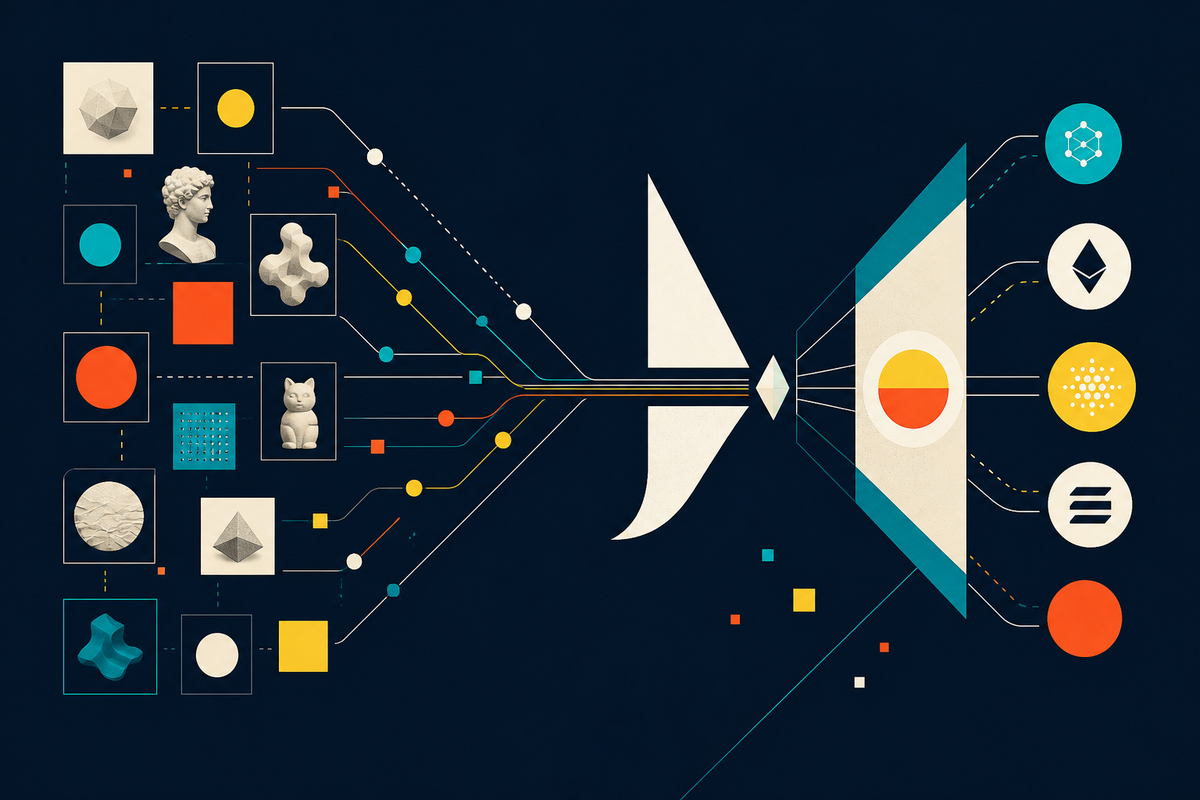
The product is less marketplace, more map
For a collector, OpenSea still performs the familiar jobs: search a collection, inspect traits, place an offer, buy an NFT, sell one later and display the result in a profile. For an artist or studio, OpenSea Studio provides no-code tools to deploy a contract, mint work, manage a collection and launch a drop. OpenSea Pro serves the faster-moving end of the market with aggregated listings and trading tools.
OS2 widened the aisle. NFTs and ordinary crypto tokens now live in the same product. Marketplace listings can be aggregated from elsewhere. Cross-chain purchasing lets a buyer pay from one chain for an asset on another without personally performing the ritual of swapping, bridging and refreshing three tabs. Token routes draw on outside aggregators including Relay, Jupiter, LI.FI and 0x. The interface is OpenSea's; much of the liquidity belongs to the wider ecosystem.
That distinction matters. OpenSea is non-custodial: it does not take possession of a user's art or tokens. A transaction is authorized from the user's wallet and settles onchain. The model gives customers control and creates a particular design headache. Consumer software tries to hide complexity; self-custody requires people to understand what they are signing. OpenSea must make a transaction feel simple without making its consequences invisible.
“We build an ocean, not an aquarium.”OpenSea culture principle
The company's best line is also a good description of its strategic difference. A centralized exchange resembles an aquarium: the operator holds the assets, controls the enclosure and makes the experience orderly. OpenSea wants the ocean - open protocols, external wallets, many chains and assets that can travel. The ocean contains more possibility. It also contains sharks, currents and gas fees.
Who needs an everything-onchain screen?
OpenSea's customers form an awkward coalition. Casual collectors want discovery and confidence. Artists want distribution, provenance and creator tools. Game studios want markets for in-game items. Professional traders want speed, depth and prices from multiple venues. Token traders want efficient routes. Developers want stable APIs and contracts. A single product serving all of them can become powerful or cluttered, sometimes before lunch.
The mobile app is the clearest attempt to turn that coalition into a network. An email-based flow can generate self-custodial EVM and Solana wallets without asking a newcomer to write down a seed phrase at the first screen. A portfolio brings balances and NFTs together. A personalized feed follows creators, collectors and traders. Apple Pay and cards can fund wallets. The idea is not merely to put the website on a phone. It is to make ownership, trading and people part of the same daily loop.
The problem being solved is fragmentation. Crypto still asks users to know which chain an asset lives on, which wallet supports it, where liquidity sits, what token pays for gas and which bridge will move funds. OpenSea's wager is that most people do not want to become amateur network engineers to buy a picture, a memecoin or a game object. Aggregation turns that confusion into a product surface.
A tollbooth with open water beneath it
OpenSea earns money when activity passes through the interface. As of May 2026, it typically charged 1 percent on NFT sales and 10 percent on NFTs minted in a primary drop. Token swaps carried a zero OpenSea fee at that moment, though outside providers and blockchains could still charge their own fees. The schedule changes, as crypto fee schedules tend to do. The durable model is transaction revenue: OpenSea makes more when its market helps more assets change hands.
Below the storefront sits Seaport, the open-source marketplace protocol OpenSea introduced in 2022. Seaport allows flexible orders containing multiple offered and requested items. It is less photogenic than a rare digital artwork and more consequential. Protocol work gives OpenSea expertise in order construction, settlement, security and gas efficiency. It also lets other builders inspect and extend the machinery rather than trust a sealed box.
Directional profile, not market-share data. OpenSea emphasizes wide asset and chain coverage while keeping custody with the user.
Competitors attack from different angles. Blur was built around aggressive professional NFT trading. Magic Eden broadened from Solana into a multi-chain marketplace. Foundation and SuperRare lean into curated art. Coinbase and Kraken offer a more familiar, custodial route into tokens. Uniswap and wallet apps compete for swaps and portfolio attention. OpenSea's answer is not to be the purest version of any one category. It is to place the categories beside one another.
That makes selection its old advantage and routing its newer one. During the NFT boom, OpenSea's shelf was the attraction. In the multi-chain era, the ability to find a listing, quote or route across scattered markets becomes the shelf. The company fits between an e-commerce marketplace, a trading terminal, a wallet dashboard and developer infrastructure. It is a strange neighborhood, but crypto has never respected zoning laws.
The long trip back to trust
Scale brought harder problems. Fraudulent collections, phishing, stolen assets, wash trading and arguments over creator royalties tested every NFT marketplace. Network transactions can be irreversible, and a marketplace's friendly button may sit one click above an unforgiving smart contract. OpenSea has invested in verification signals, support, security reviews and safer onboarding, yet no interface can remove the need to inspect a transaction before approving it.
OpenSea never needs custody of a wallet to facilitate a trade, but self-custody transfers responsibility to the user. Gas, third-party routing fees, slippage and product availability vary by chain and region. Some mobile trading products are unavailable in the United States, United Kingdom and sanctioned jurisdictions.
Regulation supplies another current. In 2024, OpenSea said it had received a Wells notice from the U.S. Securities and Exchange Commission and pledged $5 million to help NFT creators and developers facing similar legal pressure. The SEC closed its OpenSea investigation in February 2025 without bringing an enforcement action. That removed one immediate cloud, not the broader question of how tokenized goods and financial products will be classified around the world.
Partnerships show where OpenSea would prefer the conversation to go. Its Art Blocks work includes custom contracts, product collaboration and an artist residency in Marfa. Its support for Art Basel's Zero 10 put digital-era art inside an established cultural fair. Robinhood Chain extends the other edge of the spectrum toward tokenized real-world assets. One side courts curators; the other courts traders. Both need an interface that can explain what is being owned.
The second act is an interface bet
OpenSea's rise was spectacular: Y Combinator in 2018, transaction volume increasing more than 600-fold during 2021, and a $300 million Series C at a $13.3 billion post-money valuation in January 2022. Those numbers belong to a specific feverish market. They are proof of distribution, not a guarantee of the next chapter.
The more relevant achievement is that OpenSea was willing to replace the product associated with that success. OS2 wound down the legacy experience and changed the company's definition of its market. The culture page now describes a lean, remote-first crew that values urgency, deep reasoning and ownership. Corporate value statements are easy to laminate. Rebuilding the main product while the category cools is at least evidence that somebody used the verbs.
For users, the proposition is pleasantly ordinary: see what you own, discover what you might want, and trade without learning the plumbing by heart. For OpenSea, the task is less ordinary. It must aggregate an open ecosystem without closing it, simplify risk without disguising it, and serve collectors and traders without turning the interface into an airport departures board.
The digital cat is still somewhere on the shelf. Now it shares the screen with Ether, a game sword, a generative artwork, a memecoin and a token that tracks a stock. OpenSea's second act depends on whether that assortment feels like chaos or, finally, a market.