A city can like your climate technology and still never buy it. The demonstration goes well. The problem is real. Then someone asks who will authorize the installation, what the maintenance arrangement looks like, and which budget pays for the experiment. The room becomes quieter. Leading Cities has built its work around that stretch of silence.
The Boston nonprofit connects entrepreneurs with communities, prepares them to work together, and helps arrange funded tests. Its signature pairing is neatly named: AcceliCITY develops the startup side; AcceliGOV helps put selected solutions into service. The distinction matters. An accelerator can produce a polished presentation. A city needs something that survives contact with its streets, staff and residents.
Consider a curb in Boston’s Roslindale neighborhood. In March 2025, itselectric and the city launched a public EV charging pilot using power from a nearby building. The company had won the 2023 QBE AcceliCITY Resilience Challenge. Leading Cities identifies the Boston installation as one of its deployments. Here was an unusually legible outcome for an innovation program: somewhere to plug in.
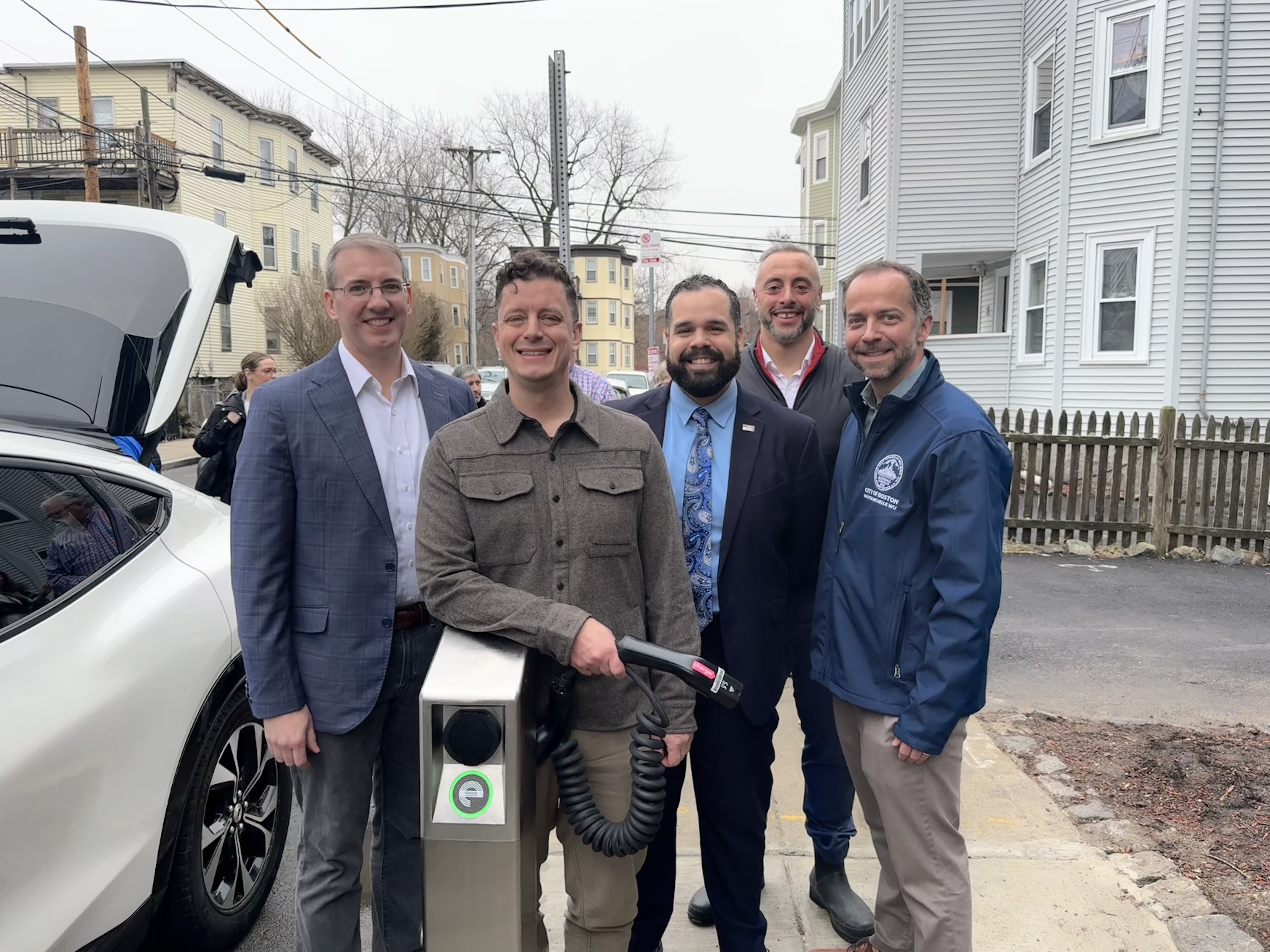
The building next door becomes part of the answer
Public charging has a particularly awkward constituency: drivers who park on the street. They cannot simply mount a charger beside their garage. Boston’s pilot uses itselectric’s small Level 2 units, a connection behind an existing building’s electricity meter, and a detachable charging cable. Drivers bring the cable; when they leave, it goes with them.
The arrangement addresses two different constraints. Nearby building power offers a route around the dedicated utility connections normally associated with public charging. The removable cable keeps an unused cable off the sidewalk. In the company’s launch announcement, the design was presented as a way to avoid the city’s capital expenditure on that charging infrastructure.
This is the kind of fit Leading Cities is trying to produce: a specific technology answering a specific municipal problem. The nonprofit neither manufactures the charger nor becomes the electricity supplier. It works among the organizations that can make the installation happen. That is a less photogenic job than designing hardware, although the ribbon-cutting photograph gives everyone something to stand beside.
A prize that comes with a practical assignment
The QBE AcceliCITY Resilience Challenge combines startup preparation with the prospect of a community pilot. For 2026, QBE announced a prize pool worth $175,000, including a $100,000 grand prize for a city project. The selected top 100 entrepreneurs were offered six months of public-private partnership training and certification, alongside mentorship and introductions to potential clients and investors.
Michael Lake, Leading Cities’ president and CEO, argues that communities need to identify risks earlier and put useful technology to work faster. The program concentrates on getting those solutions ready for public institutions, with their own responsibilities and ways of making decisions.
“Disasters may be rising, but so are the number of solutions to tackle them.”
Michael Lake · April 2026
RCOAST, which analyzes coastal erosion, won the 2025 challenge after a competition drawing more than 820 entrepreneurs from 71 countries. Its $100,000 award was designated for a city pilot, with the winning technology entering AcceliGOV’s community selection process. The prize therefore carries an assignment: make the proposition useful in a place that can test it.
The 2026 challenge page reports more than 960 applications from 77 countries, evaluated by over 200 judges. There is no application fee, and Leading Cities says it takes no equity from applicants or winners. That gives founders a different bargain from an accelerator that exchanges capital and support for an ownership stake.
Total advertised prize pool, including a $100,000 city-pilot grand prize.
City Hall has its own curriculum
Training is a substantial part of the offer. Leading Cities Academy’s public-private partnership readiness program comprises four 12-week courses covering procurement, credibility, ethics and funding. Its progressive credentials run from Bronze to Diamond. At the top level, the requirements include completion of all 12 modules, comprehension checks and an AcceliGOV project.
There is an intelligible commercial logic here. A founder who understands procurement and public priorities can spend less time making proposals that a potential customer cannot use. The Academy sells that preparation. Its published price chart lists both recorded learning and live speaker sessions, with lower prices for LaunchPad 11 members.
| Enrollment | Recorded | Live |
|---|---|---|
| Nonmember | $3,000 | $5,000 |
| LaunchPad 11 member | $1,000 | $3,000 |
One level covers three modules over approximately three months. Published pricing checked September 2026.
The prices make an important distinction visible: free application to a challenge does not make every service free. The Academy also advertises possible full course reimbursement for eligible Massachusetts employers with one to 100 W-2 employees. Qualification and approval matter. A prospective participant can use the Academy’s program page to choose a format and check eligibility.

The town that edited its own risk map
Dargo, a small town in Victoria, Australia, offers a revealing example of adaptation. WEO’s satellite and AI mapping pilot came through the QBE AcceliCITY Humanitarian Challenge, involving Australian Red Cross, QBE Foundation and Leading Cities. Red Cross’s account says more than 45 residents joined co-design workshops.
Some early language, risk categories and navigation did not match how residents understood their surroundings. WEO simplified categories, changed labels and redesigned navigation. The map gained assembly points, healthcare locations and other landmarks that mattered locally. Community feedback changed the product.
That experience also overturned an expectation. The technical team had anticipated that co-design would slow the work; residents’ clarity sometimes left development catching up. Local champions helped people use the resulting tool. Some requested capabilities, including real-time road closures, remained beyond the pilot’s technical reach.
The transferable lesson from Dargo’s experience is practical: give residents authority to alter the interface and invest in trusted local people. Copying the software alone would leave out much of what made the project usable.
“Free” still needs a project manager
AcceliGOV’s appeal to communities is straightforward. Selected hosts can test a vetted solution through a prepaid project. Leading Cities helps bring the parties together, examines fit, and supports the process. Its offer is particularly relevant to communities that want evidence before allocating resources to a wider installation.
A host still needs to do its part. The published AquaSave pilot description, for example, calls for building selection, installation access, a community project manager, a technical contact, connectivity and historical water and energy data. The proposed nine-month project includes up to 50 hot-water devices, baseline assessment, monitoring and a final impact report.
- 01Define the local problem
- 02Vet the solution and prepare the partners
- 03Fund and run a bounded pilot
- 04Measure results, then decide what follows
Those requirements show where the model needs cooperation. A community without site access, usable baseline data or someone responsible for delivery cannot obtain those ingredients simply by winning a competition. For a prospective host, the sensible first task is to compare the project’s requirements with what its own team can supply.
They also suggest a method readers can borrow: define a baseline before installing equipment, assign an owner, and agree on the evidence that will inform the next decision. A pilot earns its keep by producing a useful answer, including an answer that requires a different design or a narrower deployment.
From ten city partners to the space between institutions
Leading Cities began at Northeastern University in 2008, through a collaboration involving ten cities, including Boston, Dublin, Barcelona and Rio de Janeiro. Its early work explored how cities could learn from one another. It evolved into an independent nonprofit focused on helping ideas reach implementation, with Lake leading the organization.
That history helps explain its position in the market. Municipalities can find vendors themselves, hire consultants or look to city networks for advice. Startups can join general accelerators. Leading Cities combines several of those functions around public-sector deployment, adding the possibility of prepaid pilots and sustained relationships with potential hosts.
Its users extend beyond big-city governments. The organization welcomes smaller towns, regional authorities and other eligible hosts. Founders, investors, corporate partners and expert mentors enter through different programs. Its stated values emphasize collaboration, integrity and practical impact, a sensible cultural vocabulary for an organization whose projects depend on people employed somewhere else.
LaunchPad 11 keeps those relationships active through a curated membership network, virtual events, expert access and City Solutions Forums where governments discuss their priorities. Sponsorship-backed challenges and paid education sit alongside that network. The business model serves several constituencies: communities seeking help, innovators seeking access, and partners supporting resilience projects.
The next question is who keeps it running
Leading Cities reports supporting more than 630 startups and reaching an ecosystem of over 16,000 communities. It also reports $3.3 billion raised by alumni and $620 million in their 2025 revenue. Those figures describe participating companies and network reach. They should not be read as the nonprofit’s own revenue or a tally of completed municipal deployments.
The sharper ambition is its commitment, made with the Clinton Global Initiative, to help deploy 100 resilience and sustainability solutions in 100 communities by 2030. The case-study library makes the distinction between stages visible. It includes completed experiments, projects underway and preparations such as Gravity Water’s June 2026 agreement with Cà Mau, Vietnam.
A successful test then faces another funding decision. LC Advisory works on the partnership, financial and operational arrangements needed for wider implementation. CIVIC, an investor-matching initiative, remains under development and validation. Both address what happens when a funded experiment needs a life beyond the award.
For a founder, Leading Cities offers a route toward a better-prepared government relationship. For a community, it offers a chance to test an idea with support. The standard worth watching is wonderfully ordinary: after the presentations and photographs, does somebody keep using the thing?