A mistyped web address is a small humiliation. Your fingers have failed a task they perform several hundred times a day. Somewhere between intention and arrival, a letter has gone wandering. For Lavin Punjabi, that gap became a place to do business. SitePlug, one of the companies he co-founded, includes technology for correcting browsing errors and connecting that misplaced intention with an advertiser.
It is a fitting entry into his career. Punjabi has repeatedly worked in the spaces that a tidier account of the internet might leave out: unused domains, the browser before a search, the phone’s own interface, the administrative tangle behind a publisher’s shopping links. The glamorous part of advertising is the message. He has spent much of his working life studying the route.
Today he is co-founder, Managing Director and CEO of Affinity Global, based in Mumbai and leading a business that operates across Asia, Europe and the United States. Its collection of advertising networks and publisher software can look sprawling at first glance. Follow the problems each business addresses, though, and a pattern emerges: someone is trying to reach an audience or earn revenue, and the existing machinery leaves something useful undone.
A career that kept changing its address
Punjabi graduated from Mumbai’s Jai Hind College in 2004 with a Bachelor of Management Studies degree. His early career included a Strategic Partner Manager role at Directi’s Skenzo. In 2006 he joined Affinity, a business spun out of the web hosting company Hostway. Affinity’s own account describes him as its first employee. Its later leadership and acquisition materials identify him as a co-founder.
The original business was domain parking: earning money from web addresses that were not operating as conventional websites. It was an appropriately modest beginning for a career concerned with overlooked digital real estate. Before Affinity became a collection of named platforms, its raw material included the sort of web address a visitor might reach without finding the website they expected.
By June 2011, Punjabi was Vice President of Business Development and Strategy. A proposed joint venture with Australia’s AdEffective aimed to bring together advertising products that occupied the bottom of a webpage. The announcement placed his work squarely between advertiser demand and publisher income. Even then, his job involved finding another usable space on a screen already crowded with competing claims.
- 2006Domain parking
Punjabi joins Affinity - 2015Performance & mobile
SitePlug and mCanvas - 2023European acquisition
Opinary joins the group - 2026AI advertising standards
Affinity joins AdCP
Affinity changed direction repeatedly. Search, display, performance advertising and mobile creative work each became part of its development. These moves matter more than a smooth origin story would suggest. A founder who has found one paying market can spend years defending the original answer. Punjabi’s career includes the less comfortable task of changing the answer while remaining in business.
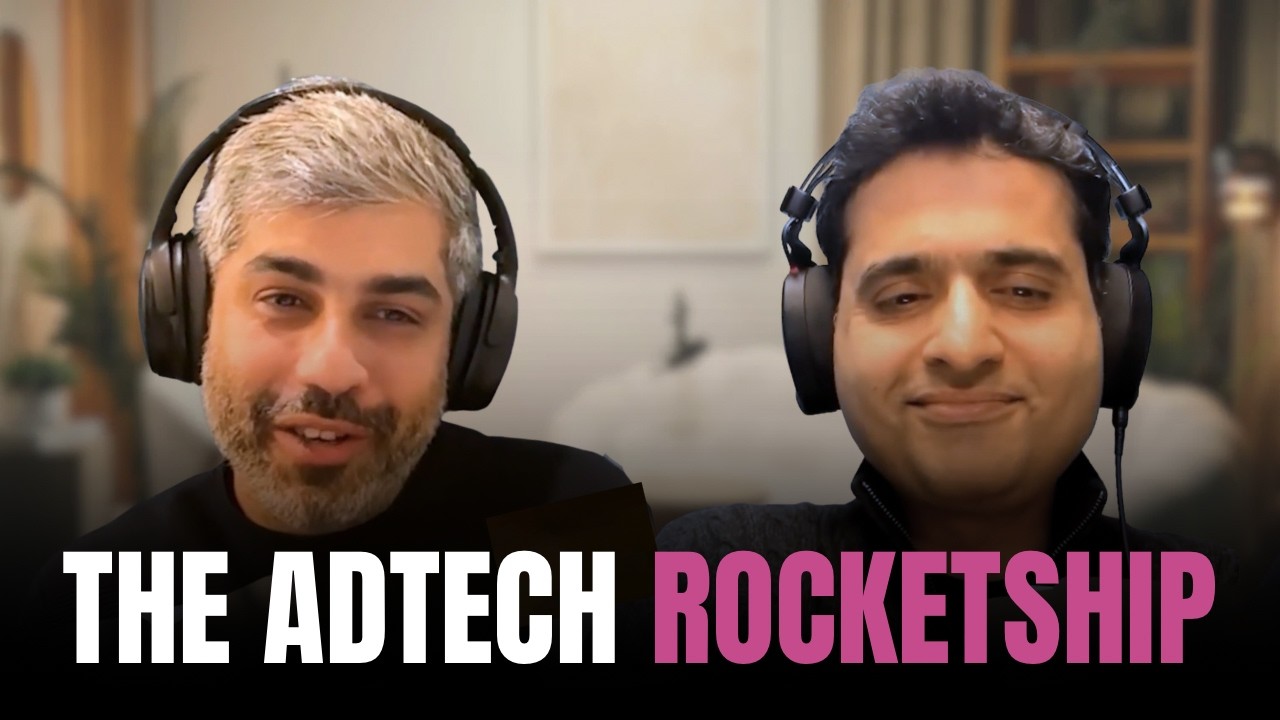
In his January 2025 conversation with Peeyush Upadhyay on The Scaleup Flight, the discussion ranged across pivots, risk, data and the need to stay profitable while developing new ventures. The tension is a practical one. An existing business has bills. A promising new idea has expenses. The challenge is making room for the second without forgetting the first.
An ad that made people walk
Punjabi’s work has also involved an argument about attention. By 2016, with mCanvas already launched, he was challenging advertisers’ habit of treating mobile as another receptacle for the same creative. A phone had its own uses, gestures and capabilities. Simply squeezing an existing ad into the available rectangle wasted much of what made the device interesting.
“Mobile needs some dedication and focus.”
Lavin Punjabi, 2016
The mCanvas proposition involved ads people chose to open, with interaction and the phone’s sensory features built into the experience. Punjabi’s case rested on a familiar irritation: people trying to read something and finding an advertisement that made escape unnecessarily difficult. He wanted brands to consider what would make a person choose to spend time with an ad.
A Reebok Floatride campaign supplied a pleasingly literal example. Writing in 2017, Punjabi described a mobile execution that used the phone’s pedometer. As users took steps, the ad revealed features of the shoe. The thing being advertised and the action being requested belonged together. A running shoe had finally found an advertising format with somewhere to go.
The example helps explain his product instincts without requiring a theory of his private personality. Here was a specific device capability, a specific brand and a specific interaction. The commercial question was whether the pieces made sense together. It also exposed the limits of treating every screen as interchangeable. A television cannot count the steps you take while holding it; trying would certainly enliven the living room.
The surprisingly complicated life of a link
Move from the visible advertisement to the machinery behind a publisher’s revenue and Punjabi’s attention becomes more operational. In August 2024, he joined Brian Morrissey on The Rebooting Show to discuss affiliate commerce. A reader sees a recommendation and a link. A publisher has to keep a business functioning behind that apparently simple exchange.
Merchants, destinations, commercial terms and changing offers complicate the job. Across thousands of links, routine decisions become a substantial workload. NucleusLinks, Affinity’s affiliate operations platform, addresses that layer of work. The opportunity begins with the observation that a small, familiar object on a webpage can conceal an inconvenient amount of administration.
Punjabi also discussed the organisational problem. Affiliate commerce can sit awkwardly between editorial and sales, with neither department’s existing habits providing an obvious home. A publisher may recognise the revenue opportunity and still struggle to organise the people responsible for it. Adding software to that situation does not automatically settle questions of responsibility.
This makes the publisher side of his career particularly revealing. His businesses deal with what happens after a strategy has been approved and somebody must actually run it. A new channel brings recurring work. A recommendation needs maintenance. Revenue depends on decisions too small to appear in the launch announcement. There is plenty of room for enterprise in the tasks that never get a ribbon-cutting ceremony.
A conceptual map of product problems, not a revenue comparison.
Berlin joins the conversation
In July 2023, Affinity completed its first acquisition, buying Berlin-based Opinary. Founded by siblings Pia and Cornelius Frey, Opinary used polls to invite readers to express an opinion within publishers’ pages. Its technology added another kind of interaction to Affinity’s portfolio, alongside a team and established relationships in European publishing.
The connection began in person. Pia Frey later recalled meeting Punjabi and Affinity colleague Bharat Sharma at OMR. Three months later, Opinary became part of the group. A corporate transaction can look inevitable when reduced to a sentence. Her recollection restores the ordinary human precondition: people met, talked and decided there was work they could do together.
Frey’s subsequent account offers a glimpse of Punjabi as a colleague. She remembered him telling the team, “You need to learn how to grow again.” Initially, she said, she did not understand. Over time, working with Affinity changed her sense of the opportunities available and the willingness required to pursue them.
She described an environment that moved before every question had an answer and gave opportunity considerable weight. Those are her observations of the business, rather than a licence to invent Punjabi’s inner life. They suggest that the acquisitions brought more than complementary technology together. People also had to negotiate the speed and expectations of their shared workplace.
Who gets included in the next version?
By 2026, the publisher software portfolio was developing further. Affinity announced the acquisition of French affiliate technology company Affilizz, with its shopping widgets and tools set to join NucleusLinks. The combination linked the shopping experience a reader sees with the operations behind it. A recommendation on a page and the systems supporting its commercial life were moving closer together.
In June, Affinity announced its founding membership of AdCP, an initiative developing open standards for AI-powered advertising. Punjabi’s concern was recognisable from his earlier work: browser and device placements need a place in the systems being designed to buy media. The list now extends to app stores, television operating systems and emerging AI interfaces.
His August appearance on Bloomberg Business Radio addressed those standards and the open web. September brought company recognition for VEVE and SitePlug at the CJ Excellence Awards, including an award for work with Expedia Group. The channels Punjabi had spent years discussing outside conventional search and social remained central to Affinity’s business.
The ambition behind that work was already explicit in 2022, when Punjabi described a goal of building an independent advertising technology business with global reach beyond Big Tech. It was a statement of intent, with the practical burden that international work brings: finding partners, understanding different markets and creating products advertisers can use across them. The ambition has a geographic scale; the day-to-day task still comes down to particular placements and relationships.
His own writing in 2021 had made the case for looking beyond search and social. He described advertising through device manufacturers, telecom operators and browsers, with creative and operational support across countries and languages. That detail gives the international ambition some substance. Reaching another market involves more than making a product available there. Someone has to make the commercial arrangement work, from the interface to the reporting an advertiser uses to judge the result.
Revenue growth over five years, reported by the company.
AI changes the language around the opportunity. The underlying question has a longer history in his career. Which part of a person’s journey has the advertising industry failed to handle well? Punjabi has asked versions of it at a mistyped address, on a phone screen and inside a publisher’s operations. Twenty years after joining Affinity, there are still places where the machinery needs attention. A wrong turn can be an excellent place to start looking.