Profile / Vol. 1 / No. 1
Lauren Berson & a Three-Year Wait
She left Andreessen Horowitz with a thesis, WeightWatchers with a playbook, and her own fertility journey with a mandate. Conceive is what came next.
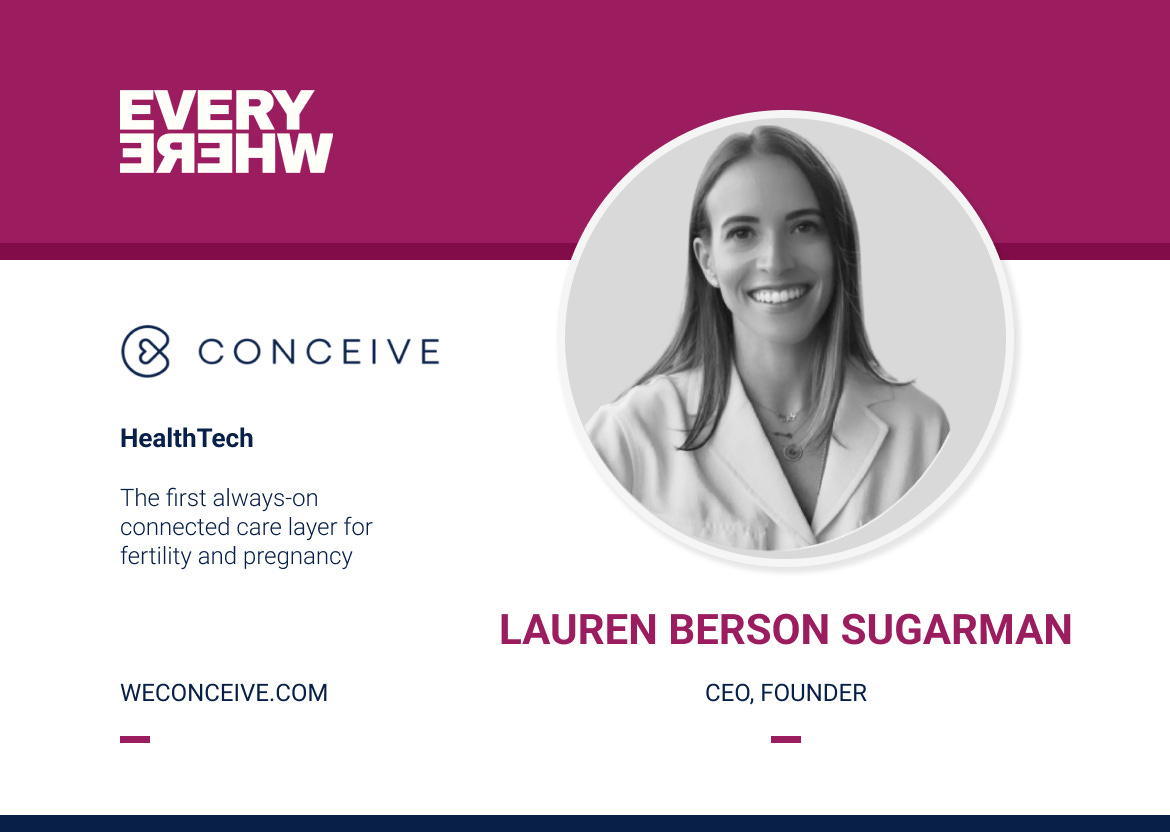
She left Andreessen Horowitz with a thesis, WeightWatchers with a playbook, and her own fertility journey with a mandate. Conceive is what came next.
Lauren Berson Sugarman runs Conceive from a Gay Road address in East Hampton, but the company itself lives in pockets and on bedside tables. It is the thing people text at 11:47 p.m. when they have just gotten a number back from a clinic and need someone, anyone, who speaks the language. That someone, on Conceive, is a nurse, a coach, or a dietitian. There is no waiting room.
Conceive sells two memberships and three promises. The memberships are Plus and Premium - text and articles in the first, 1:1 video and community in the second. The promises are: always on, evidence-based, and human. The company reports that 61% of members become pregnant within six months and that anxiety scores drop by 80%. A "Conceive baby" is born, by the company's count, every 15 days.
The unusual move is the dual go-to-market. Conceive sells direct to people who want help, and it sells into fertility clinics that want better outcomes for the patients they already have. The same software, two front doors. Sugarman cites a 5x return on investment for partnering clinics. The thesis, repeated across her decks and podcast appearances, is that fertility care has plenty of medicine and almost no continuity. Continuity is the product.
This is the company she is building right now. Where it came from is more interesting.
Source: Conceive, public statements and company website.
"Heart and technology."
- Lauren Berson Sugarman, on what makes Conceive differentThe version Sugarman has told on podcasts and in print is short and clean: she spent three years trying to conceive. The information was bad. The waiting was worse. The community did not exist. When her daughter finally arrived, the founder problem had already taken shape - she knew what she had needed, and it had not been built.
She had spent the previous fifteen years preparing for the build without knowing it. At Citi early in her career. At Google during the Android and Google+ years on Strategic Partnerships. At Andreessen Horowitz, where she worked as a senior partner during the firm's early move into biotech and digital health, eventually writing on the a16z blog. Then to WeightWatchers, where she ran strategic growth and M&A and watched, up close, what a behavioral health community could do at scale when it was built right.
Three companies, one consistent lesson: communities turn medical outcomes. Sugarman did not invent that observation. She just had a place to point it next.
In May 2021 she put the company in the ground. In April 2022 she announced $3.7M in seed funding led by Kindred Ventures, with Founder Collective, Great Oaks, and forty-plus founders and angels alongside. Crunchbase shows another seed close in August 2024 that brought total funding to around $4.93M. Modest by the standards of the venture-backed digital health graveyard. Suspiciously fit-for-purpose by everyone else's.
"Our North Star is improving outcomes - not just achieving pregnancies and live births but also fostering emotional resilience."
- Lauren Berson SugarmanShe studied improv at the Upright Citizens Brigade. Founders who can read a room without a script tend to do better on first calls with nurses, investors, and patients alike.
Active with JCCA, a New York child services organization supporting foster care families. The cause is family, not the brand.
The personal angel vehicle she runs on the side. 15+ companies. 4 funds as an LP. Quiet, deliberate, founder-aimed.
Conceive's registered HQ. A fertility startup with a beach-town zip. The team itself is remote.
The site runs on Webflow. Support flows through Intercom. The application logic sits on Ruby on Rails. Boring choices, on purpose.
When asked what makes Conceive different, she answers in three words. "Heart and technology." Then she gets back to work.
Clinics already exist. What does not exist, in Sugarman's reading, is the layer that holds a patient between appointments - the messages at midnight, the article that explains what FSH is, the human who has heard it all before. Conceive does not replace the doctor. It replaces the silence.
Direct-to-consumer is the loud go-to-market. The B2B contract with fertility clinics is the quiet one - and the one that pays the bills while DTC scales. A 5x ROI for partner clinics is the number she keeps showing.
Kindred Ventures led the seed. Founder Collective and Great Oaks came along. Forty-plus founders and angels filled the round. The cap table reads like a working group.
Her daughter is the product spec. Sugarman has said the founding moment was realizing how isolating fertility had been - and that sharing the story opened "floodgates" of connection. Conceive is the institutional version of that opening.
Three observations recur across her interviews and posts. The first is that community is a clinical intervention - not a marketing layer. Behavior changes faster when people feel less alone, and behavior is what fertility outcomes track. The second is that the cheapest unit of care is a well-trained nurse on a phone at the right minute. The third is that the right answer in healthcare is rarely either-or - DTC or B2B, AI or human, evidence or empathy - and the founders who refuse the binary tend to win the decade.
Sugarman's biography is, in this sense, a long argument for hybridity. Citi taught her finance. Google taught her scale. a16z taught her capital. WeightWatchers taught her community. The three-year wait taught her the rest. Conceive is the place all four memos finally meet.
And the next chapter, the one the company is writing right now, is about getting bigger without getting cold. Always-on care that actually feels on. A pregnancy every five days. A baby every fifteen. Numbers that mean people.