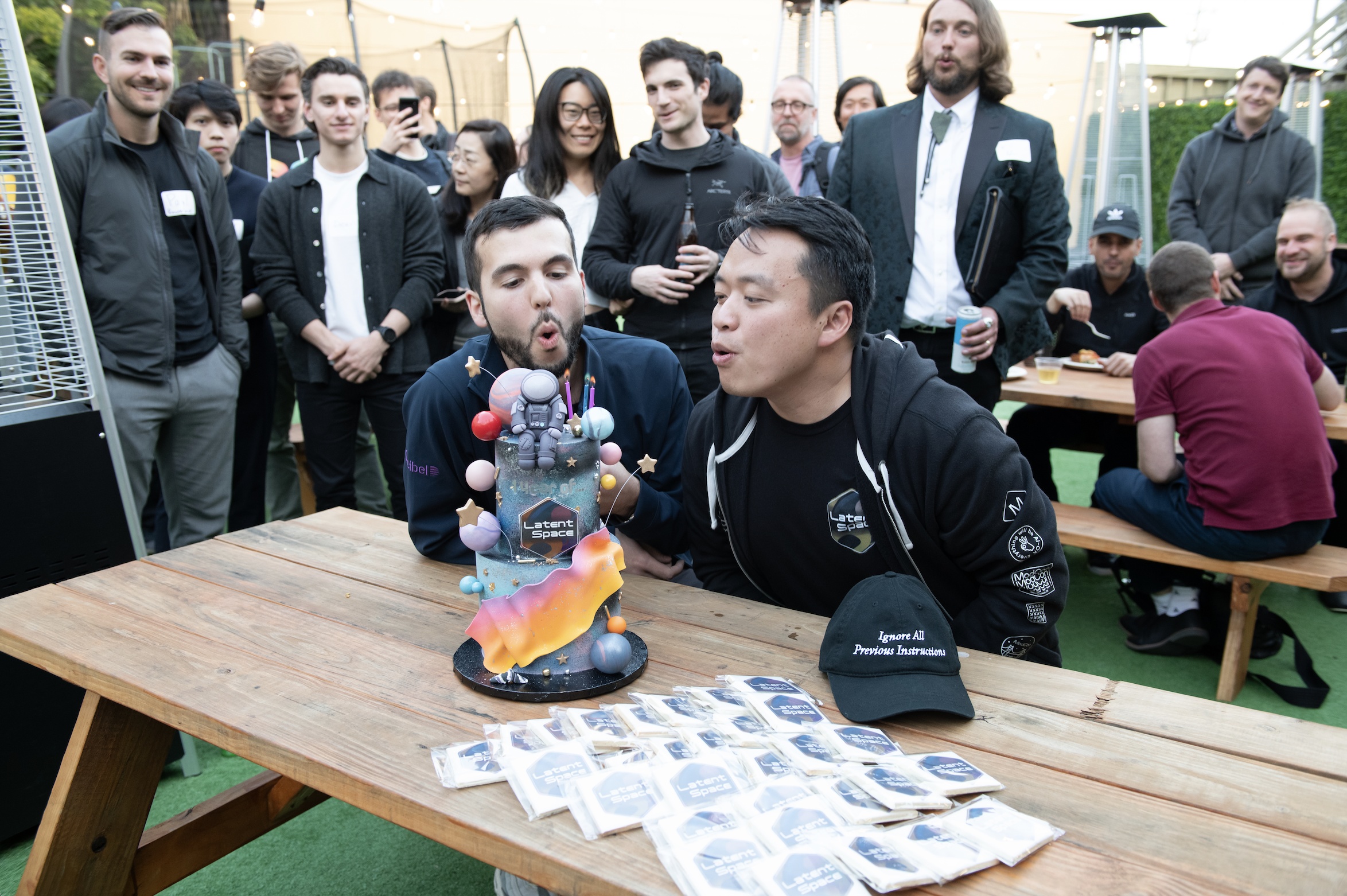
At Latent Space’s first podcast birthday, there was a cake decorated with planets and an astronaut. There was also a competition. Ten teams demonstrated their work; Pixee and RWKV won. By the March 2024 anniversary recap, the show had passed 750,000 downloads. A birthday party had become a useful picture of the business: people learning about AI, then gathering to show what they could build.
- For builders: interviews, essays and news about turning AI models into software.
- For busy readers: transcripts, chapters and a practical reading list.
- For the business: paid subscriptions, sponsorships and a growing network of specialist shows.
It is tempting to treat a technical publication as a delivery mechanism for information. Latent Space suggests another possibility. Sometimes the valuable thing is recognizing a group before its members have settled on what to call themselves. Give that group the right questions, a shared vocabulary and somewhere to meet, and the information has a reason to travel.
01A job hiding in plain sight
Shawn Wang, known as swyx, started the newsletter in 2022. The podcast followed in 2023 with Alessio Fanelli. Wang’s background includes developer tools; Fanelli is an engineer and Decibel partner who works with technical founders. They brought the habits of people who have built software to conversations about people building software.
On June 30, 2023, Wang published The Rise of the AI Engineer. His argument concerned an emerging kind of work: applying foundation models through APIs and open-source tools. Building a useful application no longer necessarily required training its underlying model. The engineer still had to evaluate it, assemble the surrounding system and make it serve a user.
That distinction gave Latent Space an editorial compass. Its reader was the person wrestling with the space between an impressive model and a dependable product. A new benchmark mattered insofar as it changed what that person could build. The important question was often waiting several steps beyond the announcement.
02The podcast you can read
The hosts’ guest brief makes that preference explicit. It asks about hardware constraints, training results, money and counterintuitive dead ends. Its compact instruction is “Examples and specifics over generalization.” Guests can pause to check something or restate an answer. Recordings are professionally edited and sent back for approval.
Those arrangements encourage a particular kind of conversation: enough room for the engineering detail that a polished launch presentation might skip. They also mean the result is a prepared, edited interview. Listeners should bring the same curiosity to a guest’s claims that the hosts bring to the technology.
Then comes an amusing complication. In August 2023, Fanelli wrote that a substantial part of the audience did not listen at all. It read the writeup and transcript. He open-sourced smol-podcaster, which automated transcription, speaker labels, timestamps and chapter creation, with models also suggesting titles and promotional copy. The conversation could become a document somebody searched at work.
“Examples and specifics over generalization.”
Latent Space’s public guest brief
03The room behind the feed
The learning products extend that logic. The 2025 AI Engineer Reading List selects roughly 50 readings across ten fields, including evaluation, retrieval, agents, voice and fine-tuning. Its designers explain why each selection matters and aim for practical use. The arbitrary limit is useful: about one reading a week for a year is a plan a small group can actually attempt.
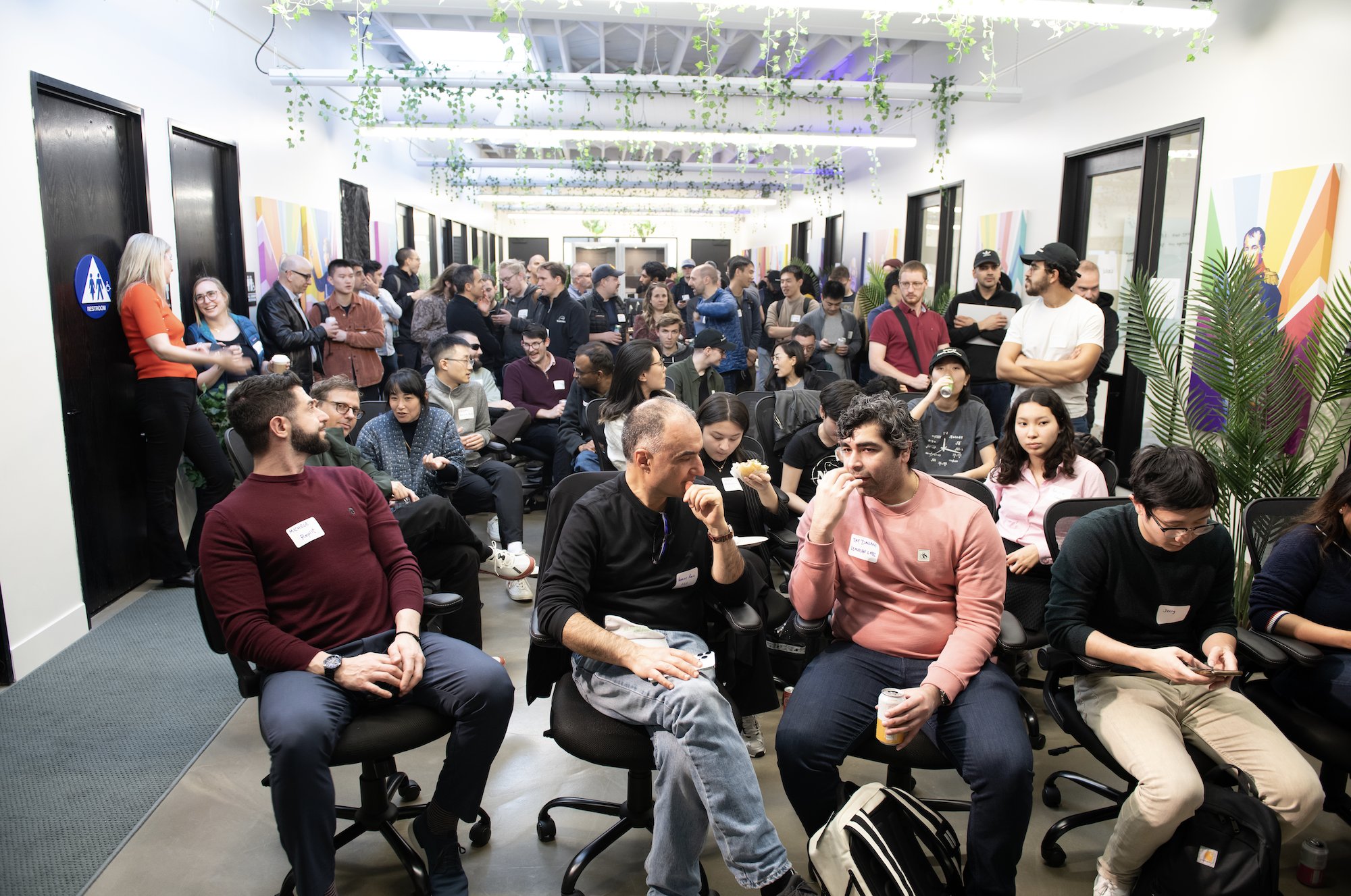
A reader can pick the field closest to a current project, follow the papers and tools, and compare notes with colleagues. Latent Space’s community calendar adds paper clubs, meetups and demo gatherings. The anniversary recap includes listener perspectives from Hungary, Australia and China. The conversation has a San Francisco center of gravity and a much wider listening radius. On October 9, 2026, the subscription page displayed more than 203,000 subscribers. That is an audience count, not a count of paying customers.
For a team using the publication, the next step is to bring one question from an episode into a design review. Which constraint resembles ours? Which assumption needs a test? Follow the transcript to the original tool or paper, then try a small, carefully measured local experiment. That is a suggested way to use the material, rather than a promise from the company. A long interview earns its place in a working week when it helps someone make a decision, or exposes a question they had forgotten to ask.
04The limits of two microphones
Success introduced a production problem. In January 2026, Wang acknowledged that writing had slipped and YouTube had started late. The response was more hosts and formats. AINews joined the publication, supplying weekday roundups alongside interviews and essays. A new studio at Kernel gave the operation a physical base in San Francisco.
AI for Science launched that month with RJ Honicky and Brandon Anderson. Wang’s explanation was refreshingly specific: he and Fanelli came from developer tools; science coverage required scientists. By later in 2026, Latent Space was also piloting Forward Deployed Engineering with Basil Chatha. Wider coverage meant inviting people qualified to ask different questions.
05Buying someone else’s homework
The money supports that editorial work. Published USD subscription plans list $6.90 a month or $69 a year. Wang said in January that Substack subscribers covered operating expenses, alongside donation support. In September, the publication reopened sponsorships after adding business and editorial leadership. Readers buy curation; sponsors buy access to a technical audience.
Free material is also available. Subscriber totals do not reveal the number of paying members.
That September update also described a Discord with tens of thousands of members that had become quieter and more promotional. Wang proposed merging its purpose with AINews and exploring a new homepage and Beehiiv migration. These were plans. The diagnosis was already valuable: membership can grow while useful participation shrinks.
Practical AI, The Cognitive Revolution and No Priors offer alternative AI conversations. Latent Space’s appeal is its concentration on implementation and material readers can revisit. It serves technical builders better than someone seeking a comprehensive policy education. Its interviews also require time, and its advice still needs testing against a reader’s own users, costs and constraints.
The copyable lesson is concrete: define an audience by its work, ask practitioners for specifics, preserve the answers in usable forms and add expertise as the subject widens. It depends on technical judgment and access to people doing the work. Buying microphones is easy. Earning the next useful question takes homework.
Start with the publication, podcast, reading list or community calendar. Follow on X and LinkedIn.
↗ Watch: Claude Code - Anthropic’s CLI Agent↗ Explore Latent Space’s video interviews↗ Open the smol-podcaster production code