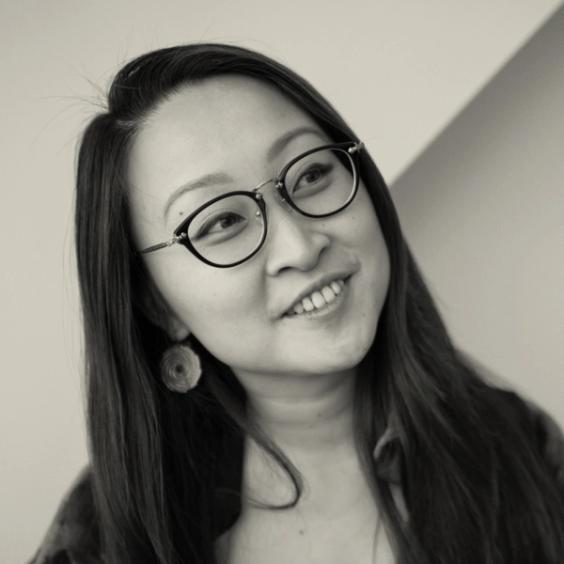
Kanjun Qiu - San Francisco. She'll tell you it's pronounced "can-june."
Person / Founder / Imbue
Kanjun Qiu
She trains machines to reason. The catch: the human never leaves the driver's seat.
She trains machines to reason. The catch: the human never leaves the driver's seat.
Most of the AI industry has been racing to make models bigger. Kanjun Qiu is running a different experiment. At Imbue, the San Francisco research lab she co-founded and leads, the wager is that scale alone stalls out - and that the real bottleneck is reasoning. "We train large foundation models optimized for reasoning," she says, "because reasoning is actually, we believe, the biggest blocker to agents or systems that can do these larger goals."
The distinction matters. An agent that can search the web is a demo. An agent that can be trusted to think through a messy, multi-step problem and show its work is a product. Imbue's roster of tools carries deliberately unglamorous names - mngr, Bouncer, Sculptor, Blueprint, Vet, Latchkey - built on a single conviction: software should stay under the control of the person using it. Closed platforms, as Qiu puts it, "lock you into their ecosystems, limit what you can do, and serve their incentives over yours."
Founded in 2021 as Generally Intelligent and rebranded Imbue in 2023, the company raised more than $200 million in a Series B that valued it north of a billion dollars, with Nvidia among the backers. That is a large sum for a speculative thesis. Qiu is unbothered by the word speculative. She has spent a career betting early and building the thing before the market agrees it should exist.
A good future is one in which the human is in the driver's seat, and the human is able to make good decisions because of what the AI is helping the human understand.
- Kanjun QiuBefore the funding rounds and the fireside chats, there was a computer science student at MIT who needed to cover tuition. Qiu wrote high-frequency trading algorithms and pointed them at the stock market. It is the kind of detail that explains more than a resume line ever could - a comfort with systems, an appetite for building the machine rather than working the job.
At the MIT Media Lab she joined the High-Low Tech group, where technology met craft. Out of that came Sew Electric, a book she co-authored that teaches middle and high schoolers computer science through sewing - conductive thread, soft circuits, code you can wear. The premise underneath it never left her work: anyone can build technology, if the tools let them in.
Then came Dropbox, where she became the company's first chief of staff and helped scale it from a couple hundred people to well over a thousand. Learning to scale humans, it turns out, is decent preparation for learning to scale machines. Her cofounder Josh Albrecht eventually pulled her away to Ember, a startup building a laser-projector VR headset. VR was not the destination. It was the partnership that mattered - the two would go on to build Sourceress, a machine-learning recruiting startup that went through Y Combinator and raised around $13 million, and then Imbue.
Ask Qiu what she is really working on and the answer widens past software. On her personal site she describes a focus on "expanding human agency, creativity, and abundance." Her guiding line: "Humanity has tremendous latent potential, both individually and collectively." AI, in her telling, is a lever on that potential - useful only if it makes people more capable, not more dependent.
This is why trust keeps surfacing in how she talks about agents. "How do we get to a situation where when you're building and using agents, these agents are trustworthy to the end user?" The hard part of an autonomous agent is not making it act. It is making it possible for a person to verify that it thought the problem through. Much of Imbue's work lives in that interface - the layer where a human can look at what the machine did and decide whether to trust it.
She keeps a running list of questions that have nothing obviously to do with her day job and everything to do with how she thinks: why did dinosaurs never develop civilization, how does culture shape what a group can achieve, what actually makes some people prolific. The AI lab is one answer to a much older curiosity about intelligence, coordination, and progress.
Closed platforms lock you into their ecosystems, limit what you can do, and serve their incentives over yours.
- On why Imbue builds open, user-controlled agentsQiu co-founded The Archive, a long-term coliving house near Dolores Park designed to foster agency and serendipity, notable enough to land a segment on Megyn Kelly Today in 2018. She is a co-founder of Neighborhood SF, an effort to build intellectual community space, and collaborated with Michael Nielsen on Science++, an investigation into how scientific progress actually happens.
She invests, too. As a general partner at Outset Capital she backs early-stage founders alongside Ali Rohde and Josh Albrecht, and she has served as a Sequoia Capital Scout. She hosts a podcast where she interviews deep-learning researchers about the intuitions and unpublished ideas they usually keep to themselves. The through-line is consistent: put interesting people in a room, remove the friction, see what they build.
Co-authors Sew Electric; becomes Dropbox's first chief of staff.
Builds a laser-projector VR headset at Ember with Josh Albrecht.
Co-founds Sourceress, an ML recruiting startup (YC 2017, ~$13M raised).
Named 2020 Forbes 30 Under 30 honoree in Enterprise Technology.
Co-founds the AI research lab Generally Intelligent.
Rebrands as Imbue; raises $200M Series B at a $1B+ valuation.
Fireside chat with Nvidia's Bryan Catanzaro at GTC on reasoning agents.
Bigger models plateau. The path to agents that finish real work runs through reasoning, not raw scale.
An agent chasing a long-range goal is only useful if the human can verify it actually thought things through.
AI should widen a person's sense of freedom and power over their own life, not quietly narrow it.
Tools you can understand, modify, and verify - because closed platforms serve themselves first.
Qiu on why the personal-computer revolution of the late 1970s is the right analogy for this moment - and why the goal is a machine that answers to you.