At West Tennessee Healthcare, the missing radiation badges had a pattern. The highest nonreturn rate was among employees wearing two. This was an awkward problem for a system trying to keep a dependable record of occupational exposure: the equipment could measure radiation, but an unreturned badge could not be analyzed.
LANDAUER’s Christine Krieman reviewed the data. She changed those workers to a single collar badge and calculated the necessary dose corrections. Nonreturns fell, according to the company’s account. The fix depended on understanding how the monitoring arrangement worked in practice. A more elaborate arrangement had become harder to maintain.
- LANDAUER combines radiation badges, laboratory analysis, software, and specialist support.
- Its OSL technology lets a dose measurement be checked again.
- The customer buys a continuing record and a workable routine around it.
That episode explains LANDAUER rather better than a photograph of its familiar hexagonal badge. The company operates where a tiny detector meets a very large organizational problem: getting people, measurements, and records to agree.
A crystal with a memory
Inside a Luxel+ badge is a thin strip of specially formulated aluminum oxide. Radiation leaves stored energy in the material. Later, in the laboratory, light stimulates the detector to release light of its own. That signal is used to calculate the accumulated dose. The process is called optically stimulated luminescence, or OSL.
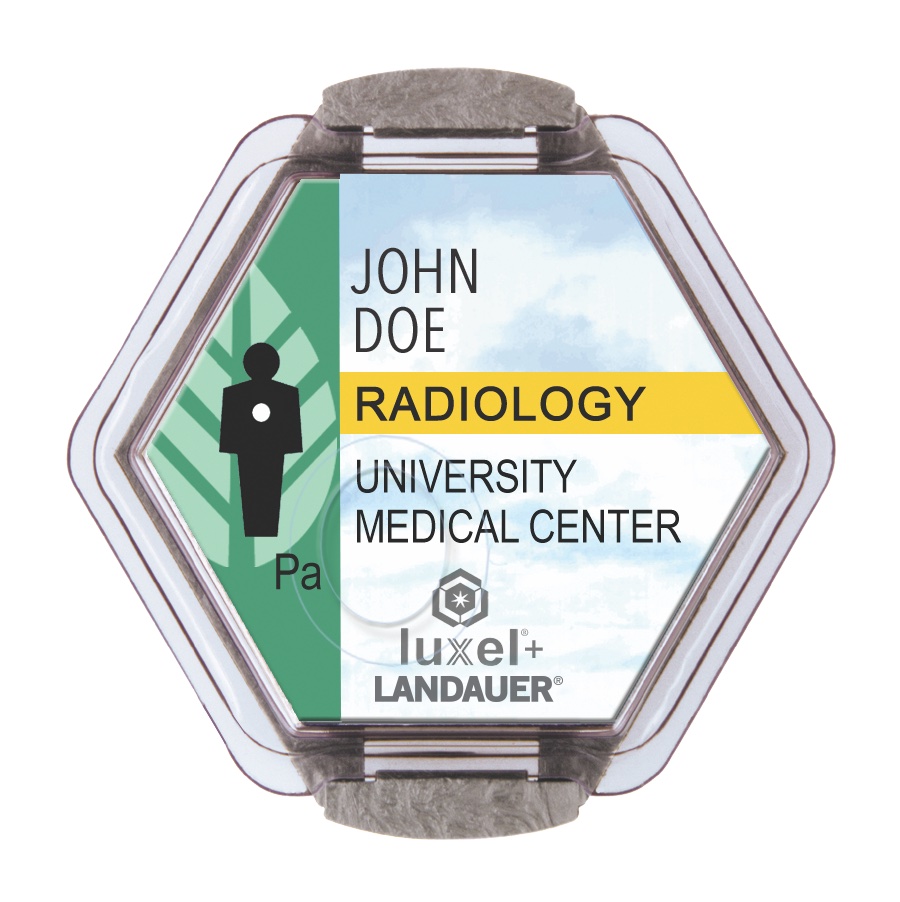
The useful wrinkle is that the material can be stimulated again. A surprising reading can receive another examination. Luxel+ also uses filter patterns that can help distinguish conditions during exposure, including whether the badge was stationary or moving. A number arrives with something to investigate.
This is a business with a long memory of its own. Robert S. Landauer Jr. started it in 1954, in the utility room of his home in Park Forest, Illinois. His first work was preparing radiation dose reports for three large Chicago-area hospitals. Film badges had to be identified, processed, and analyzed after they came back.

By 1964, the company says, it was digitally analyzing more than a million dosimeters. OSL arrived in 1998. The detector changed; the essential transaction remained recognizable. Someone wears a device. Someone else turns its contents into a record that can be checked.
people served globally, approximately, according to LANDAUER’s US company history.
The envelope is part of the product
LANDAUER sells a subscription that includes regular dosimeter exchanges, analysis in its NVLAP-accredited laboratory, standard reports, and access to myLDR, its online management portal. Customers range from dental and veterinary practices to hospitals, universities, nuclear facilities, and industrial employers. The setting changes. Keeping track of individual exposure remains the assignment.
- 01WearAssigned person.
Correct position. - 02ReturnCollect badges.
Keep exchanges moving. - 03ReadLaboratory analysis.
Recheck when needed. - 04ReviewMaintain the record.
Follow up.
Even the shipment has a witness. A control dosimeter travels with each batch to account for background exposure during transport and storage. Reports then organize a worker’s results by wear period, quarter, year, and lifetime to date. The routine is designed to preserve context as well as produce a reading.
The hardware follows the body and the job. Saturn rings monitor hands. VISION monitors the lens of the eye. Neutrak addresses neutron exposure. InLight dosimeters and OSLR readers let organizations with their own programs perform analysis onsite. LANDAUER can supply the equipment behind the service as well as the service itself.

There is an economic clue in Fortive’s 2017 acquisition announcement. LANDAUER had generated $143 million in revenue in 2016; more than 80% was considered recurring. Fortive announced an enterprise value of approximately $770 million, including assumed debt and net of acquired cash. The expensive purchase was a continuing relationship with workplaces that needed another report after the next wear period.
For customers, the buying decision is a program decision. LANDAUER’s quote process asks about participant numbers, badge frequency, dosimeter types, and reporting options. A small dental office and a nuclear laboratory have different requirements. Comparing them by the appearance of the badge misses much of what either is purchasing.
The work after the number
West Tennessee’s relationship with LANDAUER widened after its radiation safety officer left in early 2021. The system chose outside support rather than recruiting a replacement. Its nuclear medicine manager, Shondra Murley, remained the local presence while LANDAUER helped prepare committee material, manage dosimetry, and handle licensing work. A medical physicist also visited its sites.
“It’s been a safety net for us to have their expertise just a phone call or email away.”
Shondra Murley
West Tennessee Healthcare
That expertise sits alongside equipment testing, shielding design, training, and accreditation support. It gives LANDAUER a position between instrument manufacturer, analytical laboratory, and outsourced professional service. Mirion’s dosimetry business offers another route to monitoring and reporting; LANDAUER’s combination must earn its place through the particular program it supports.
Recent software releases target the work around the reading. Signature Suite, announced in September 2024, adds digital signatures, archived reports, and participant distribution records. ALARA Service, announced in July 2025, manages notifications, reminders, and responses when internal investigation levels are exceeded. In September 2025, two Premier purchasing agreements expanded member access to monitoring and medical physics consulting.
By August 2026, LANDAUER’s product guidance was dwelling on another ordinary administrative concern: who can see and change what. It described individual logins, role-based permissions, and account structures for different departments or sites. A hospital system needs to coordinate local responsibility with oversight across locations. Those details help explain why the company keeps building around the badge.
There are practical limits. Luxel+ accumulates exposure for later analysis; it does not warn a wearer of a hazard as it happens. Badges must suit the radiation being monitored and be worn, stored, and returned correctly. Nor is West Tennessee’s single-badge arrangement a universal shortcut: it involved a specialist’s dose corrections for that program.
The transferable lesson is to examine where the routine breaks. Find the workers, locations, or steps producing the exceptions. Then ask what can be simplified without losing the measurement you need. At West Tennessee, an investigation of missing badges led to a change in the arrangement. The detector was already doing its job. The surrounding work needed attention.