Before LAGOS became a national jewelry name, it was a repair shop on Philadelphia's Jewelers Row. Steven Lagos opened it in 1977, barely out of his teens, and learned the trade at the bench: clasps, settings, proportions, the small engineering decisions that separate an object that merely shines from one a person will actually wear. The repair work paid the bills. More important, it taught him that jewelry has to function.
That belief still explains the company better than any polished slogan. LAGOS makes bracelets, rings, earrings, necklaces and watch bracelets for people who want fine materials without treating the result as a museum piece. Its customer may buy a diamond ring for an anniversary, stack silver bracelets on an ordinary Tuesday, or dress an Apple Watch for dinner. The occasion changes. The design grammar does not.
The grammar is called Caviar: neat rows of luminous metal beads, nested to create texture and movement. Lagos found the idea while working with hematite in the 1980s. The dark round stones reminded him of fish roe, and the word carried a useful suggestion of luxury. By 1984, Caviar had become the brand's organizing device. It is now worked into sterling silver, 18-karat gold, ceramic, diamonds and colored stones. A shopper does not need to see the clasp to guess the maker.
“Our brand needs a code.”Steven Lagos, on the role of Caviar
One rule, thousands of variations
The obvious danger in a signature is monotony. LAGOS handles that tension by treating Caviar less as a finished product than as a unit of construction. Beads can become a flexible rope, edge a diamond station, frame a gemstone, alternate with black ceramic or sit beside a polished gold bar. Scale, color and silhouette move around while the texture holds the family together.
That is also the practical problem the company solves. Fine-jewelry counters can be intimidating, and precious materials alone are poor navigational tools. Gold is gold; diamonds are diamonds. A stable motif gives customers a clear entry point. They can recognize an existing bracelet, add another width or metal, and build a stack without starting over. For gift buyers, the same vocabulary reduces guesswork. For collectors, it turns separate purchases into a continuing set.
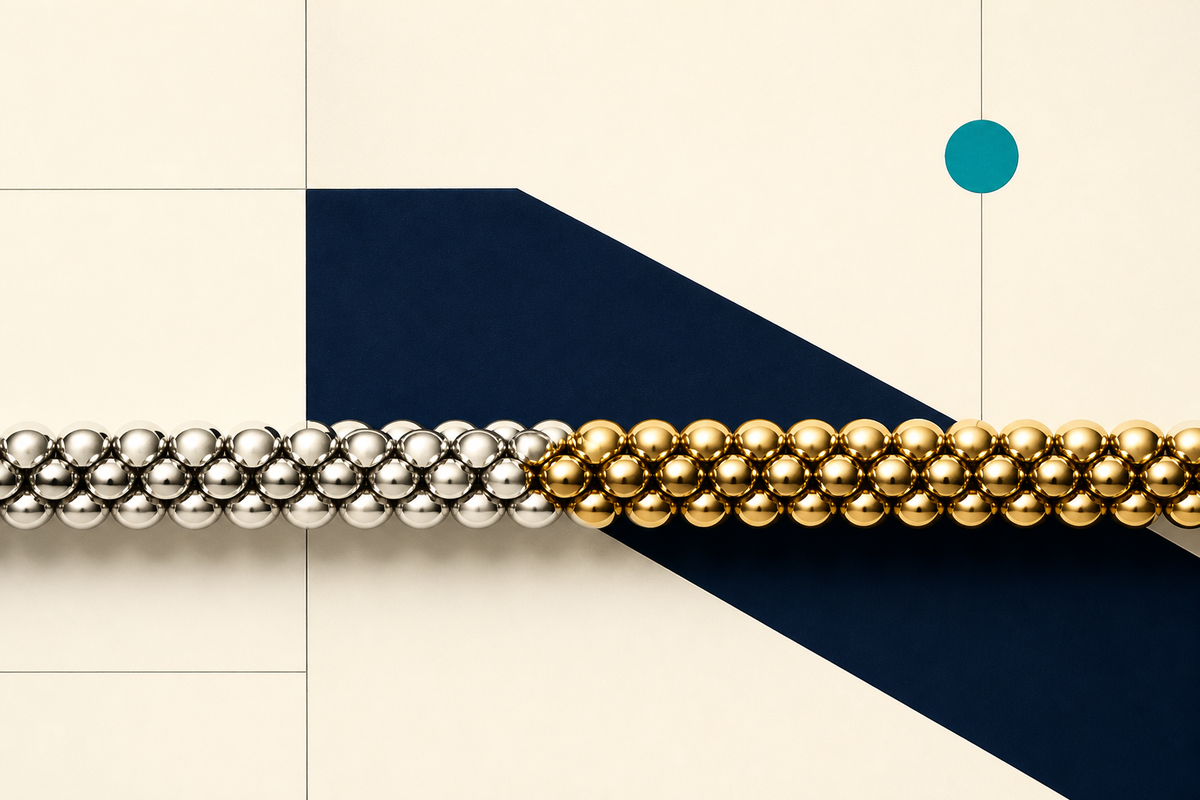
The production is deliberately hard to see. LAGOS describes its beading process as proprietary and says a single creation can take hundreds of steps. Its public history traces a shift to offshore manufacturing in 2005, a Bangkok atelier in 2013 and the acquisition of a Bangkok factory in 2022. Philadelphia remains the headquarters and commercial home; Bangkok gives the company closer control over a labor-intensive craft and its supply chain.
The watchband that became a doorway
Smart Caviar, introduced in 2018, is the sharpest example of the design system doing new work. The product replaces an Apple Watch's sporty band with a fine-jewelry bracelet. It does not compete with the watch's sensors, software or display. It fixes a social mismatch: a useful device that can look underdressed beside a tailored jacket, evening clothes or a wrist full of precious metal.
The attachment was commercially meaningful. In a 2022 interview, Steven Lagos said Smart Caviar had sold more than 35,000 units and that 78 percent of its sales represented new customers. Those are company-reported historical figures, not current audited totals, but the pattern matters. LAGOS borrowed the installed base of a mass-market technology product without surrendering its own identity. The watch brought utility and familiarity; Caviar brought finish and belonging.
The line now includes metal, ceramic and diamond treatments and fits Apple Watch models across supported case sizes. It is still a narrow solution - LAGOS says it is not designed for other smartwatch platforms - but narrowness is part of its strength. The product does one legible thing and can be explained in a sentence.
A jewelry house with several cash registers
LAGOS is privately held and does not publish audited revenue, valuation or detailed ownership. Estimates for both sales and headcount vary widely across business databases, so precision would be theater. What is visible is the model: design and manufacture a proprietary-looking product, sell it directly online and through the Rittenhouse Square flagship, and extend reach through department stores and independent jewelers.
The mix matters in fine jewelry. Ecommerce makes discovery, gifting and repeat purchase convenient. Physical stores let customers feel weight, try proportions and compare stacks under the unforgiving honesty of a mirror. Wholesale partners provide local trust and trained sales staff. LAGOS lists branded locations inside Bloomingdale's, including its 59th Street flagship boutique, alongside Nordstrom and independent authorized retailers. Earlier company statements placed distribution at roughly 350 to 400 doors.
The assortment provides the price ladder. Sterling-silver jewelry offers an entry into the brand; two-tone pieces pair silver with 18-karat gold; diamond, full-gold and one-of-a-kind Studio designs move into five-figure territory. Engraving, custom sizing, repairs, cleaning, gift boxes and care materials extend the relationship after checkout. In a category where objects are expected to outlast trends, service is part of the product.
Where Caviar sits at the counter
LAGOS operates in the broad middle of designer fine jewelry, though “middle” understates the range. David Yurman is the nearest conceptual alternative, with its own instantly recognizable cable and a similar fluency in silver, gold and gemstones. John Hardy also competes through artisanal texture. Tiffany and Cartier bring deeper heritage and global status at the upper end, while Mejuri, Pandora and other accessible brands compete for self-purchase, gifting and personalization.
LAGOS differs less through raw material than through consistency. Its advantage is the accumulated recognition of a surface used for more than 40 years. The company can introduce a black ceramic bracelet, a gold ring or a watch attachment and make each one advertise the rest. Competitors can offer a beaded object. Matching the association between bead pattern and brand requires time, distribution and restraint.
There is another distinction in how the pieces behave. Caviar is not simply decoration stamped onto a flat surface. The nested beads give rope bracelets articulation, letting precious metal follow the wrist rather than sit rigidly above it. That physical comfort supports the company's promise of everyday wear. It also makes the signature available to touch as well as sight - useful in a market where photographs drive discovery but the final decision often happens at a counter. The object confirms what the image promised.
That restraint has limits. A signature can turn into a cage; dependence on Apple makes Smart Caviar vulnerable to case and connector changes; and mixed distribution requires careful pricing and inventory coordination. Luxury demand can wobble with consumer confidence. The company's answer has been controlled expansion rather than category tourism. Steven Lagos has said he is not interested in fragrances or sunglasses. The business stays close to jewelry.
Men, high jewelry and the next generation
Recent moves stretch the house without erasing it. Anthem, the men's collection launched in 2024, translates Caviar through matte ceramic, curb chains, natural stones, skulls and other rock-influenced motifs. The name nods to the Grateful Dead album Anthem of the Sun. The Studio Collection moves in the opposite direction, toward limited and one-of-a-kind pieces with expressive gemstones and red-carpet scale.
Kate Lagos, Steven's daughter, joined the company in 2015 and now works as associate designer and brand stylist. Her role adds a family-continuity story, but her most visible contribution is practical: showing customers how to mix, match and stack products. Styling turns a catalog into combinations, and combinations increase the number of plausible next purchases.
Partnerships broaden the story again. LAGOS has supported the Breast Cancer Research Foundation with limited Pink Caviar bracelets; in 2025 it pledged 25 percent of each bracelet sale to the organization. It has worked with Keep Memory Alive, partnered with fellow Philadelphia company STARR Restaurants for a Father's Day promotion, and used celebrity dressing to place Studio and collection pieces on awards-season carpets. These are familiar luxury-marketing tools, but they all depend on the same thing: an object that reads clearly in a photograph.
The clever part is not that LAGOS repeats itself. It is that each repetition makes the original idea easier to recognize.
Nearly 50 years after the repair shop opened, LAGOS fits into the market as a focused American jewelry house: smaller and more specialized than the global maisons, more materially ambitious than mass personalization brands, and unusually committed to a single visual code. It helps customers assemble jewelry that can move between work, weekends, gifts and formal occasions without losing its identity.
The lesson travels beyond jewelry. A company does not always need more messages. It may need one good unit - a shape, interaction, ritual or phrase - with enough range to survive repetition. LAGOS found its unit in a row of tiny beads. The rest of the business is the patient work of deciding what those beads should do next.