Kyle Hanslovan had a product to explain and a problem with the explanation. His experience included government cyber operations and winning a hacking competition. Those were useful credentials for a cybersecurity founder. They did not automatically produce a sentence an investor wanted to hear.
One investor took him for tacos in Silicon Valley. Over lunch, Hanslovan and his co-founders worked on the pitch. The investor’s diagnosis was economical: “Kyle, your pitch sucks.” It is the sort of feedback that saves everyone a second meeting, provided the first meeting has decent food.
Hanslovan tells this story without making himself the cleverest person at the table. The idea needed an interpreter. He had been describing something that sounded like a services business when he meant repeatable software with human expertise behind it. The distinction mattered to the people holding the checkbooks.
The lunch belongs near the beginning of his story because it captures the work that came after the hacking. He could understand an intruder’s route through a computer. He still had to understand a customer’s route to a purchase.
A Florida education in getting through
Before the classified work, there were library computers. Growing up near the Central Florida coast, Hanslovan taught himself to code and experimented with getting access to internet accounts. The early web offered a curious teenager both a classroom and plenty of opportunities to make regrettable decisions.
An Air Force recruiter offered a more organized direction. Hanslovan graduated from high school early and joined in 2003. His first posting was in England, working on information assurance and responding to cyberattacks on the base. Skills acquired by testing boundaries now had a defensive purpose.
Later, he served with the Maryland Air National Guard’s 175th Cyberspace Operations Group. The movement between civilian security work and military operations gave him experience on both sides of a network’s defenses. Knowing how someone might enter helped him recognize what needed watching.
The teenage ventures were not all digital. He has described selling Costco candy to afford shoes and modifying PlayStations. There is an entrepreneurial education here too: find something people want, work out how to supply it, and discover which rules stand between the two.
He also describes a childhood shaped by a single mother and limited money. In his account, that upbringing helps explain his interest in smaller entrepreneurs. The businesses he wanted to serve were familiar in a way a procurement department at a giant corporation might not be.
“I’m a bit of a career rule breaker.”
Kyle Hanslovan / 2024
The customer without a security department
Hanslovan co-founded Huntress in 2015 with Chris Bisnett and John Ferrell. The question was how to make their security experience available to businesses that could not afford to hire people like them. A specialist’s knowledge could travel further if it became part of a product.
His earlier offensive work had also given him doubts about promises of perfect prevention. An attacker slipping past a defensive product did not cease to exist. Someone still needed to notice the intrusion and do something about it. That gap became a place for Huntress to work.
Small-business customers introduced a further complication. Some had no IT department. Others already had people with more work than time. Adding another tool could mean adding another queue to check, another configuration to understand, another alert whose meaning somebody had to investigate.
The early Huntress product was modest: an installer and email alerts, with the founders doing analysis by hand. It had no elaborate dashboard. The company’s first task was to deliver a useful result reliably enough that someone would keep paying for it.
Hanslovan found that strangers gave him sharper feedback than friendly contacts. They could tell him they did not understand the offer, or simply would not buy it. Friendship had made some conversations pleasant. Distance made others useful.
That is an unglamorous discovery for a founder with a glamorous former employer. The stranger has no obligation to be impressed. Their refusal can describe the market more accurately than an encouraging introduction.
The route to the customer
A company you could not find in one office
The customer problem helped determine the sales route. Managed service providers already looked after the technology of multiple smaller businesses. Working through them gave Huntress a way to reach organizations one founder could never call individually. The relationship also put the product beside an IT team the customer already knew.
Hanslovan’s technical background was useful when teaching those teams about attacks. Education became part of the company’s growth: explain what criminals were doing, demonstrate why it mattered, and let the practical question of protection follow.
The company was fully remote from its founding. Hanslovan, now based in Jacksonville, had worked with geographically separated military teams long before remote work became an everyday hiring consideration. A person’s ability to contribute did not depend on living near the same office.
Distance still required deliberate communication and gatherings. Saving an office lease did not absolve anyone from building a workplace. The arrangement made hiring across locations possible; it also made coordination part of the job.
His approach to leadership puts candor near the center. In public interviews, he says the team needs permission to give and receive constructive criticism. The founder who had to improve his pitch wants people around him who will point out what needs improving next.
That includes resisting profitable detours when they pull the company away from its purpose. It is a practical concern for a growing business. Every attractive opportunity takes people and time from another one, and a mission must eventually survive a budgeting conversation.
When the attack arrived through the front door
On July 2, 2021, attackers used Kaseya’s VSA software to spread ransomware through managed service providers to their customers. A tool meant to help administer computers became a delivery route for an attack. Shared infrastructure had made a large number of businesses reachable at once.
Huntress investigated the incident and shared updates through its blog and Reddit. Its team also took protective steps for partners using VSA, initially withholding technical details until Kaseya released the required patch. The response drew on knowledge of the attackers’ methods.
The episode exposed the double responsibility in the partner model. A provider can extend expertise across many companies. An attack on a provider’s tools can travel across them too. A smaller customer sits at the end of both possibilities.
For Hanslovan, the commercial purpose of security is concrete. He talks about businesses losing access to payroll and people whose livelihoods depend on those payments. The result of an intrusion reaches beyond a computer screen. That is why a customer cares about the outcome more than the elegance of the machinery producing it.
The scoreboard gets bigger
Huntress’s funding grew in stages. A $60 million Series C in 2023 was followed by a $150 million Series D in June 2024, valuing the company at $1.55 billion. Financing gave the team resources to develop products and expand its reach. It also gave outsiders a convenient number to put in a headline.
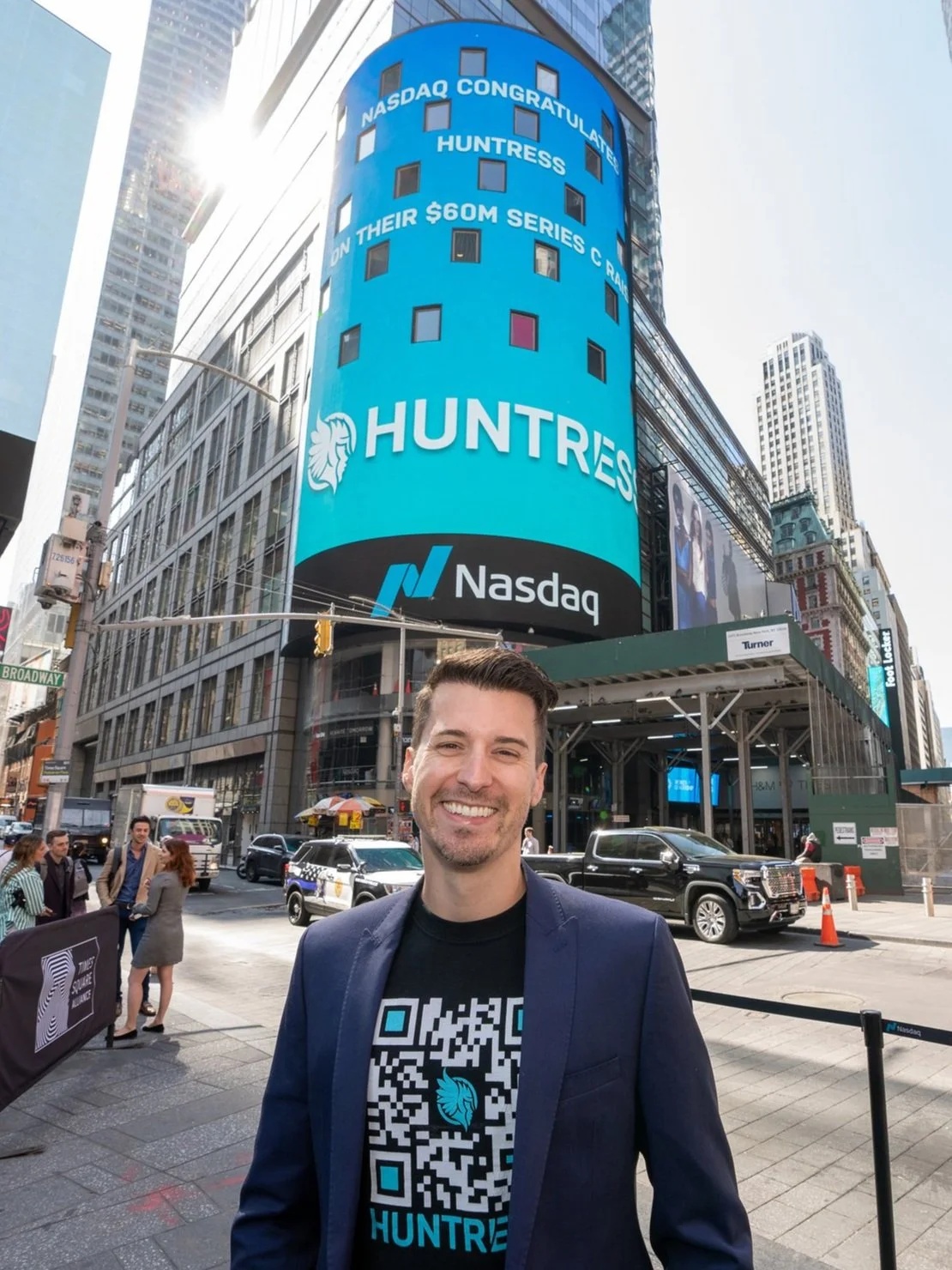
Hanslovan received EY’s Entrepreneur Of The Year 2024 Mid-Atlantic Award. It was a regional recognition, and he credited his teammates’ work and ideas. The award attached one name to an enterprise built by many people.
By March 2025, Huntress had expanded beyond its earlier focus into areas including identity protection and security information and event management. Its model combined software with a human-led operations center, trying to keep the amount of work handed back to customers manageable.
The distinction between gathering data and gathering useful data mattered to that model. An overwhelmed team gains little from being given more material it cannot act on. Useful filtering affects both the speed of an investigation and the cost of running it.
A dated snapshot / July 30, 2026
Those July 2026 figures describe a company with a much larger audience for its decisions. More customers mean more chances to notice patterns across attacks. They also mean more people relying on the company to communicate clearly when something has gone wrong.
Still answering to the people on the other end
In his July 2026 reflections, Hanslovan asked partners and customers to help keep Huntress accountable as it scaled. He acknowledged that the business now served large organizations too, while insisting its original small-business commitment should endure. Growth had changed the company’s range; he wanted the purpose to remain recognizable.
His ambitions extend toward a million protected businesses and beyond. The proposed advantage comes from sharing what the company learns: an attack observed in one place should improve protection elsewhere. Each customer’s experience can contribute to the defense of another.
AI enters that plan with a demanding condition. Hanslovan wants analysts, researchers, engineers, and threat hunters setting the direction. He has warned that a polished machine-written account can wrap a genuine event in an unsupported explanation. Speed is useful only if the resulting investigation holds up.
The concern returns him to the customer who has little spare expertise. That person needs a clear account of what happened and what to do next. An impressive report that requires a second expert to untangle it recreates a problem Huntress was supposed to solve.
Outside work, his public biography describes a father of three who goes to games, wears Converse with a tuxedo, and spends time at the racetrack. The hacker has retained an interest in testing the dress code.
But the recurring business question is less decorative. Can the person on the other end use what he is offering? Hanslovan learned to ask it in the early calls. A company with hundreds of thousands of customers has reason to keep asking.
Keep following the story
- Watch: Hanslovan on Forgecast - Securing the 99%
- Listen: the early customers and education behind Huntress’s growth
- Read: Citizen Cyber - the Air Force chapter
- Read: the pitch, the taco lunch, and learning to run Huntress
- Read: Hanslovan on the decision to serve smaller businesses
- Read: his approach to candor, leadership, and customer feedback
- Read: Huntress’s protective response to the Kaseya attack
- Read: Huntress’s expanding security model in 2025
- Read: Hanslovan’s July 2026 business reflection
- Read: his plans for AI, research, and the next stage
- Read: Huntress’s July 2026 operating update