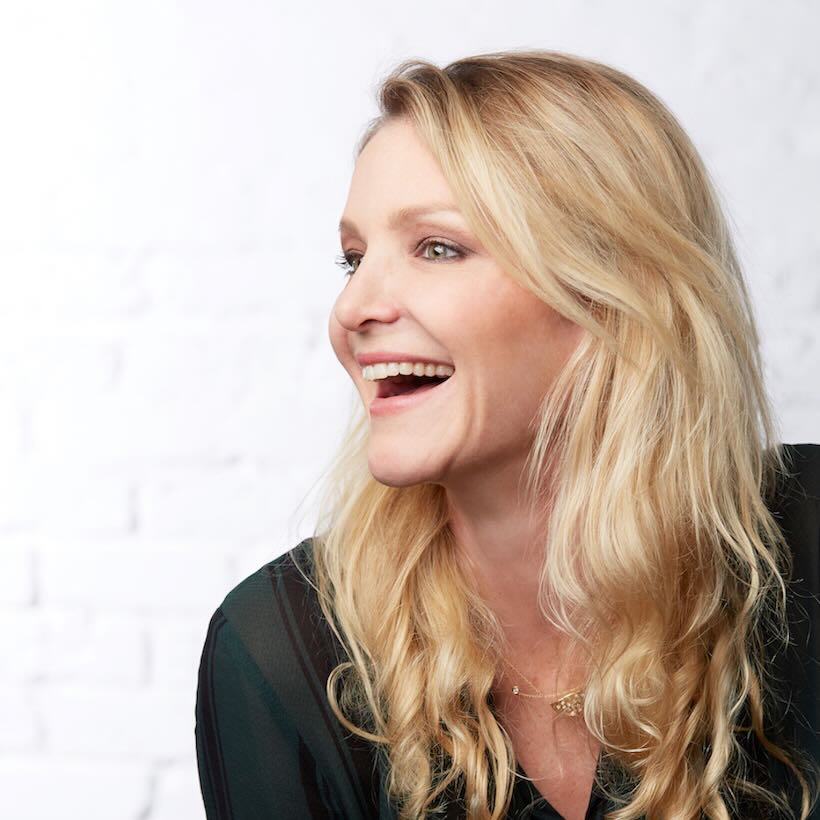
Kristy Caylor. Industrial engineer. Recovering luxury founder. Coming for your junk drawer.
The Profile
Kristy Caylor
She spent twenty years selling clothes. Then she built a bag that pays you to give them back.
She spent twenty years selling clothes. Then she built a bag that pays you to give them back.
Fill a bag with the clothes you never wear, the shoes with the busted sole, the tangle of chargers for phones you no longer own. Seal it. Ship it free. A few days later, credit lands in your account that you can spend at Sephora or on an Uber Eats order. That is Trashie, and Kristy Caylor built it.
Caylor is the founder and CEO of Trashie, which she describes as the first scaled recycling-and-rewards platform in the United States. The product people actually talk about is the Take Back Bag - a prepaid mailer that has become internet-famous among Gen Z and millennials, the kind of thing that gets called a "cheat code" on TikTok. You clean out your closet, you get paid in a currency called TrashieCash, and the stuff you sent goes to be reused, resold, or responsibly recycled instead of buried.
The framing matters to her. Recycling, in Caylor's telling, has always asked people to feel bad first and act second. Trashie flips the order. "It's not really a license to overconsume," she has said, "as much as it is a conversation around sustainability that we can start to have in an easy, non-confronting, meaningful way." Convenience is the strategy. Reward is the hook. The landfill diversion is what happens while you are busy enjoying yourself.
Recycling needs to work today, and we can't wait for innovation to catch up.Kristy Caylor
Caylor did not arrive in fashion the usual way. She studied industrial engineering at Northwestern - the discipline of systems, flows, and bottlenecks - and paired it with a minor in fine-arts painting. Engineer and artist, in one degree. Then she added an MBA in entrepreneurship and finance from USC. It is a strange combination, and it turns out to be the exact combination you would design if you wanted someone to move millions of garments through a reverse-logistics network and make it feel like a lifestyle brand.
She spent her early career at Gap Inc., launching and scaling businesses including Banana Republic Petites and Banana Republic Japan. She helped lead Gap's Product (RED) division, the cause-marketing effort tied to global health funding. Selling was never the problem for her. Selling responsibly was the question that would not leave her alone.
In 2010 she co-founded Maiyet, one of the first ethically driven luxury brands, and served as its president and creative director. She sourced from a network of artisans across fourteen countries, launched the collection on the Paris runway, opened a store in New York, and sold into Barneys, Net-a-Porter, Selfridges, Bergdorf Goodman, Neiman Marcus, and Saks. It was luxury with a conscience, and it earned its place at the top of the market.
But the scale of the problem kept outrunning the scale of the fix. "After building businesses for Gap for many years," she has said, "I was troubled by the negative impact the industry had on people and the planet." Progress was slow. New models struggled to move the market. So in 2018 she launched For Days, the first fully circular apparel brand, built on five years of research. Trashie grew out of that work - the moment the recycling engine became bigger than the clothing line it started inside.
Two decades of selling, then a decade of un-selling. The throughline: make doing good actually sell.
Launches and grows businesses at Gap Inc., including Banana Republic Petites and Banana Republic Japan.
Helps lead Gap's Product (RED) division, pairing commerce with cause.
Co-founds Maiyet; president and creative director. Paris runway, a New York store, sold at Barneys and Bergdorf.
Co-founds CERCI Collective, focused on technology for supply-chain efficiency and sustainability.
Launches For Days, the first fully circular apparel brand and a zero-waste fashion company.
Founds Trashie, the first scaled recycling-and-rewards platform in the US.
Trashie raises a $10M Series A and expands from textiles into e-waste.
Clothes, shoes, accessories, linens - in any condition. Old tech too. The point is you don't have to sort or judge what's "good enough."
A prepaid label turns your clutter into a package. No thrift-store guilt, no drop-off runs, no deciding what's worthy.
Rewards land in your account to spend at merchants like Sephora, Uber Eats, and TripAdvisor - not just more clothes.
Incoming textiles are sorted across roughly 250 quality levels, where competitors use a handful. The obsession decides what's reused, downcycled, or recycled.
The stated result: 95% of received items are kept from landfill through reuse or responsible recycling.
Caylor won't promise to end fast fashion. She promises to move what already exists more responsibly than the alternative.
Caylor has been named to the Glossy 50, Goldman Sachs' Most Intriguing Entrepreneurs, Entrepreneur's 100 Women of Influence, and Worth Magazine's Worthy 100. Her work has been recognized repeatedly by Fast Company - Innovation by Design, World Changing Ideas, and Brands That Matter.
She's a member of the CFDA and has served on the World Economic Forum's Global Future Council on Consumerism, with involvement across the UN Foundation and the Ellen MacArthur Foundation. The pattern is consistent: institutions keep asking the fashion insider who decided to work on the exit rather than the entrance.
Most Intriguing Entrepreneurs.
Innovation by Design & World Changing Ideas.
100 Women of Influence.
Worthy 100 honoree.
People did not like the idea of owning things forever. There was opportunity in helping people with the burden of stuff.Kristy Caylor, on the insight behind Trashie