The most revealing line in Kristie Schmuck's résumé may be the least glamorous one. Before the conference stages, before the chief marketing officer title, before her employer became part of an $835 million deal, she managed demand generation. That meant automation systems, campaign operations, handoffs between marketing and sales, and the stubborn daily question of whether attention had turned into anything useful. It is an education in marketing without mood lighting. Every elegant promise eventually has to survive a form, a funnel and a spreadsheet.
That early work at Emburse, from 2016 to 2018, put Schmuck close to the circuitry. Public professional profiles describe her building and optimizing systems in Marketo and Salesforce, running multi-channel campaigns, and helping sales and customer-success teams manage the full customer lifecycle. A campaign could look clever from the outside and still fail because the machinery underneath it coughed. She learned where the coughs lived.
Then she changed altitude. In 2018, she moved to Slalom as a growth-marketing and digital-strategy consultant. The tools remained, but now they sat inside larger questions: which technology belongs in the stack, how should a company acquire customers, and what must a digital experience do after it catches someone's eye? Consulting rewards the ability to enter somebody else's complicated room, find the light switch, and leave a map behind.
The marketplace becomes the medium
By 2019, Schmuck was publishing under Perpetua's name. Perpetua sold software for optimizing advertising on Amazon and other marketplaces, a technical description for a very human contest. Someone searches for a product. Several brands appear. Price, placement, copy, reviews, inventory and habit crowd into one small screen. The shopper decides. Perpetua worked on the signals and software around that decision; Schmuck worked on making the proposition intelligible.
Her early articles were tactical. One argued that sellers might deliberately raise their advertising cost-of-sale target around Prime Day, a counterintuitive move unless the wider commercial moment justified it. Another followed two businesses expanding across Amazon marketplaces. One made massage tables. The other sold equipment for a racket sport. Their memorable connection was not software at all: the people managing their Amazon growth were married to each other.
The case study worked because Schmuck found the domestic comedy inside a technical problem: two marketers at two unrelated brands, sharing a home and comparing notes about the same unruly marketplace.
It is a small example, but a useful one. Business software tends to arrive wrapped in abstractions - optimization, efficiency, scale. A good marketer looks for the person losing every Friday to manual campaign changes. The product becomes concrete when time returns to the calendar. Data may win the argument; the reclaimed Friday makes you care.
A small company enters a larger orbit
Perpetua itself was moving quickly. When Ascential announced its acquisition in April 2021, the Toronto company had 66 employees and had recorded $3.8 million in 2020 revenue, more than triple the prior year. The deal put a seller-focused advertising platform inside a broader digital-commerce portfolio. Schmuck became VP of Marketing, responsible not merely for attracting leads but for locating Perpetua inside a changing constellation of products, customers and sister companies.
The widening brief, 2016-2024
Corporate combinations are usually announced with arrows that point politely to the right. The lived version is untidier. Names overlap. Teams inherit new colleagues and fresh acronyms. Customers need to understand what became possible without sitting through the organizational chart. In October 2023, Perpetua and the other Ascential Digital Commerce businesses gathered under one name: Flywheel.
For a marketing leader, this is the difficult species of simplification. The outside story must become clearer while the inside operation becomes broader. Flywheel now combined commerce operations, media execution, market intelligence and software. Its promise had to accommodate large brands and marketplace sellers, managed services and self-service tools, advertising and inventory, creative work and analytics. A brand can contain many things. A sentence cannot, at least not gracefully.
Schmuck became Flywheel's chief marketing officer in December 2023. The timing offered no gentle orientation. Omnicom had already agreed to acquire Flywheel, and the transaction closed on January 2, 2024. According to Omnicom's announcement, Flywheel brought more than 2,000 people and work for over 4,500 brands. The plan was to connect product and transaction data from Flywheel Commerce Cloud with audience and behavioral data in Omnicom's Omni system.
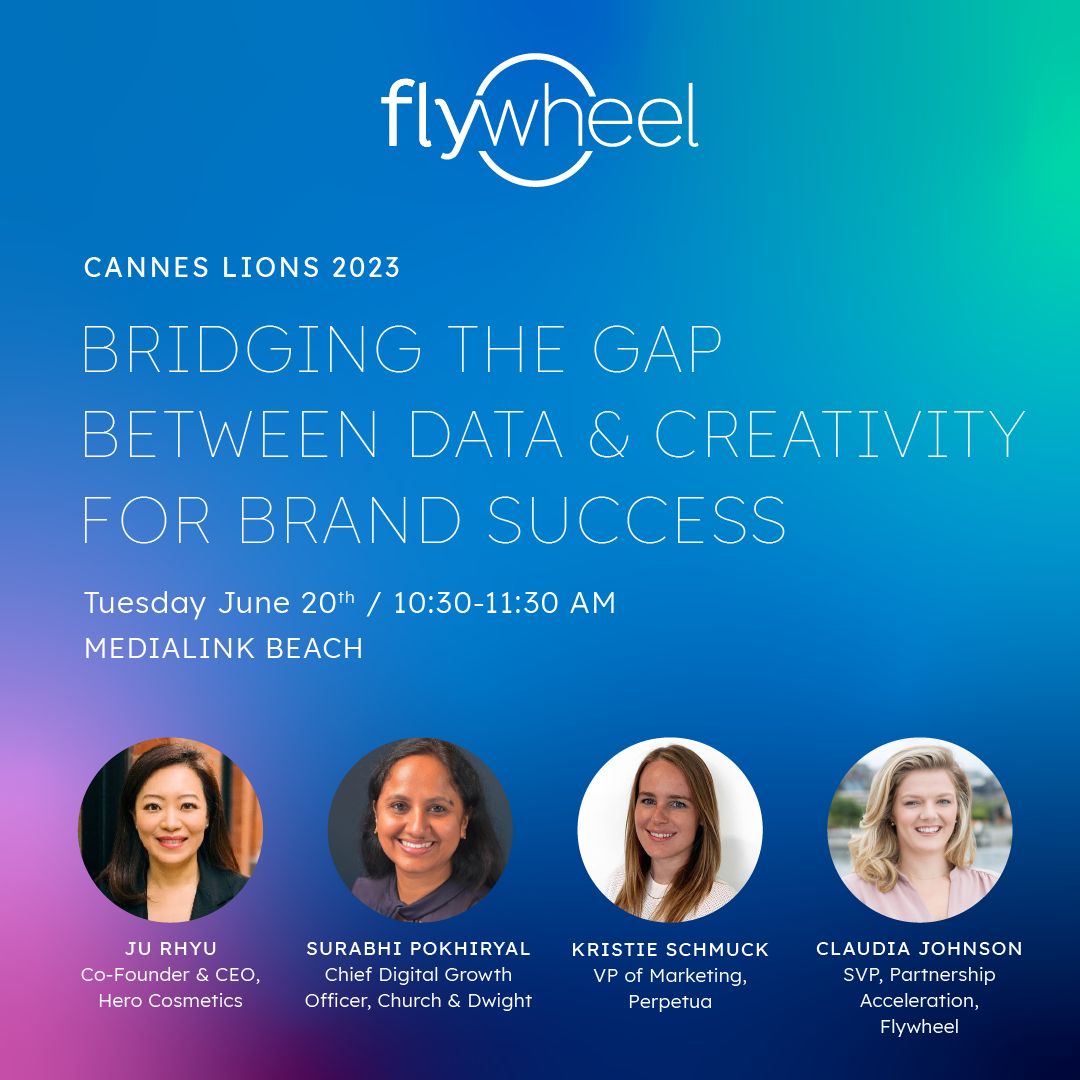
Schmuck's job had reached the place her career had been pointing: make the data understandable without sanding away the complexity; make the creative promise concrete without reducing it to a dashboard. At Cannes Lions in 2023, while still VP of Marketing at Perpetua, she appeared with executives from Hero Cosmetics, Church & Dwight and Flywheel on a panel called “Bridging the Gap Between Data & Creativity for Brand Success.” The title reads now like a compact career thesis.
“Digging into AMC is not an option, it's a necessity.”Kristie Schmuck, writing after Amazon unBoxed 2024
The CMO who still reads the release notes
The revealing thing about Schmuck's 2024 recap of Amazon's unBoxed conference is its level of detail. A CMO could have stayed at “the future of commerce.” Schmuck descended into audience bid multipliers, streaming-TV inventory, campaign overlap and Amazon Marketing Cloud. She translated product announcements into decisions a brand might make: build a custom audience, set a measurable goal, test premium inventory, follow exposure further down the funnel.
Her view of AI creative tools was similarly practical. Efficiency was welcome; content integrity and brand safety still needed adult supervision, particularly in regulated industries. The position was neither awe nor alarm. It was an operator's answer: experiment, watch the outputs, remember the trust already attached to the brand. New software is exciting. A damaged reputation is also measurable, usually after the invoice arrives.
That same recap described a funnel whose old boundaries were collapsing. Streaming ads could lead to custom audiences, display campaigns and sales measurement inside one ecosystem. The classic partitions - brand up top, performance down below - had become porous. This is precisely the environment for which Schmuck's odd-looking sequence of jobs makes sense. Demand generation taught her the bottom of the funnel. Consulting widened the frame. Perpetua put the marketplace at the center. Flywheel and Omnicom joined media to commerce data at global scale.
There is another shift hidden in this account. Marketplace advertising used to seem like the last, slightly grubby step after the proper brand work had finished. Now the shelf is a screen, the screen is a store, and the store owns a media network. Search results can carry a brand introduction; a streaming ad can be shoppable; an audience can be built from exposure and followed toward a purchase. The checkout aisle has acquired a data science department. Schmuck's field did not merely grow. It swallowed several neighboring fields and asked them to share a dashboard.
That expansion changes what a marketing executive must be able to translate. The product team speaks in features. Media buyers speak in audiences and inventory. Commerce teams care about stock, margin and sales. Creative teams defend meaning and memory. Customers mostly want to know what to do next. Schmuck's writing does its best work when it crosses those dialects: a platform announcement becomes a test, a test gets a goal, and the goal remains attached to a commercial outcome. Clarity, in this world, is less a gift for slogans than a willingness to finish the chain of reasoning.
There is a temptation to tell a career like this as a clean ascent. It is more interesting as an expansion of field. The same marketer who once worried about lifecycle handoffs now had to explain why audience data, retail operations, advertising technology and market intelligence belonged in one offer. Each promotion added altitude, but the public work suggests she kept a hand on the controls.
Useful ambition, plainly stated
Schmuck does not maintain a large public archive of personal manifestos. What is visible is work: articles, event appearances, company transitions and a social biography with an affection for data, reality television and commerce. The combination has comic balance. Reality television runs on dramatic edits; commerce analytics runs on refusing them. Both, however, are obsessed with behavior under pressure.
Her professional connections also tell the story of widening rooms. At Perpetua, she worked alongside founder and CEO Rosco Hill and leaders including Adam Epstein and Joe Rideout. At Cannes, the circle included consumer-brand and agency executives. At Flywheel, her marketing brief sat inside a network that Omnicom bought specifically to connect media influence with marketplace sales.
The record also shows a preference for proximity. In 2024, she invited her network to Flywheel's Cannes programming; months later, she published the long Austin conference debrief. One activity gathers the room, the other processes what the room learned. Neither is mysterious. Both are the recurring labor of an executive marketer: bring the right people close, then turn a crowded conversation into a useful point of view.
The durable idea across those rooms is the moment of choice. A shopper sees something, weighs something, and acts. Modern retail media surrounds that instant with an extravagant quantity of machinery. Schmuck's career has been a tour of the machinery, from the automation that catches a lead to the company narrative that earns a meeting. Her advantage is not that she escaped the plumbing. It is that she remembers what it is for.
Marketing likes a grand reveal. Commerce prefers the receipt. Schmuck has learned to work in the narrow, consequential space between them - where a story makes a promise, the system records a decision, and somebody must be accountable for whether the two agree.