There are two ways to read a spreadsheet. The first is to admire its clean borders, orderly columns and obedient decimal points. The second is to ask who never made it into a cell. Kristi R. Mitchell has spent more than 25 years working in the gap between those readings. She knows the institutional craft of evidence: how information is collected, standardized, translated and carried into consequential rooms. Her founder chapter began when she decided that the people described by research should have more influence over its design.
Mitchell is a health services researcher based in Vienna, Virginia. She is the co-founder, chief executive and board chair of Health Equity Outcomes, known as HEO, and a co-founder and principal of Atlas Clarity. The first is a nonprofit. The second is a consultancy. Their structures differ, but the proposition joining them is plain: evidence becomes more useful when communities help determine the questions, the methods and the meaning.
That proposition did not arrive as a sudden conversion. It grew through long exposure to the machinery of institutions. Mitchell spent 12 years at the American College of Cardiology and another 11 at the advisory firm Avalere Health. Twenty-three years is less a résumé line than a geological era in modern professional life. It is time enough to learn where a system is sturdy, where it creaks and where good intentions tend to get caught in committee.
The education of a translator
Her formal education already contained the outline of the career to come. At Brown University, Mitchell earned an A.B. that paired human biology with public policy. The combination put the individual and the institution in the same frame. At the University of Michigan School of Public Health, she added an MPH in epidemiology and public health policy and administration. The training was quantitative, administrative and political in the small-p sense: how people, evidence and systems negotiate with one another.
At the American College of Cardiology, Mitchell's work sat close to the infrastructure of professional knowledge. She provided scientific and technical oversight for national registry and quality-improvement programs. She helped integrate clinical guidance, performance measurement, dataset development and education. By the time she served as Chief Science Officer, she understood that evidence does not simply emerge. It is built, maintained, interpreted and distributed. Every choice in that sequence has consequences.
The work also made her a translator. A registry speaks one dialect. A policy committee speaks another. Practitioners, organizations and the public bring their own vocabularies, pressures and clocks. Mitchell's career has repeatedly placed her between those groups, turning rigor into something people can act on without flattening the nuance that made it rigorous.
Eleven years near the decision
At Avalere Health, Mitchell moved deeper into evidence translation and strategic advice. She rose to lead the firm's Center for Healthcare Transformation as Practice Director. Her remit crossed industries and organizations, with data serving as a tool for practical decisions rather than an ornament brought out for the final slide. She worked on the difficult middle passage between knowing something and getting a system to behave as if it knows.
The title sounds grand, as titles often do. The underlying labor was more exacting: align people who answer to different incentives, decide which evidence can bear weight, identify what is measurable and make a recommendation sturdy enough to survive contact with reality. Mitchell became recognized for work in patient-powered data collection, an awkward phrase for an elegant idea. People can be contributors to the evidence, not merely subjects inside it.
After 11 years, she left. The useful verb here is not escaped, disrupted or reinvented. She left an established platform to pursue a specific conviction. HEO would help underserved and underrepresented communities participate more actively in research. Atlas Clarity would apply evidence, strategy and a community-centered lens across programs and partnerships. The move was less a rejection of institutional experience than a decision to redeploy it.
One thesis, two organizations
The paired structure is revealing. Nonprofits and consultancies occupy different economic and institutional terrain. One can build community capacity and pursue a public mission; the other can advise organizations that control resources, research agendas and implementation. HEO and Atlas Clarity share leadership and expertise while approaching the same stubborn distance from opposite banks.
Mitchell co-founded both with Sheila Fifer, a researcher and entrepreneur whose own career bridges policy, outcomes research and organizational building. Their wider team brings experience in strategy, policy, finance and research. This is not the cult of the solitary founder. It is the more credible, less cinematic business of assembling complementary people and keeping a mission coherent across projects.
Their model treats community participation as infrastructure. That distinction matters. A listening session held after the questions have been chosen and the budget spent may be courteous, but it is not shared agency. Mitchell's work places participation earlier, while the shape of the effort can still change. Trust then becomes less like a message to broadcast and more like an account that must be funded over time.
In public forums, she returns to the relationship between leadership, culture, trust and measurable action. She has discussed ways to broaden participation in research, including the use of trusted local messengers and practical support that removes barriers. She has also worked across advisory groups and cross-sector collaborations. The settings vary. The operating question remains: what would a system do differently if the people closest to its consequences had standing in its design?
The patience hidden inside change
Mitchell's public language is notably fond of verbs that require company: collaborate, engage, empower, partner. None offers the instant gratification of conquer. Collaboration is slow because other people get a vote. Engagement is demanding because a meeting is the beginning of an obligation, not its end. Partnership means accepting that expertise can arrive without the résumé one expects.
There is humor in the contrast between the polished vocabulary of transformation and the ordinary work required to produce it. Strategies are announced in bold type; trust is earned in calendar invitations, returned calls and the willingness to explain the acronym again. Mitchell appears comfortable with this unglamorous layer. Her organizations emphasize tools, training, research networks and durable local capacity. The ambition is structural. The daily work is human-sized.
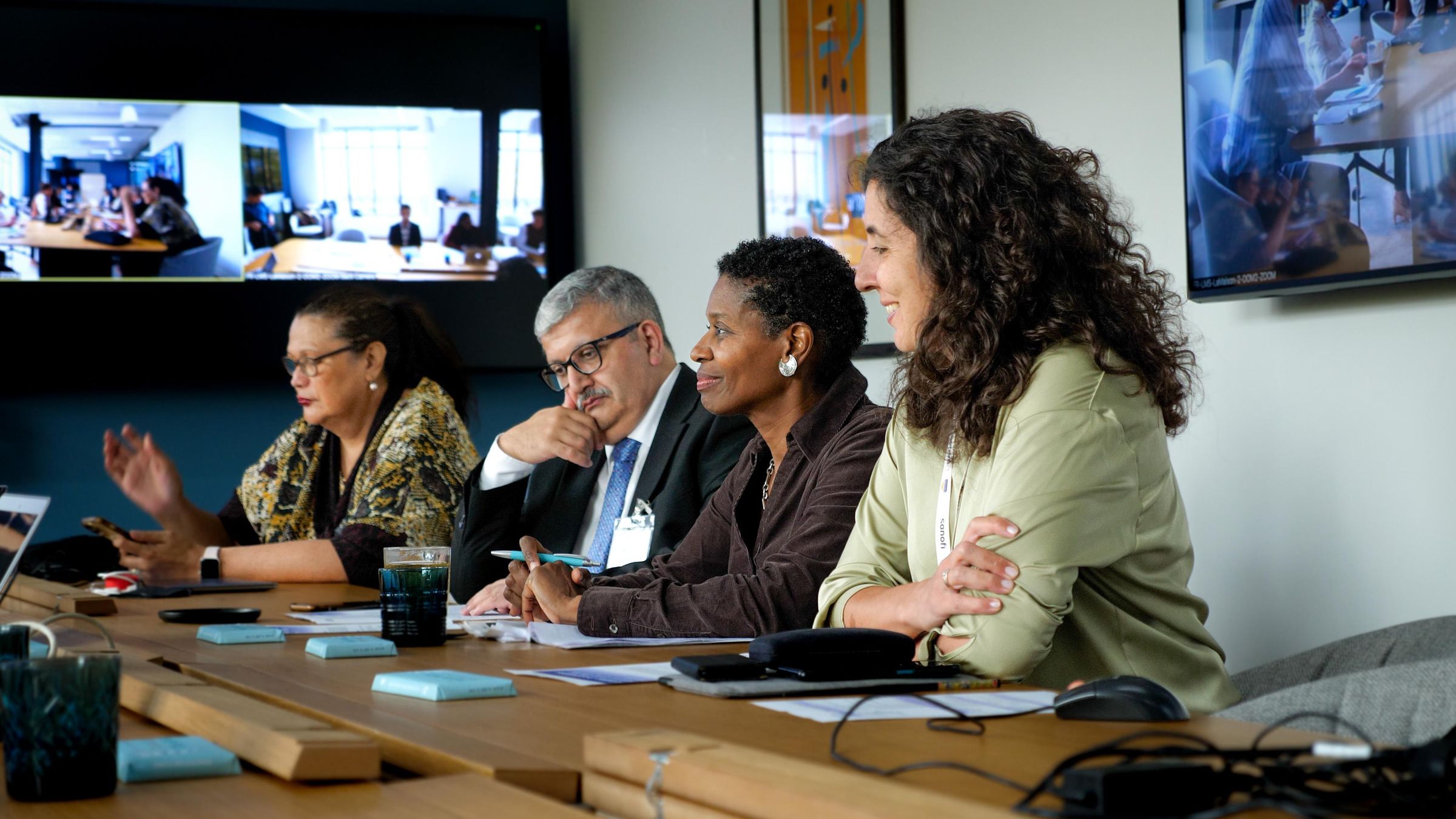
Even the team's rare in-person moments reflect that mixture. During a retreat after a year of remote work, the Atlas Clarity and HEO group moved between strategy sessions, shared meals, bowling and time at a project site. The agenda combined whiteboards with the simple relief of being together. It is difficult to build community-centered work if the people doing it remain abstractions to one another.
At the American College of Cardiology, she learned how registries, measures and professional guidance are built.
At Avalere Health, she led the translation of evidence into strategy and system change.
With HEO and Atlas Clarity, she moved community participation closer to the beginning of the work.
Partnerships connect local implementation, institutional decision-makers and international collaborators.
A larger table, built to bear weight
Mitchell's career can be mistaken for a story about changing sectors: association to advisory firm, employee to founder, established institution to young organization. The more useful reading is about continuity. She has stayed close to the same problem while moving her vantage point. How does sound evidence become action? Over time, she added a sharper companion question: who gets to participate before the action is chosen?
Her answer is neither anti-institutional nor sentimental about community wisdom. Institutions possess scale, resources and technical capacity. Communities possess knowledge that those systems cannot manufacture from a distance. The challenge is to create a working relationship in which neither side is decorative. This is why her founder story feels less like a leap into the unknown than the next stage of a long experiment.
In early 2026, Atlas Clarity and HEO expanded a partnership with the Health Policy Partnership, connecting policy-level work with local implementation and measurement. Mitchell greeted the collaboration in the language she uses most naturally: complementing another team's strengths. It was a small sentence with a complete management philosophy inside it. The point of a partnership is not to become identical. It is to make the seam between different kinds of expertise useful.
A career spent around measurement invites a final measure. Twelve years, then eleven, then nearly five as a founder. More than 25 years of publications and presentations. Those numbers establish endurance, but they do not quite explain the work. The stronger measure may be the distance between a person affected by a decision and the room where that decision takes shape. Mitchell has made it her business to shorten it.