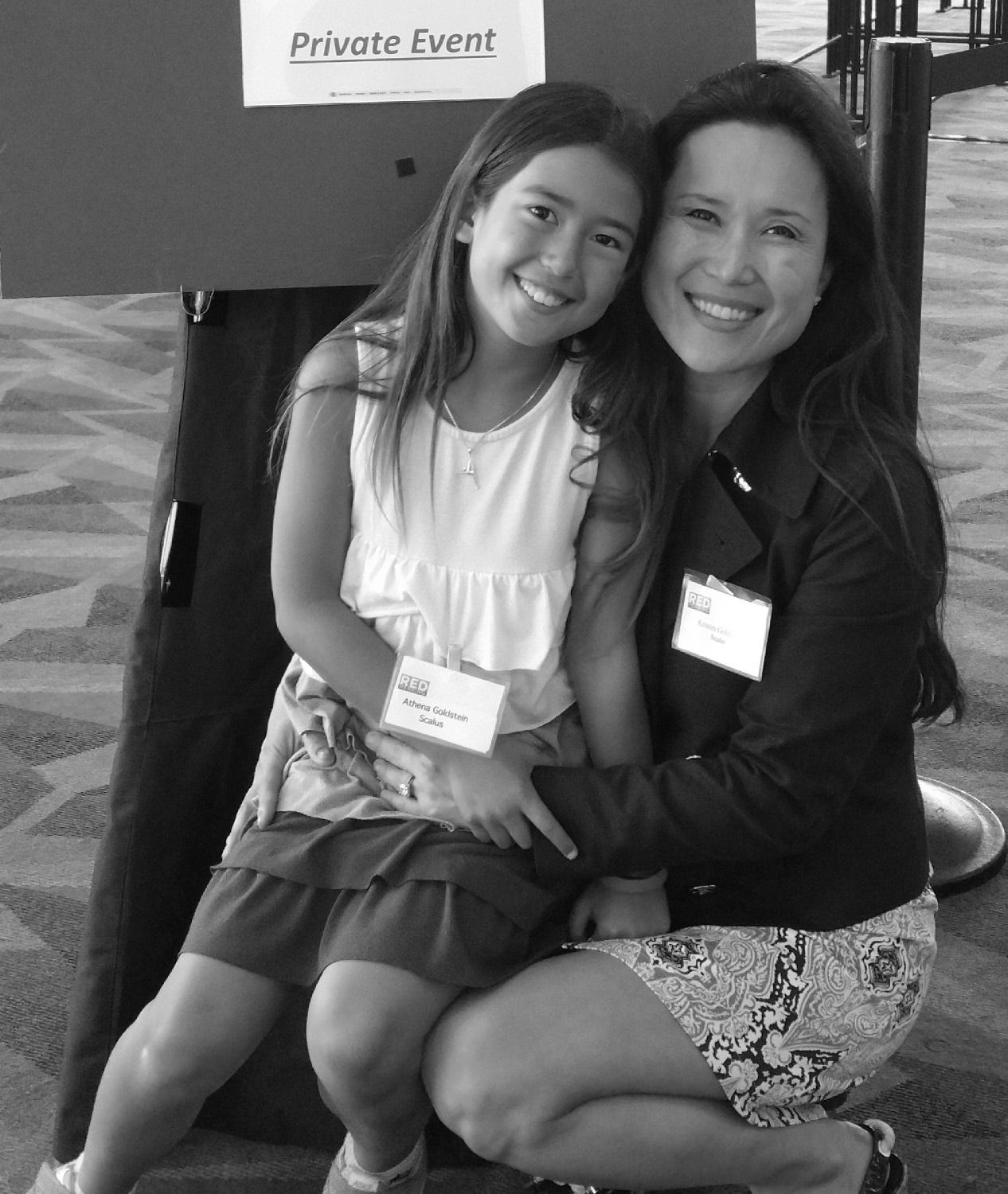
The name on the company belonged to her daughter. At a technology investor conference, Kristen Koh Goldstein posed with Athena, the two of them smiling beneath a sign announcing a private event. The photograph has none of the usual props of a corporate origin story. There is a child’s name badge, a mother’s arm and a very ordinary fact: work and family had arrived in the same place.
In April 2016, Goldstein launched HireAthena, bringing together BackOps’ back-office services and Scalus’ workflow software. The aim was to bring one million mothers back to work. That was a goal, with a great deal of employment still to be created. But the question underneath it was immediate. How could a capable professional keep earning when the available jobs assumed a life she did not have?
Four jobs before Wall Street
Goldstein knew something about work that had to fit around other obligations. As an immigrant teenager in Arlington Heights, Illinois, she helped her parents pay the rent. She later described sleeping on a worn loveseat from a church garage sale in the family’s small apartment. At Cornell, she worked four jobs. Earning money was already a family responsibility.
She is a graduate of Cornell and Harvard Business School. Her career moved between evaluating software businesses and managing their finances: Credit Suisse First Boston in the 1990s, Epinions as director of finance, Goldman Sachs as an investment analyst, and Loyalty Lab as co-founder and CFO. The itinerary crossed the line between assessing a company from outside and being responsible for what happened inside it.
Her self-published career history dates the Loyalty Lab role to 2003–2006. TIBCO acquired the company in 2010. By then, Goldstein had experience of the less photogenic side of entrepreneurship: the financial operations that must keep working while everybody is busy explaining the future. A promising product does not reconcile its own accounts. Enthusiasm is also a poor substitute for payroll.
The people were there. The arrangement wasn’t.
BackOps began in 2010. Goldstein wanted to give small businesses affordable back-office support while creating flexible professional work for mothers. Those needs could meet in accounting, finance and HR. A startup needed somebody who knew what she was doing; an experienced parent needed work that did not make a daily commute the price of admission.
The business was based in San Francisco, but the work did not have to stay there. HireAthena’s company description places its remote workers across the United States. Its offering connected startups, nonprofits and smaller businesses with people who could handle the back office. Geography became a way to reach available skill, rather than a boundary drawn around an office.
The launch spelled out an arrangement around school schedules, with unfinished work completed after children went to bed. It also described the team as full-time employees. Those details gave the idea some weight. Flexible work still involved responsibilities, customers and deadlines. It required an employer to arrange those obligations so that a parent could actually meet them.
An introduction, answered
Goldstein’s account of building BackOps has a supporting cast with actual jobs to do. She credited Aileen Lee with much of its first $1 million in revenue. When she needed marketing help, Victoria Treyger came to the office. Anne Dwane helped with a team question. Brandee Barker offered advice about public relations. The network operated through useful answers arriving when they were needed.
She called this circle a not-so-secret society of female entrepreneurs. The description is charming because the examples are so practical. Nobody had to invent a ceremonial handshake when there was a company to run. Help meant time, attention and the willingness to put experience at another founder’s disposal.
Goldstein had something to contribute in return: taking back-office responsibilities off an entrepreneur’s hands. That made the relationships reciprocal without reducing them to transactions. The larger lesson of her account is that a founder can be independent and still depend on people. Revenue has a number attached to it. The conversation that helped produce it rarely does.
The handoff becomes the product
Then the business encountered the problem that would produce another business. BackOps grew, and keeping its people coordinated became difficult. Goldstein could not readily see where work was getting stuck or who was responsible for a delay. A service with more customers also had more opportunities for something to disappear between two conscientious people.
The company tried seven collaboration applications before building its own solution. Scalus emerged from that effort. The problem was specific: make responsibility and the next step visible across a distributed workforce. In the 2016 launch, the software was part of HireAthena’s explanation for how remote staff could be brought aboard and work could be standardized.
A separate development story shows how much execution sat behind the promise. When an outsourced website project failed to meet the company’s standards, HireAthena worked with Gigster on a replacement. Even a company devoted to making work run smoothly had to find a better way to get its own work finished. There is a certain fairness in that.
By the time the pieces came together under HireAthena, Goldstein had moved from finding people to organizing the conditions in which they could deliver. A marketplace could introduce a client and an accountant. The workflow had to carry the relationship through the ordinary Tuesday when something needed checking, approving or passing to the next person.
The village needs instructions
Goldstein’s public advice about growth returns to the awkwardness of that transition. Early colleagues can know each other well enough to work through shorthand. A larger team needs explanations. In her SaaStr talk, she described the movement from a family to a village, a change that brings different expectations along with the extra people.
She also described hiring an executive with an impressive background at a larger startup. The first months went well. Later, the fit deteriorated. She delayed the decision, then began arranging the person’s departure around month seven. Her account made clear that a prestigious résumé could occupy a position without providing the work the position needed.
The consequences extended beyond salary to morale, turnover and time. These experiences informed the hiring discussions she later took to the SaaStr podcast: how quickly to bring people in, how to introduce them to the existing team, and how a founder recognizes that her own behavior has become part of the problem.
The emphasis on consistency makes sense for the business she was building. A customer buying accounting support needs a dependable result on the next occasion, too. Growth adds people who did not share the founding conversations. Somebody has to make the expectations understandable. The village eventually needs instructions, however fondly its founders remember improvising.
Who gets the credit?
One of Goldstein’s formative lessons in collaboration came from Heidi Roizen. In a 2004 board discussion, Roizen recognized when a point Goldstein had made returned in another person’s contribution. She gently brought the earlier contribution back into view while allowing the discussion to continue. Credit was restored without turning the meeting into a trial.
Goldstein later gave the practice a name: pulling a Heidi. She wrote about using it herself in startup meetings. It is an unusually precise account of inclusion. There is a particular person, a particular contribution and a moment when somebody with standing can ensure the room remembers where the idea began.
That concern also helps explain her interest in making work visible through software. Goldstein has described herself as an introvert. A system that records responsibility can spare a quieter colleague some of the labor of continually announcing what she has done. The design question reaches beyond where people sit to how they receive recognition.
“I would have learned to code.”
Kristen Koh Goldstein, on what she would do differently
Her answer about learning to code offers another glimpse of the operator behind the company. She had discovered programming late in college. Financial modeling provided another outlet for structured thinking, but the curiosity remained. It is a revealing regret for somebody whose career kept bringing her back to the relationship between a practical problem and a piece of software.
A name that kept its meaning
Her life outside the company has its own specific objects and institutions. She has listed sewing and collecting antique American silver among her interests. She has served on the boards of the Bay Area Discovery Museum and the World Affairs Council of Northern California. Those details suggest a wider set of commitments than a succession of startup titles can capture.
More recently, her public profile lists an advisory role at JAR Farms beginning in June 2022. The farm’s team page names her as a mentor supporting her children’s project. The relationship has shifted: the founder who created work around family life is also helping the next generation build something of its own.
Return to the conference photograph and the company name acquires its full scale. Athena was a child with a visitor’s badge, and her mother was a finance professional trying to make room for both parts of her life. The business that followed depended on the details: a customer, an accountant, a clear task, a workable schedule. Goldstein kept going back to those details because people’s livelihoods were attached to them.